US Supreme Court Tariff Ruling and Strategic Implications for India
Source:Indian Express ↗
Why It Matters
Understanding these global developments is crucial for UPSC aspirants as they intersect India's economic interests (trade deals, solar industry exports) with vital strategic concerns (Middle East energy flows, Af-Pak regional security).
Summary
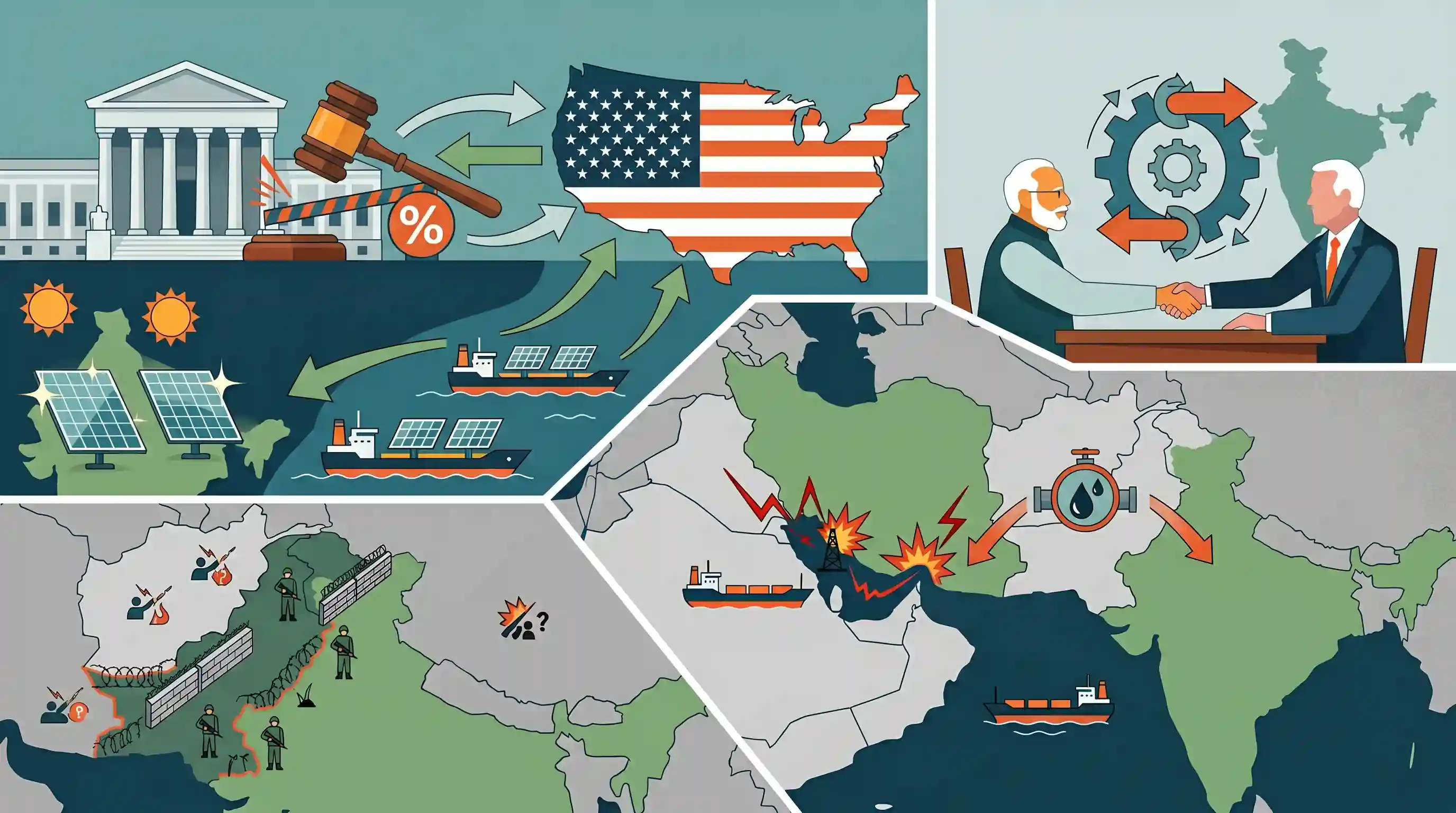
The article covers key global developments relevant to India, including the US Supreme Court striking down a controversial tariff policy favored by Donald Trump, which impacts global trade norms and India's solar sector. It also explores the prospects of an India-US trade deal, the geopolitical fallout of escalating conflicts involving Iran on energy security, and the ongoing security challenges stemming from Pakistan and Afghanistan.
Key Points
- The US Supreme Court struck down a major tariff policy favored by Donald Trump, challenging protectionist trends and potentially benefiting India's solar industry.
- Discussions on a prospective US-India trade deal reflect efforts to balance economic interests amidst evolving global trade dynamics.
- Escalating tensions and the threat of war involving Iran pose severe risks to Middle Eastern stability and India's energy security.
- The fluid political and security situations in Pakistan and Afghanistan continue to shape India's neighborhood policy and strategic calculations.
Important Terms
World Trade Organization (WTO)

A global international organization (est. 1995) that regulates rules of trade between nations, provides a forum for negotiations, and settles trade disputes to ensure smooth and predictable global commerce.
UPSC context
GS Paper 2 & 3 (International Relations/Economy); tests understanding of multilateralism, MFN principles, and global trade governance.
Protectionism
Economic policy of restricting imports through tariffs, quotas, or subsidies to shield domestic industries from foreign competition, often balancing between national self-reliance and global trade integration.
UPSC context
GS Paper 3 (Economy); relevant to debates on globalization, trade wars, and 'Atmanirbhar Bharat'.
Energy Security
The uninterrupted availability of energy sources at an affordable price, involving the diversification of suppliers, maintenance of strategic reserves, and protection of critical transit chokepoints like the Strait of Hormuz.
UPSC context
GS Paper 3 (Infrastructure/Energy); focuses on India's import dependence, supply chain vulnerabilities, and geopolitical risks in West Asia.
Neighborhood First Policy
India's foreign policy framework prioritizing relations with immediate neighbors through enhanced connectivity, economic integration, and people-to-people ties to ensure regional stability and prosperity.
UPSC context
GS Paper 2 (International Relations); key to India’s regional leadership, SAARC/BIMSTEC dynamics, and managing ties with Pakistan and Afghanistan.
Strategic Autonomy
A country's ability to pursue its national interests and foreign policy independently, without being forced into restrictive alliances or influenced heavily by external powers.
UPSC context
GS Paper 2 (International Relations); fundamental concept in India's multi-aligned foreign policy approach.
US Supreme Court (Judicial Review of Trade)
In the trade context, this refers to judicial oversight over executive authority to impose tariffs, particularly regarding whether a president exceeds statutory powers during trade emergencies.
UPSC context
GS Paper 2 (IR/Comparative Constitution); examines the limits of executive power and its impact on international trade law.
Anti-Dumping Duty
A protectionist tariff that a domestic government imposes on foreign imports that it believes are priced below fair market value, often used to protect local manufacturers.
UPSC context
GS Paper 3 (Economy); relates to trade disputes, WTO compliance, and domestic manufacturing (e.g., solar sector).
Prelims Trap
Countervailing duties are applied by the WTO directly to punish countries for dumping goods below cost.
CVDs offset government subsidies, while Anti-Dumping Duties (ADD) target below-cost dumping. Furthermore, individual nations impose them—not the WTO directly—though they must comply with WTO rules.
Static Concepts Connected
What are the core WTO-compliant trade remedy measures available to nations?
- Anti-Dumping Duty (ADD): Tariffs imposed on imports priced below the exporter's normal domestic market price to prevent predatory pricing.
- Countervailing Duty (CVD): Specific duties levied to offset unfair, trade-distorting subsidies provided by the exporting country's government to its producers.
- Safeguard Measures: Temporary import restrictions (tariffs or quotas) applied to protect a domestic industry from an unforeseen, sudden surge in imports.
Which key maritime chokepoints dictate Middle Eastern energy flows to India?
- Strait of Hormuz: Connects the Persian Gulf to the Gulf of Oman. Over 20% of global oil consumption passes through here, making it critical for India's energy security.
- Bab el-Mandeb: Connects the Red Sea to the Gulf of Aden. Vital for transit to the Suez Canal; vulnerable to regional conflicts (e.g., Houthi attacks).
Cross-Topic Patterns
Solar supply chains & protectionism
India's 500 GW non-fossil target clashes with Western protectionism (like US countervailing duties) and domestic reliance on Chinese solar imports, creating a trilemma for India's green energy transition.
Middle East conflicts & imported inflation
Strait of Hormuz disruptions inflate crude prices and freight war-premiums. This directly widens India's Current Account Deficit (CAD) and challenges the RBI's inflation targeting mandate.
Divergent trade and defense trajectories
While India and the US converge heavily on defense and technology (iCET, Quad), their economic relations remain fraught with tariff disputes, mini-trade wars, and the suspended GSP status.

Expect a multi-statement Prelims question integrating WTO trade remedies (CVD vs ADD) with India's solar manufacturing initiatives (PLI).
Linked PYQs · 4
Linked PYQs · 4
- 2012MainsGS2
Discuss the likely negative impact of the protectionist measures proposed by the US on India's software industry.
- 2018MainsGS2
In what ways would the ongoing US-Iran Nuclear Pact Controversy affect the national interest of India? How should India respond to this situation?
- 2020PrelimsGS1
With reference to Trade-Related Investment Measures (TRIMS), which of the following statements is/are correct? 1. Quantitative restrictions on imports by foreign investors are prohibited. 2. They apply to investment measures related to trade in both goods and services. 3. They are not concerned with the regulation of foreign investment. Select the correct answer using the code given below:
- 2025MainsGS2
"Energy security constitutes the dominant kingpin of India's foreign policy, and is linked with India's overarching influence in Middle Eastern countries.” How would you integrate energy security with India's foreign policy trajectories in the coming years?
