United States Supreme Court Ruling on Global Tariffs
Source:Indian Express ↗
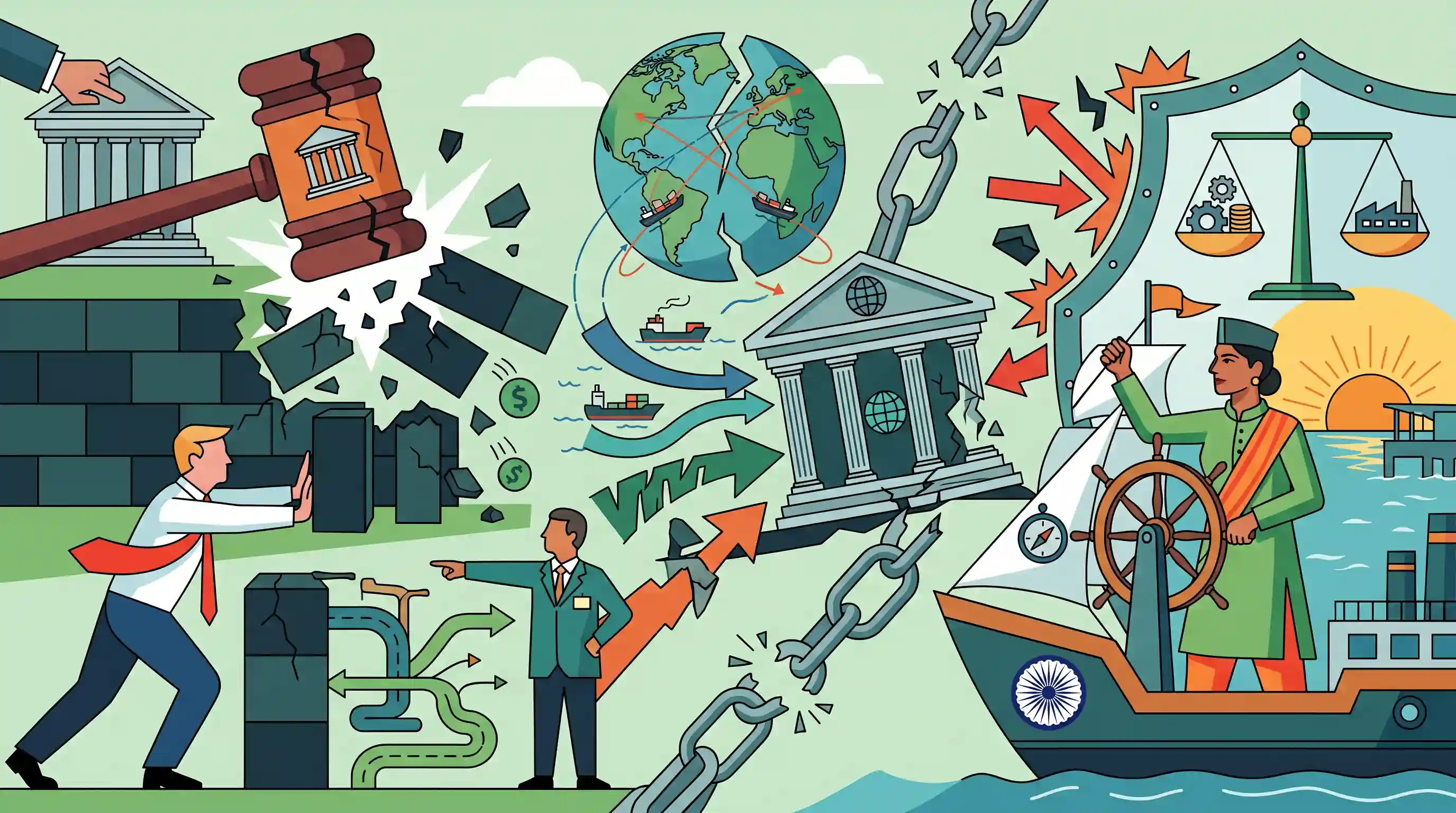
Why It Matters
The rise of sovereign nationalism and trade protectionism in major economies like the US directly impacts global supply chains, the efficacy of the WTO, and macroeconomic stability. These themes are highly relevant for GS2 (International Relations) and GS3 (Economy), especially concerning how India navigates a world moving away from free trade.
Summary
The US Supreme Court's ruling to strike down President Donald Trump's global tariffs marks a critical domestic institutional check on the executive's protectionist trade agenda. While the decision offers temporary relief to global supply chains and trading partners, the article posits that the administration will likely pursue alternative avenues to maintain its confrontational trade policies. This persistent push towards protectionism and sovereign nationalism challenges the multilateral, rules-based trading system anchored by the WTO. For countries like India, navigating this shifting landscape requires strategic recalibration to mitigate the impacts of potential trade wars, ensure macroeconomic stability, and protect national economic interests amidst a waning era of unrestricted globalization.
Key Points
- The US Supreme Court recently struck down President Donald Trump's global tariffs, acting as an institutional check on the executive's aggressive trade agenda.
- Despite this judicial setback, the Trump administration is expected to continue its confrontational trade policies and protectionist stance through alternative executive or legislative mechanisms.
- The ongoing pursuit of unilateral trade measures severely challenges multilateral institutions like the WTO and the broader rules-based global trading system.
- Rising protectionism and the waning of unrestricted globalization pose significant risks to global macroeconomic stability and the resilience of international supply chains.
- For developing economies like India, the shifting landscape of global trade demands strategic recalibration to mitigate the fallout from potential trade wars and safeguard domestic economic interests.
Important Terms
World Trade Organization (WTO)

The global international body regulating trade between nations. It promotes a rules-based system, handles dispute settlements, and aims for free trade through agreements and non-discrimination principles.
UPSC context
GS Paper II/III: Crucial international institution; tests understanding of global trade governance, dispute resolution, and impacts on India’s interests.
Protectionism
Economic policies, such as tariffs, quotas, and subsidies, designed to restrict imports and favor domestic industries over foreign competitors. It often challenges the liberal, rules-based global trading order.
UPSC context
GS Paper III: Indian Economy; tests the impact of global trade shifts and 'America First' policies on India’s manufacturing and exports.
US Supreme Court
The highest federal court in the US, acting as a domestic institutional check on executive power by adjudicating the constitutionality and legality of presidential actions like unilateral trade tariffs.
UPSC context
GS Paper II: International Relations/Constitutional comparisons; tests the role of the judiciary in checking executive overreach and international trade.
International Emergency Economic Powers Act (IEEPA)
A 1977 US law granting the president broad authority to regulate economic transactions during a declared national emergency. It was the primary legal basis for the struck-down 2025 global tariffs.
UPSC context
GS Paper II: Effect of policies of developed countries; specific legal mechanism used to implement protectionist trade agendas affecting global markets.
Most-Favoured-Nation (MFN) Principle
A core WTO principle requiring member nations to treat all other members equally. If a country grants a special favor to one, it must do so for all WTO members.
UPSC context
GS Paper II/III: Trade policy; tests knowledge of fundamental international trade rules and the consequences of their erosion via unilateral tariffs.
Global Supply Chains
The international network of facilities and distribution channels used to deliver products from source to consumer, which becomes disrupted by trade wars and protectionist tariff regimes.
UPSC context
GS Paper III: Economy/Infrastructure; tests understanding of global economic interdependence and the structural impacts of geopolitical instability on commerce.
Prelims Trap
"The WTO Appellate Body recently struck down the US global tariffs to protect free trade."
It was the US Supreme Court (domestic judicial review) that struck them down. The WTO Appellate Body remains non-functional due to long-standing US blockages of judge appointments.
Static Concepts Connected
What are the three trade remedy measures allowed under the WTO?
- Anti-dumping duty: Imposed on imports priced below their fair market value to protect domestic industries from predatory pricing.
- Countervailing duty: Neutralizes the negative effects of foreign government subsidies provided to their exporters.
- Safeguard measures: Temporary restrictions on imports to protect a specific domestic industry from an unexpected, sudden surge in imports.
How does Judicial Review apply to executive actions in trade and taxation?
- Constitutional validity: Courts assess if executive trade actions violate constitutional limits or overstep the powers specifically delegated by the legislature.
- Legislative primacy: Ensures that the imposition of tariffs strictly follows frameworks set by the legislature, checking arbitrary executive protectionism.
Cross-Topic Patterns
Protectionism & Supply Chain Resilience
The shift towards US protectionism directly connects to India's push for initiatives like the Supply Chain Resilience Initiative (SCRI) and PLI schemes to insulate its manufacturing from trade shocks.
WTO Paralysis & Rise of Bilateral FTAs
As unilateral tariffs undermine multilateralism and the WTO Appellate Body remains paralyzed, India is aggressively pivoting to bilateral comprehensive agreements (CEPA/ECTA) to secure stable market access.

Expect a 2026 multi-statement question linking WTO dispute settlement paralysis, unilateral trade barriers, and global supply chain shocks.
Linked PYQs · 4
Linked PYQs · 4
- 2018MainsGS2
What are the key areas of reform if the WTO has to survive in the present context of "Trade War', especially keeping in mind the interest of India?
- 2018MainsGS3
How would the recent phenomena of protectionism and currency manipulations in world trade affect macroeconomic stability of India?
- 2025MainsGS3
What are the challenges before the Indian economy when the world is moving away from free trade and multilateralism to protectionism and bilateralism? How can these challenges be met?
- 2025MainsGS2
"With the waning of globalization, post-Cold War world is becoming a site of sovereign nationalism.” Elucidate.
