US Supreme Court Ruling on Welfare Funding and Separation of Powers
Source:The Hindu ↗
Why It Matters
Provides a valuable comparative constitutional law example (US vs India) regarding the limits of judicial intervention in executive resource allocation. It also highlights the dire socio-economic impacts of legislative gridlock and delayed appropriation bills on crucial social welfare and food security programs.
Summary
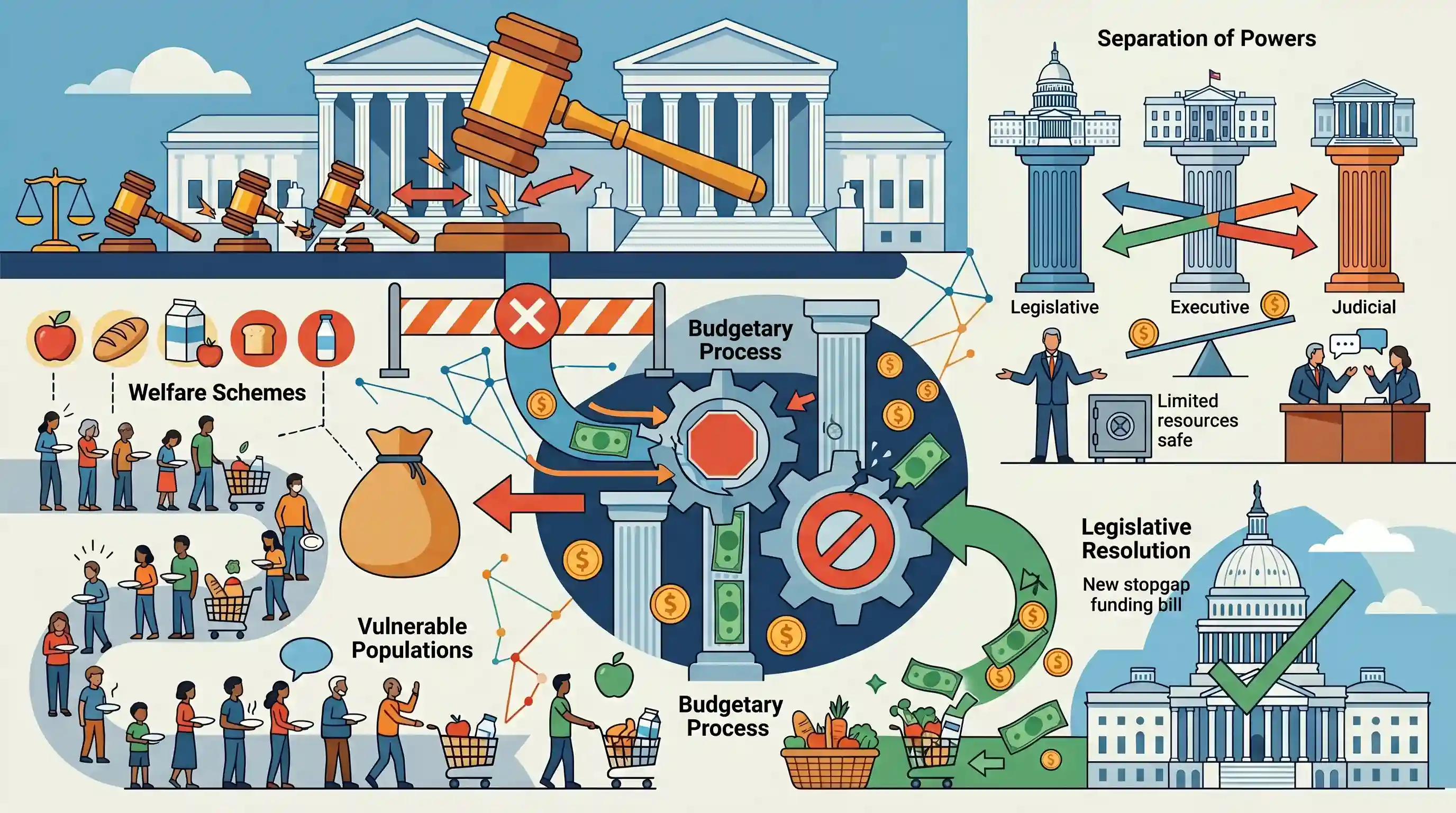
The US Supreme Court temporarily halted lower court mandates that would have required the government to issue full SNAP (Supplemental Nutrition Assistance Program) benefits despite a federal government shutdown. The Biden administration argued that courts cannot constitutionally force the executive to reallocate limited resources without legislative appropriation, emphasizing the doctrine of separation of powers. While the funding gap severely threatened the food security of millions of vulnerable citizens relying on welfare schemes, recent Senate action on a stopgap funding bill signals a likely legislative resolution to the crisis.
Key Points
- The US Supreme Court extended an administrative stay blocking lower court orders that would have forced the Biden administration to issue full SNAP benefits during the federal government shutdown.
- The Biden administration successfully argued that federal courts lack the constitutional authority to mandate the reallocation of limited resources, highlighting a classic separation of powers conflict.
- The suspension of full SNAP funding due to the shutdown severely threatened the food security of millions of low-income Americans, underscoring the vulnerability of welfare beneficiaries to legislative gridlock.
- The US Senate passed a stopgap funding measure aimed at ending the shutdown and restoring essential services and full nutrition assistance, pending House approval.
Important Terms
SNAP (Supplemental Nutrition Assistance Program)

A US federal assistance program providing food-purchasing power to low-income individuals. It is the American counterpart to India's National Food Security Act (NFSA) and Public Distribution System (PDS).
UPSC context
GS II (Social Justice); Tests understanding of international welfare models compared to India's food safety nets.
Continuing Resolution (Stopgap Funding)
A short-term US legislative measure that provides temporary funding to keep federal agencies operational when annual appropriation bills have not been passed.
UPSC context
GS II (Parliamentary Procedures); Tests knowledge of budgetary tools like 'Vote on Account' and temporary fiscal measures.
Separation of Powers
A constitutional doctrine dividing government authority into distinct Legislative, Executive, and Judicial branches to prevent the concentration of power through a system of checks and balances.
UPSC context
GS II (Constitutional Comparison); Fundamental for comparing the Indian parliamentary system with the US presidential model.
Appropriation
The formal legislative act of authorizing the expenditure of public funds. Under constitutional law, no government money can be withdrawn or spent without specific legislative approval.
UPSC context
GS II (Budgeting); Tests knowledge of parliamentary control over the purse and Article 114 of the Indian Constitution.
Food Security
A condition where all people have physical and economic access to sufficient, safe, and nutritious food. It is a core objective of social welfare policies globally.
UPSC context
GS II (Hunger) and GS III (PDS); Tests analysis of state-led interventions for vulnerable populations and nutrition.
Judicial Overreach
A situation where the judiciary oversteps its constitutional mandate by interfering in matters reserved for the legislative or executive branches, such as budgetary allocations.
UPSC context
GS II (Judiciary); Tests the ability to critique judicial activism versus constitutional boundaries in different democracies.
Prelims Trap
"Failing to pass the Appropriation Bill in India results in a temporary government shutdown of non-essential services."
In India's parliamentary system, defeating an Appropriation Bill amounts to a loss of parliamentary confidence. The Council of Ministers must resign; the government does not merely "shut down."
Static Concepts Connected
How does the Constitution strictly regulate withdrawals from the Consolidated Fund of India?
- Article 114(3): No money shall be withdrawn from the Consolidated Fund except under appropriation made by law, ensuring parliamentary control over the purse.
- Vote on Account: Allows the Lok Sabha to grant an advance for estimated expenditure for a part of the financial year, pending the regular budget's passage.
How does executive survival differ during a budget defeat in the US versus India?
- Presidential System (US): The executive (President) does not rely on legislative majority. A budget gridlock leads to a halt in government operations, not executive resignation.
- Parliamentary System (India): The executive is collectively responsible to the legislature. A failure to pass the budget signals a loss of majority, forcing the government to resign.
Cross-Topic Patterns
Judicial restraint in fiscal policy
Both US and Indian courts generally invoke the doctrine of separation of powers to decline mandating executive expenditure that lacks explicit legislative appropriation, thereby avoiding 'judicial legislation'.
Comparative food security: SNAP vs NFSA
Unlike SNAP which is vulnerable to periodic funding cliffs, India's NFSA creates a legally enforceable entitlement to subsidized foodgrains, structurally insulating PDS beneficiaries from annual legislative budget gridlocks.

Expect a comparative Prelims question testing the constitutional outcome of a budget defeat: US 'shutdown' vs Indian loss of confidence.
Linked PYQs · 3
Linked PYQs · 3
- 2020MainsGS2
Judicial Legislation is antithetical to the doctrine of separation of powers as envisaged in the Indian Constitution. In this context justify the filing of large number of public interest petitions praying for issuing guidelines to executive authorities.
- 2019MainsGS2
Performance of welfare schemes that are implemented for vulnerable sections is not so effective due to absence of their awareness and active involvement at all stages of policy process. Discuss.
- 2024PrelimsGS1
Which of the following statements are correct in respect of a Money Bill in the Parliament? 1. Article 109 mentions special procedure in respect of Money Bills. 2. A Money Bill shall not be introduced in the Council of States. 3. The Rajya Sabha can either approve the Bill or suggest changes but cannot reject it. 4. Amendments to a Money Bill suggested by the Rajya Sabha have to be accepted by the Lok Sabha. Select the answer using the code given below :
