US student visa revocation warnings and international student rules
Source:The Hindu ↗
Why It Matters
The stringent U.S. visa policies highlight the vulnerability of the Indian student diaspora and demonstrate how shifts in the domestic immigration policies of developed nations directly impact Indian citizens, brain drain dynamics, and bilateral relations.
Summary
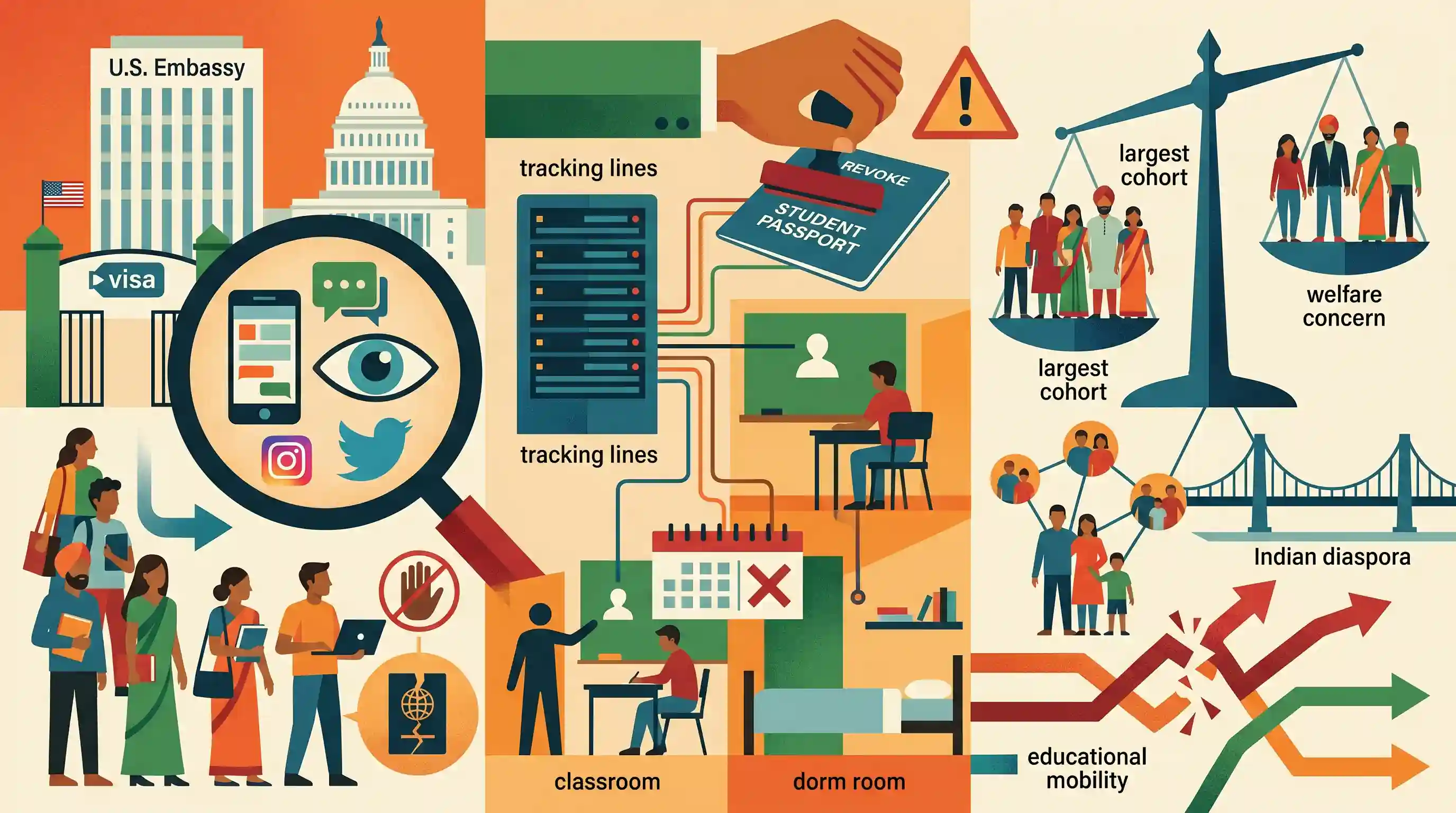
The U.S. administration is implementing stricter rules and vetting processes for student visas, including rigorous social media screening. The U.S. Embassy in India has warned that visas may be revoked if students drop out or miss classes without informing campus authorities. With Indian students currently making up the largest cohort of international students in the U.S., these tightened immigration policies—enforced via the SEVIS tracking system by ICE—raise significant concerns regarding the welfare of the Indian diaspora and cross-border educational mobility.
Key Points
- The U.S. administration is imposing strict social media screening and vetting requirements for student visas.
- The U.S. Embassy in India warned that dropping out or skipping classes without informing authorities could lead to visa revocation and deportation.
- U.S. Immigration and Customs Enforcement (ICE) uses the SEVIS database to closely track international students.
- These tightened immigration policies have a disproportionate impact on Indian students, who form the largest group of international students in the U.S.
Important Terms
SEVIS (Student and Exchange Visitor Information System)

A web-based database managed by the U.S. Department of Homeland Security to track and monitor F, M, and J non-immigrant students and exchange visitors.
UPSC context
GS Paper II: International Relations and Indian Diaspora; tests knowledge of regulatory mechanisms affecting Indian students and mobility in bilateral relations.
U.S. Immigration and Customs Enforcement (ICE)
A U.S. federal agency under the Department of Homeland Security responsible for enforcing immigration laws and managing the Student and Exchange Visitor Program (SEVP).
UPSC context
GS Paper II: Effect of policies of developed countries; tests understanding of foreign law enforcement agencies that impact the legal status of the diaspora.
Indian Diaspora
The diverse global community of Indian citizens and persons of Indian origin living abroad; Indian students in the U.S. currently form its largest international cohort.
UPSC context
GS Paper II: Indian Diaspora; tests ability to analyze the impact of foreign policies on the welfare and influence of overseas Indians.
F-1 Visa
The primary non-immigrant visa category for international students seeking to pursue full-time academic studies at accredited colleges, universities, or high schools in the United States.
UPSC context
GS Paper II: Bilateral Relations; essential for discussing educational diplomacy and the human capital flow between India and the U.S.
Student and Exchange Visitor Program (SEVP)
The administrative division within ICE that manages SEVIS, certifies schools to host international students, and ensures compliance with federal immigration regulations.
UPSC context
GS Paper II: Government policies and interventions; tests awareness of the specific regulatory bodies that govern international education and migration.
U.S. Embassy in India
The main diplomatic mission of the United States in New Delhi, responsible for official communications, visa processing, and issuing advisories to Indian citizens.
UPSC context
GS Paper II: Bilateral relations; functions as the frontline institution for diplomatic dialogue and policy implementation affecting Indian interests.
Prelims Trap
China remains the largest source of international students in the United States.
India recently surpassed China to become the largest cohort of international graduate students in the U.S. Options stating China is the largest are outdated traps.
Static Concepts Connected
What mechanisms assist Indians overseas in distress?
- MADAD Portal: A Consular Grievances Monitoring System launched by MEA, enabling overseas Indians to log and track grievances online.
- Indian Community Welfare Fund (ICWF): Provides emergency boarding, emergency medical care, legal aid, and air passage to distressed Indian citizens abroad.
How does reverse migration (brain gain) impact the domestic economy?
- Innovation and R&D: Returning skilled professionals enhance domestic R&D, foster startup ecosystems, and bring global corporate best practices.
- Capital and Investments: Returnees often repatriate accumulated wealth, savings, and investment capital, which directly boosts domestic market liquidity and MSME growth.
Cross-Topic Patterns
Visa curbs and WTO GATS Mode 4
Tightened US visas impede the "movement of natural persons", frustrating a core Indian demand under the WTO's General Agreement on Trade in Services (GATS).
Mandatory screening and Data Privacy
US AI-driven social media vetting of foreign students raises extraterritorial privacy concerns, clashing with the consent and data minimization principles of India's DPDP Act.

Expect a 2026 GS2 question linking US visa protectionism (H1B/student) to India's push for GATS Mode 4 (movement of natural persons).
Linked PYQs · 2
Linked PYQs · 2
- 2020MainsGS2
Indian diaspora has a decisive role to play in the politics and economy of America and European Countries'. Comment with examples.
- 2023MainsGS2
Indian diaspora has scaled new heights in the West. Describe its economic and political benefits for India.
