US Strikes and Strait of Hormuz Oil Route Blockade Crisis
Source:The Hindu ↗
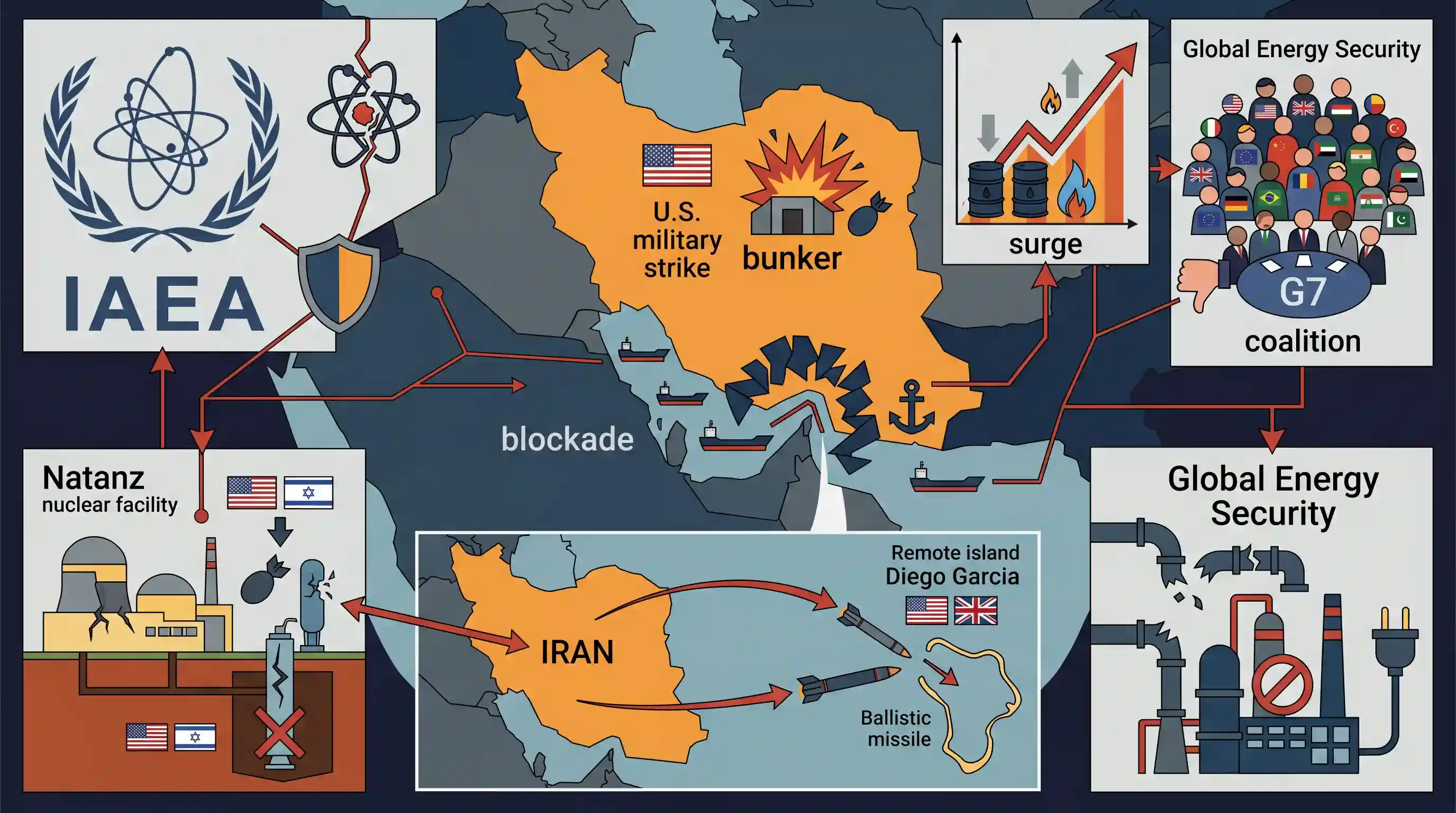
Why It Matters
The Strait of Hormuz is a vital maritime choke point for India's and the world's energy needs. Ongoing US-Iran hostilities directly threaten global crude oil supply chains, exacerbating inflation and impacting India's energy security and foreign policy in West Asia. The involvement of Diego Garcia and nuclear facilities raises the stakes of the conflict to a broader international security level.
Summary
Tensions in the Middle East have escalated significantly following a US military strike on an Iranian bunker in response to Iran's de facto closure of the Strait of Hormuz, a critical global choke point for crude oil and LNG. A coalition of over 20 countries condemned the blockade, which has caused global energy prices to surge. Meanwhile, the conflict has expanded geographically, with Iran allegedly launching an unsuccessful ballistic missile attack against the US-UK military base in Diego Garcia. A reported US-Israeli strike on Iran's Natanz nuclear facility has further destabilized the region, raising urgent concerns regarding global energy security and potential nuclear risks.
Key Points
- The US military destroyed an underground Iranian bunker storing anti-ship cruise missiles and radar equipment near the Strait of Hormuz.
- A joint statement from 22 countries condemned Iran's 'de facto closure' of the Strait of Hormuz, a critical global choke point for crude oil and liquefied natural gas.
- The geopolitical standoff has disrupted global energy markets, causing Brent crude prices to surge beyond $105 per barrel.
- Iran allegedly launched an unsuccessful ballistic missile strike on the joint US-UK military base in Diego Garcia, showcasing its long-range missile capabilities.
- Iran's Natanz nuclear facility was reportedly targeted by the US and Israel, prompting the IAEA to call for military restraint to avoid a nuclear accident.
Important Terms
Strait of Hormuz

A critical maritime chokepoint between Iran and Oman connecting the Persian Gulf to the Gulf of Oman. It carries ~20% of global oil and 35% of LNG.
UPSC context
GS Paper 1 (Geography) & Paper 3 (Energy Security); tests understanding of global trade vulnerabilities and India's energy dependence on West Asia.
Diego Garcia
A strategic US-UK military base in the Chagos Archipelago, Indian Ocean. It serves as a key logistics hub for power projection in the Middle East and Indo-Pacific.
UPSC context
GS Paper 2 (International Relations); crucial for Indian Ocean Region (IOR) security dynamics and the Chagos sovereignty dispute involving Mauritius.
International Atomic Energy Agency (IAEA)
An autonomous UN-related international organization that promotes the peaceful use of nuclear energy and verifies compliance with the Nuclear Non-Proliferation Treaty (NPT).
UPSC context
GS Paper 2 (Important International Institutions); tests knowledge of global nuclear governance, safeguards, and India's status as a founding member.
Islamic Revolutionary Guard Corps (IRGC)
An elite branch of the Iranian Armed Forces established to protect the country's Islamic system. It operates significant domestic and extraterritorial military and economic interests.
UPSC context
GS Paper 2 (International Relations); relevant for Middle East security, state-sponsored activities, and regional proxy conflicts.
Natanz Nuclear Facility
Iran's primary uranium enrichment complex. It houses both above-ground and hardened underground facilities and has been a central focus of international nuclear negotiations and sabotage.
UPSC context
GS Paper 2 (IR) & Paper 3 (Security); key site in the Iran Nuclear Deal (JCPOA) and regional stability discussions.
US Central Command (CENTCOM)
A U.S. Department of Defense combatant command responsible for military operations in the Middle East, Central Asia, and parts of South Asia.
UPSC context
GS Paper 2 (International Relations); essential for understanding US military architecture and its strategic influence in India’s extended neighborhood.
Prelims Trap
Diego Garcia is a sovereign overseas military territory of the United States.
Diego Garcia is part of the Chagos Archipelago. Following a 2025 treaty, sovereignty belongs to Mauritius, though the US/UK retain a 99-year base lease.
Static Concepts Connected
What are the key maritime chokepoints in the Middle East?
- Strait of Hormuz: Connects the Persian Gulf to the Gulf of Oman; bordered by Iran, Oman, and the UAE.
- Bab el-Mandeb: Connects the Red Sea to the Gulf of Aden; bordered by Yemen, Djibouti, and Eritrea.
- Suez Canal: An artificial waterway in Egypt connecting the Mediterranean Sea directly to the Red Sea.
What is the mandate of the International Atomic Energy Agency (IAEA)?
- Core Mandate: An autonomous UN-affiliated organization that promotes the peaceful use of nuclear technology while inhibiting its military use.
- Nuclear Safeguards: Conducts physical inspections to verify that non-nuclear-weapon states are not diverting nuclear material to weapons programs.
- Additional Protocol: A voluntary agreement granting the IAEA expanded rights of access to information and sites within a member state.
Cross-Topic Patterns
Energy chokepoints and imported inflation
Disruptions in the Strait of Hormuz threaten India's current account deficit and inflate import bills, linking Middle Eastern geopolitics directly to domestic macroeconomic stability.
Diego Garcia & Chagos decolonization
Iran's strike highlights Diego Garcia's strategic military value precisely when the 2025 UK-Mauritius sovereignty transfer significantly alters Indian Ocean maritime dynamics.

Expect a 2026 map question pairing Middle East chokepoints (Hormuz, Bab el-Mandeb) with their bordering nations and water bodies.
Linked PYQs · 4
Linked PYQs · 4
- 2014PrelimsGS1
Turkey is located between
- 2022PrelimsGS1
The term "Levant" often heard in the news roughly corresponds to which of the following regions?
- 2017MainsGS2
The question of India's Energy Security constitutes the most important part of India's economic progress. Analyze India's energy policy cooperation with West Asian countries.
- 2023MainsGS3
What is oil pollution? What are its impacts on the marine ecosystem? In what way is oil pollution particularly harmful for a country like India?
