West Asian Conflict Escalation and Global Energy Supply Risks
Source:The Hindu ↗
Why It Matters
The Middle East is a vital source of India's energy imports and home to a large Indian diaspora. Ongoing conflicts in the region heavily impact global oil prices and supply chains. UPSC frequently tests the geographical locations of these flashpoints in Prelims and asks about India's energy security and West Asia policy in Mains GS-2.
Summary
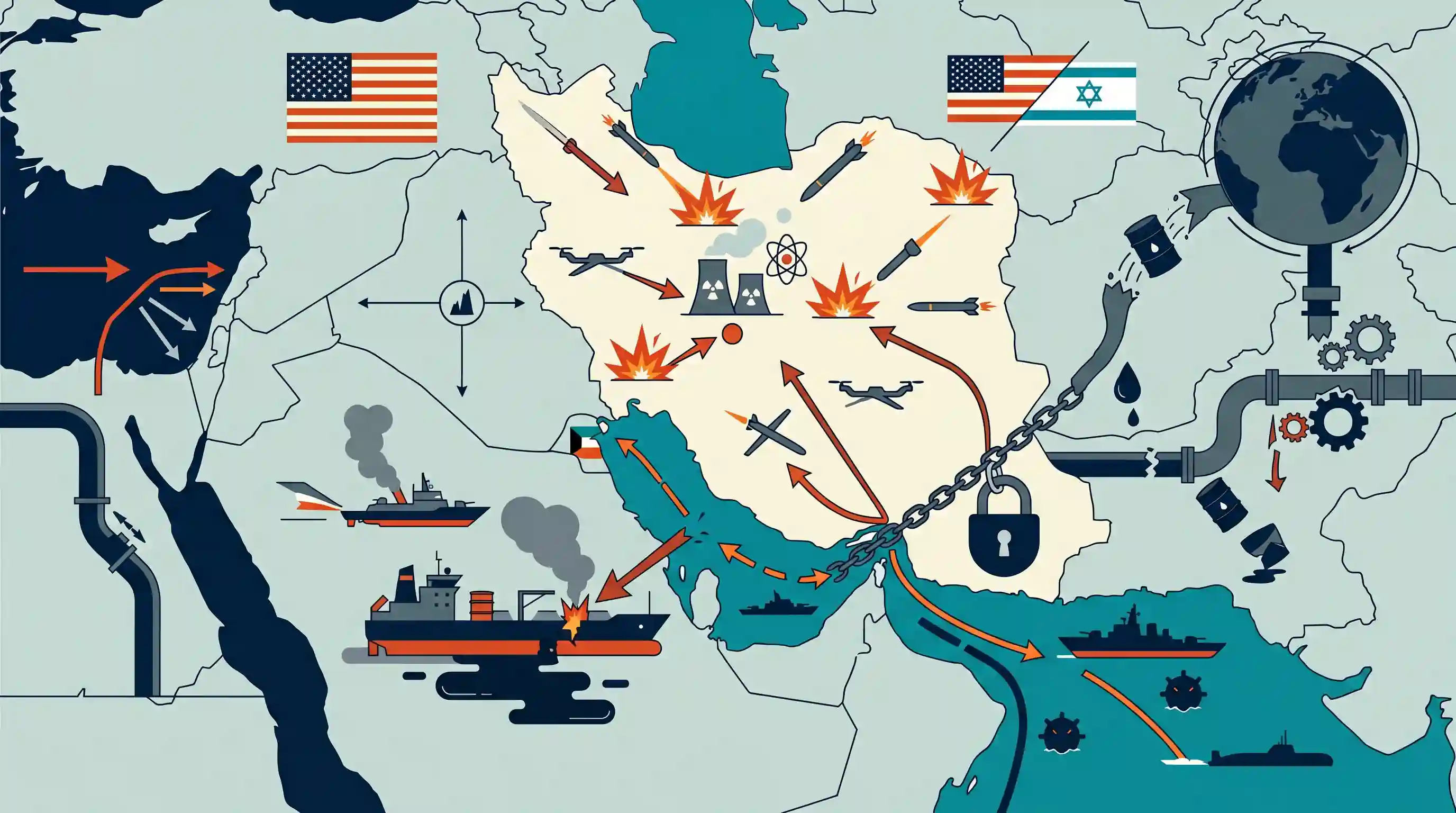
Escalating conflicts in the Middle East saw the U.S. and Israel striking targets in Iran, including the city of Isfahan (known for its nuclear facilities), while Iran attacked a fully loaded Kuwaiti oil tanker in the Persian Gulf off Dubai. This significant escalation threatens global energy security, disrupting the supply of oil and natural gas and raising severe concerns about maritime security in critical global chokepoints like the Strait of Hormuz.
Key Points
- Escalating conflict in the Middle East involves the U.S. and Israel launching strikes on Iranian targets, including the nuclear-linked city of Isfahan.
- In retaliation, Iran targeted a fully loaded Kuwaiti oil tanker in the Persian Gulf near Dubai, raising alarms over maritime safety.
- The tit-for-tat attacks threaten global energy security by disrupting the supply of oil and natural gas flowing through critical chokepoints like the Strait of Hormuz.
- This volatile geopolitical situation directly impacts India's strategic interests, particularly regarding energy imports and diaspora security in West Asia.
Important Terms
Strait of Hormuz

A narrow maritime chokepoint between Iran and Oman connecting the Persian Gulf to the Gulf of Oman; handles ~20% of global oil trade.
UPSC context
GS Paper I (Geography) and GS Paper II (IR); critical for studying global energy security and maritime trade chokepoints.
Isfahan
A major Iranian city and strategic hub housing key military infrastructure, including nuclear facilities and air force bases.
UPSC context
GS Paper I (World Geography); frequently appears in map-based questions related to West Asian conflict zones.
Hezbollah
A Lebanese Shia militant group and political party, backed by Iran, considered a primary non-state actor in Middle Eastern geopolitics.
UPSC context
GS Paper II (IR); tests knowledge of regional alliances (Axis of Resistance) and non-state actors in international conflict.
Maritime Security
The protection of maritime interests, trade routes (SLOCs), and sovereignty from threats like piracy, state-sponsored attacks, and terrorism.
UPSC context
GS Paper III (Internal Security); relates to India's role as a 'net security provider' and the SAGAR initiative.
Energy Security
The uninterrupted availability of energy sources at an affordable price, often threatened by geopolitical instability in hydrocarbon-rich regions.
UPSC context
GS Paper III (Economy/Environment); vital for understanding India's import dependence and macroeconomic stability.
Persian Gulf
A strategic Mediterranean-sized water body bordered by major oil producers like Saudi Arabia and Iran, central to global energy dynamics.
UPSC context
GS Paper I (Geography); key for studying regional topography and India's 'Look West' policy interests.
Prelims Trap
"The Strait of Hormuz connects the Persian Gulf directly to the Red Sea, serving as a primary oil route."
Aspirants often confuse Hormuz with Bab-el-Mandeb. The Strait of Hormuz connects the Persian Gulf to the Gulf of Oman, not the Red Sea.
Static Concepts Connected
Which eight nations border the Persian Gulf?
- Arab States: Saudi Arabia, Kuwait, UAE, Qatar, Bahrain, Oman, and Iraq share the coastline.
- Non-Arab State: Iran holds the entire northern coastline of the Gulf.
- Key Exclusion: Yemen does not border the Persian Gulf, a frequent distractor in Prelims map options.
How do crude oil price shocks impact India's macroeconomic stability?
- CAD Widening: Higher import bills for inelastic oil demand sharply widen the Current Account Deficit (CAD).
- Cost-Push Inflation: Expensive crude raises domestic fuel prices, driving up transportation costs and triggering broader inflation.
- Rupee Depreciation: Surging demand for US dollars to fund the inflated import bill weakens the Indian Rupee.
Cross-Topic Patterns
Gulf volatility & Strategic Petroleum Reserves
Disruptions in the Strait of Hormuz highlight the urgency of expanding India's Strategic Petroleum Reserves (e.g., Padur, Chandikhol) to buffer against global supply shocks.
Diaspora security & evacuation diplomacy
Regional wars threaten millions of Indian expats, making proactive non-combatant evacuation operations (like Operation Raahat) and remittance-flow stability a dual crisis-management challenge.

Map-based matching of West Asian nuclear sites (Isfahan) and maritime chokepoints is highly probable as a multi-statement question in 2026.
Linked PYQs · 5
Linked PYQs · 5
- 2022PrelimsGS1
The term "Levant" often heard in the news roughly corresponds to which of the following regions?
- 2024PrelimsGS1
Consider the following statements : Statement-I : Sumed pipeline is a strategic route for Persian Gulf oil and natural gas shipments to Europe. Statement-II : Sumed pipeline connects the Red Sea with the Mediterranean Sea. Which one of the following is correct in respect of the above statements?
- 2025MainsGS2
"Energy security constitutes the dominant kingpin of India's foreign policy, and is linked with India's overarching influence in Middle Eastern countries.” How would you integrate energy security with India's foreign policy trajectories in the coming years?
- 2017MainsGS2
The question of India's Energy Security constitutes the most important part of India's economic progress. Analyze India's energy policy cooperation with West Asian countries.
- 2018MainsGS2
“India’s relations with Israel have, of late, acquired a depth and diversity, which cannot be rolled back.” Discuss.
