US Bangladesh Reciprocal Trade Agreement and Textile Tariffs
Source:Indian Express ↗
Why It Matters
Demonstrates the evolving geopolitical alignments and transactional trade strategies in South Asia. Bangladesh's commitment to buy US energy and military equipment while curbing defense imports from other nations significantly alters the region's strategic calculus, posing indirect implications for India's regional hegemony and trade competitiveness.
Summary
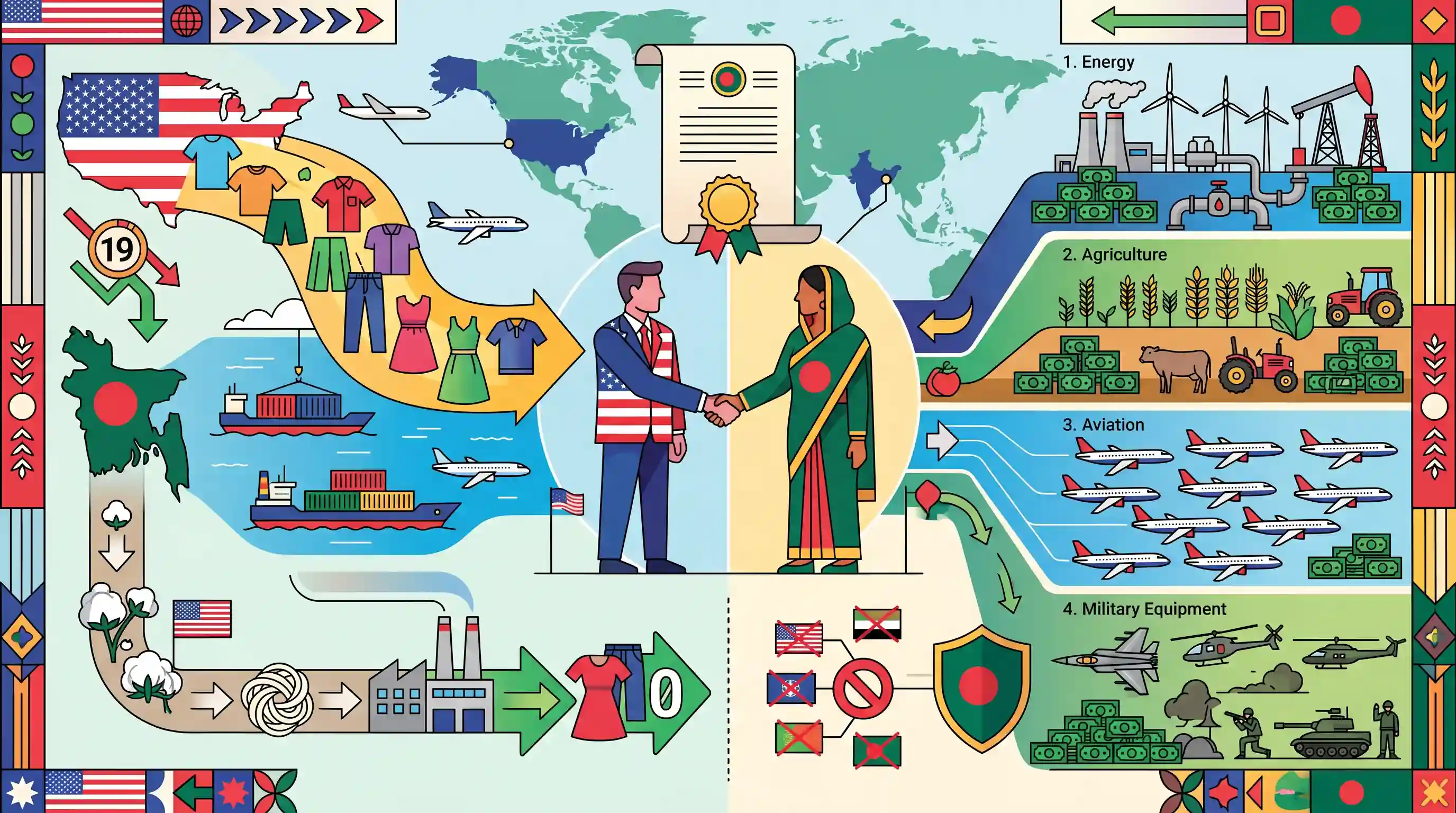
The United States and Bangladesh have signed a historic reciprocal trade agreement, marking the first such deal in South Asia. The agreement reduces overall US tariffs on Bangladeshi exports to 19% and offers zero-tariff market access for Bangladeshi apparel made with American cotton and fibers. In a highly transactional exchange, Bangladesh has committed to large-scale procurements from the US, including $15 billion in energy, $3.5 billion in agriculture, 14 Boeing aircraft, and military equipment, while capping defense purchases from specific rival nations.
Key Points
- The US and Bangladesh signed the first Agreement on Reciprocal Trade in South Asia, reducing US tariffs on Bangladeshi exports from 20% to 19%.
- Bangladesh gained zero-tariff access for specific textile and apparel goods that use US-produced cotton and man-made fibers.
- Bangladesh committed to procuring $15 billion in US energy products, $3.5 billion in agricultural goods, and 14 Boeing aircraft.
- Bangladesh agreed to purchase US military equipment while limiting its defense procurements from certain other countries.
Important Terms
US-Bangladesh Agreement on Reciprocal Trade

A 2026 bilateral deal reducing US tariffs on Bangladeshi goods to 19% while granting zero-tariff access for apparel using US cotton, in exchange for major energy and agricultural procurement.
UPSC context
GS Paper II (International Relations) and GS Paper III (Economy). Tests understanding of bilateral trade dynamics and South Asian geopolitics.
Reciprocal Tariff
A trade policy where a country (e.g., the US) imposes the same tariff rate on a partner's imports as that partner levies on its own goods.
UPSC context
GS Paper III (Economy). Crucial for understanding shifts from multilateralism (WTO) to transactional bilateralism in global trade.
Office of the US Trade Representative (USTR)
The US federal agency responsible for developing and coordinating international trade, commodity, and direct investment policy, and leading trade negotiations with other nations.
UPSC context
GS Paper II. Important for monitoring trade diplomacy and institutional actors influencing India's export environment.
Biman-Boeing Deal
A $3.7 billion procurement of 14 aircraft for Bangladesh’s national carrier, used as a strategic lever to narrow trade deficits and secure favorable tariff terms with the US.
UPSC context
GS Paper II (International Relations). Exemplifies "transactional diplomacy" where commercial deals facilitate strategic trade concessions.
Cotton-for-Zero-Tariff Mechanism
A specific trade incentive granting duty-free US market access to Bangladeshi garments, provided they are manufactured using American-grown cotton or man-made fibers.
UPSC context
GS Paper III (Industrial Growth). Significant for its potential to disrupt India's yarn exports and regional textile supply chains.
Prelims Trap
The agreement grants unconditional zero-tariff access to all Bangladeshi textile exports to the US.
The zero-tariff benefit is strictly conditional on 'Rules of Origin' requiring the use of US-produced cotton and fibers, specifically designed to exclude third-party (like Indian) raw materials.
Static Concepts Connected
What are 'Rules of Origin' in international trade agreements?
- Definition: Criteria used to determine the exact national source of a product for customs, quotas, and trade purposes.
- Anti-Circumvention: They prevent third-party countries from routing their goods through a treaty-partner nation to bypass tariffs and claim preferential access.
- Value Addition: Requires a minimum percentage of local value addition or specific manufacturing processes (like sourcing specific raw materials) to qualify for tariff cuts.
Why does India's readymade garment (RMG) sector struggle against regional competitors?
- Tariff Disadvantages: Competitors like Bangladesh and Vietnam often enjoy preferential zero-tariff access in major markets (US/EU) via LDC status or FTAs, heavily undercutting Indian prices.
- Fiber Bias: Global demand is shifting rapidly to synthetic Man-Made Fibers (MMF), but India's industry and policies remain heavily concentrated on cotton.
- Economies of Scale: India's RMG sector is highly fragmented and dominated by MSMEs, limiting the economies of scale and technological upgrades seen in rival nations.
Cross-Topic Patterns
Geo-economics of defense capping
The US leverages its lucrative consumer market access to enforce strategic defense decoupling, explicitly restricting Bangladesh from purchasing Chinese military hardware like J-10C jets and relying on the Pekua submarine base.
Double-blow to Indian textiles
This deal simultaneously hurts Indian agriculture by displacing raw cotton exports to Bangladesh, and manufacturing by cementing an 18% tariff disadvantage for Indian garments in the US market.

Rules of origin tied to defense caps makes this prime for a 2026 question on geo-economics and India's textile export vulnerabilities.
Linked PYQs · 3
Linked PYQs · 3
- 2019MainsGS2
‘What introduces friction into the ties between India and the United States is that Washington is still unable to find for India a position in its global strategy, which would satisfy India's national self-esteem and ambitions.’ Explain with suitable examples.
- 2017MainsGS3
Account for the failure of manufacturing sector in achieving the goal of labour-intensive exports. Suggest measures for more labour-intensive rather than capital-intensive exports.
- 2023MainsGS3
Faster economic growth requires increased share of the manufacturing sector in GDP, particularly of MSMEs. Comment on the present policies of the Government in this regard.
