Strait of Hormuz Maritime Security and Unmanned Aerial Warfare
Source:Indian Express ↗
Why It Matters
The Strait of Hormuz is a vital chokepoint for global oil transit; disruptions there directly impact India's energy security and inflation. Furthermore, the proliferation of offensive drone technology (UAVs) by state and non-state actors presents novel challenges to conventional maritime and national security frameworks.
Summary
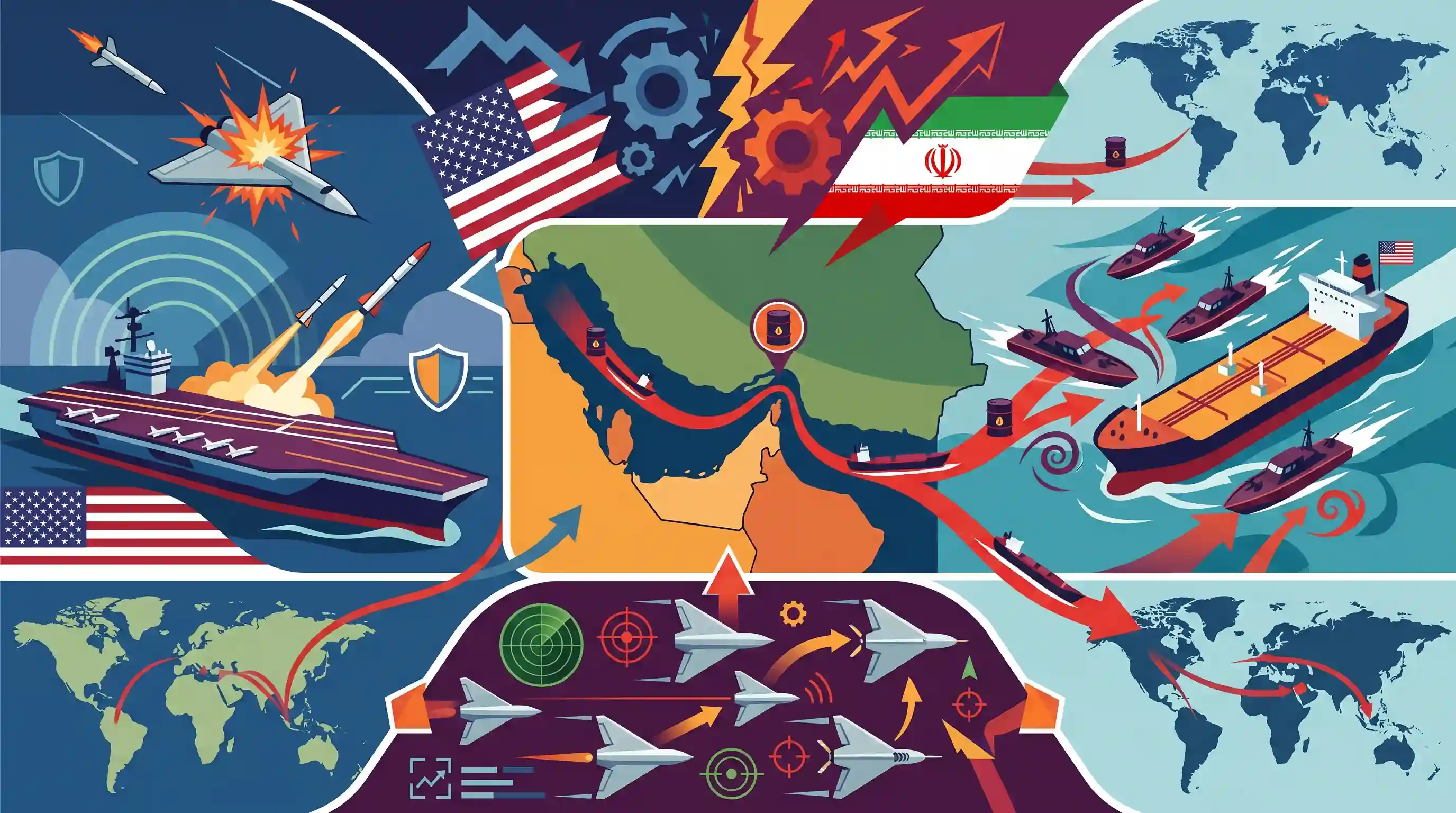
The US Navy shot down an Iranian Shahed drone approaching the USS Abraham Lincoln aircraft carrier, while Iranian IRGC gunboats harassed a US-flagged commercial tanker in the Strait of Hormuz. These incidents highlight escalating US-Iran geopolitical tensions and the growing security threats posed by drone warfare in one of the world's most critical maritime chokepoints for global oil transit.
Key Points
- The US military shot down an Iranian-designed Shahed drone that was flying dangerously close to the USS Abraham Lincoln aircraft carrier.
- In a concurrent incident, Iranian Islamic Revolutionary Guard Corps (IRGC) fast-attack boats harassed a US-flagged commercial tanker in the Strait of Hormuz.
- The Strait of Hormuz is a critical global maritime chokepoint, and disruptions there pose severe risks to global oil transit and energy security.
- The deployment of Shahed drones underscores the rising prominence and threat of Unmanned Aerial Vehicles (UAVs) in modern asymmetric warfare and regional disputes.
- These events highlight the escalating military and geopolitical tensions between the United States and Iran in the Persian Gulf region.
Important Terms
Islamic Revolutionary Guard Corps (IRGC)

An elite branch of the Iranian Armed Forces established after the 1979 Revolution. It operates independently of the regular military, reports directly to the Supreme Leader, and oversees Iran's ballistic missile and proxy operations.
UPSC context
GS Paper 2 (International Relations) and GS Paper 3 (Security). Crucial for understanding West Asian security dynamics and state-sponsored proxy warfare.
Strait of Hormuz
A strategic waterway between Iran and Oman connecting the Persian Gulf to the Gulf of Oman. It is the world's most critical chokepoint, handling approximately 20% of global oil consumption.
UPSC context
GS Paper 1 (Geography) and GS Paper 2 (International Relations). Key for questions on global energy security and maritime trade routes.
Shahed Drones
A family of Iranian-made loitering munitions, often called 'kamikaze' or 'suicide' drones. They are low-cost, long-range UAVs designed to detonate on impact, frequently used in swarming tactics to overwhelm air defenses.
UPSC context
GS Paper 3 (Science and Technology/Security). Illustrates the shift toward asymmetric warfare and the technological challenges of modern air defense.
Maritime Chokepoint
A narrow geographical feature, typically a strait, that is vital for global trade or military movement. Blockage of such points can lead to significant economic or security disruptions.
UPSC context
GS Paper 1 (World Geography). A standard concept for physical and economic geography questions regarding global shipping lanes.
Energy Security
The reliable availability of energy sources at an affordable price. In a geopolitical context, it involves protecting critical infrastructure and sea lanes from disruption to ensure stable global supplies.
UPSC context
GS Paper 3 (Energy/Economy). Vital for India's strategic interests, as disruptions in the Middle East directly impact domestic inflation and the fiscal deficit.
Geopolitics of West Asia
The study of the effects of Earth's geography on politics and international relations. In the Middle East, this involves the struggle for regional influence between powers like the US, Iran, and Saudi Arabia.
UPSC context
GS Paper 2 (International Relations). Central to India's 'Link West' policy and its diplomatic balancing act between competing regional powers.
Prelims Trap
The Strait of Hormuz directly connects the Persian Gulf to the Red Sea.
The Strait of Hormuz connects the Persian Gulf to the Gulf of Oman. It is the Bab-el-Mandeb strait that connects the Red Sea to the Gulf of Aden.
Static Concepts Connected
What are the key maritime chokepoints in the Middle East region?
- Strait of Hormuz: Connects the Persian Gulf to the Gulf of Oman and Arabian Sea. Bordered primarily by Iran to the north and Oman to the south.
- Bab-el-Mandeb: Connects the Red Sea to the Gulf of Aden and Arabian Sea. Bordered by Yemen on the Arabian Peninsula, and Djibouti and Eritrea in Africa.
How do loitering munitions differ from traditional Unmanned Combat Aerial Vehicles (UCAVs)?
- Loitering Munitions: Expendable "kamikaze" drones (like Iran's Shahed) designed to hover in an area, locate a target, and crash into it with a built-in explosive payload.
- Traditional UCAVs: Reusable combat drones (like the US MQ-9 Reaper) that launch external missiles or drop bombs, returning to base after completing the strike mission.
Cross-Topic Patterns
Strait disruptions and India's CAD
Geopolitical tensions in Hormuz cause spikes in freight and war-risk insurance premiums, directly widening India's Current Account Deficit through imported oil inflation.
Rise of asymmetric naval warfare
Deploying cheap kamikaze drones alongside fast-attack boats allows smaller forces to use swarm tactics, denying sea control and challenging technologically superior blue-water navies.

Middle East chokepoints (Hormuz, Bab-el-Mandeb) paired with bordering nations will likely form a paired-matching question in Prelims 2026.
Linked PYQs · 3
Linked PYQs · 3
- 2023MainsGS3
The use of unmanned aerial vehicles (UAVs) by our adversaries across the borders to ferry arms/ammunitions, drugs, etc., is a serious threat to the internal security. Comment on the measures being taken to tackle this threat.
- 2025MainsGS2
"Energy security constitutes the dominant kingpin of India's foreign policy, and is linked with India's overarching influence in Middle Eastern countries.” How would you integrate energy security with India's foreign policy trajectories in the coming years?
- 2024PrelimsGS1
Consider the following statements : Statement-I : Sumed pipeline is a strategic route for Persian Gulf oil and natural gas shipments to Europe. Statement-II : Sumed pipeline connects the Red Sea with the Mediterranean Sea. Which one of the following is correct in respect of the above statements?
