US Senate Vote on Iran War Powers and Constitutional Separation
Source:Indian Express ↗
Why It Matters
The article provides a practical example of the separation of powers and legislative-executive relations in the US system, useful for comparative constitutional analysis. Additionally, US military posture towards Iran directly influences stability in the Middle East, an area critical to India's energy security and diaspora interests.
Summary
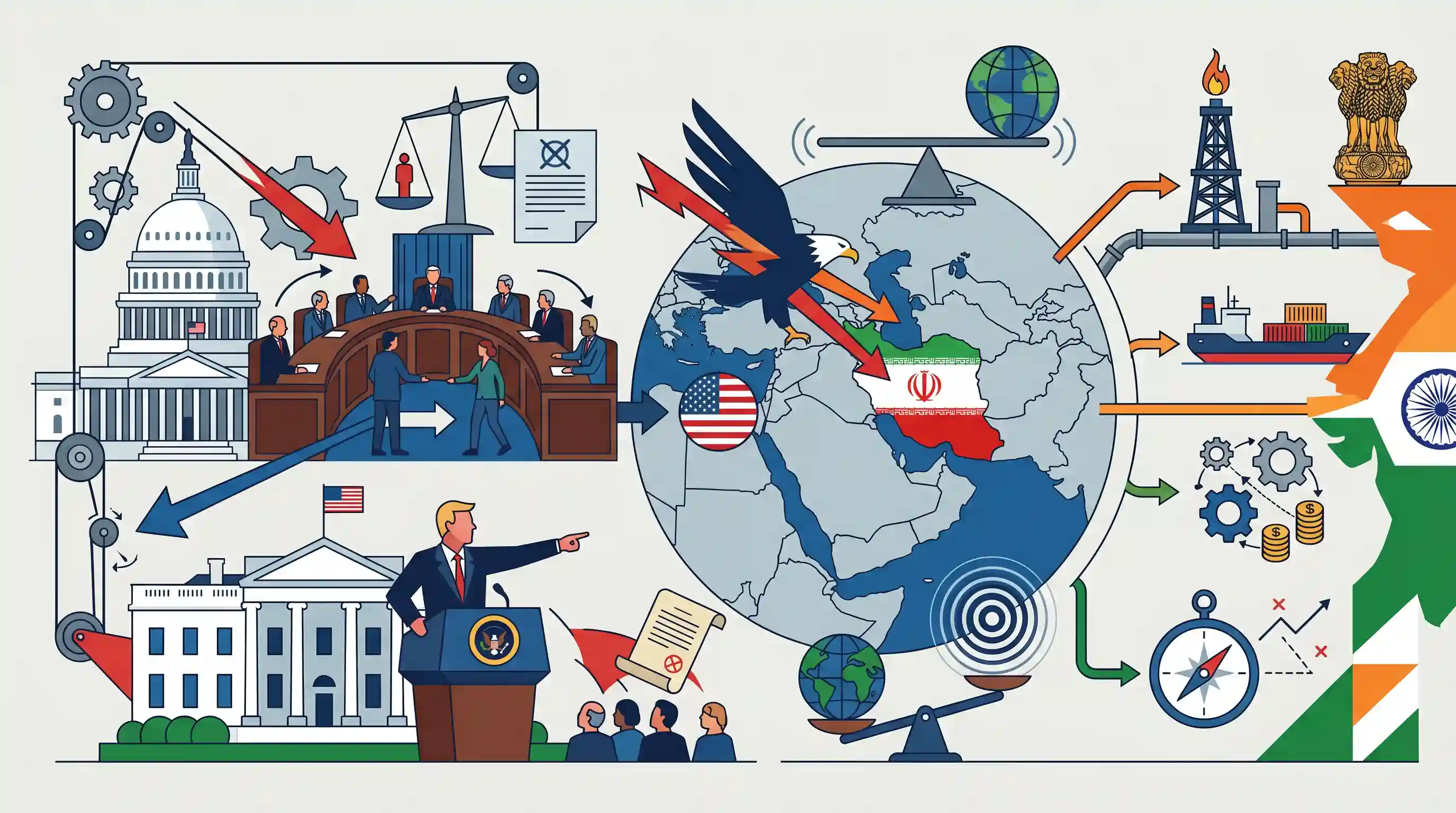
The US Senate narrowly rejected an Iran War Powers Resolution intended to restrict the President's authority to initiate military action against Iran without explicit Congressional approval. The resolution, invoking the 1973 War Powers Act, failed after key Republican senators reversed their stance following administration briefings. The executive branch argued that such legislative constraints would weaken US negotiating leverage and embolden Iran. This development underscores the inherent constitutional friction in the US political system regarding the separation of powers and war-making authority, while also signaling continued US strategic assertiveness that impacts the geopolitical stability of the Middle East.
Key Points
- The US Senate blocked a War Powers Resolution (49-51 vote) that would have required the President to withdraw US forces from hostilities against Iran without explicit Congressional approval.
- The resolution failed after two Republican senators reversed their initial support following a closed-door briefing by the Vice President and the Special Envoy to the Middle East.
- The administration argued the resolution would undermine US negotiating leverage and strategic ambiguity by signaling weakness to Iran.
- The debate reflects the ongoing constitutional tension in the US regarding the separation of powers between the executive branch (Commander-in-Chief) and the legislative branch (power to declare war).
Important Terms
1973 War Powers Act

A 1973 US federal law intended to check the President's power to commit the military to armed conflict without Congressional consent. It requires notification within 48 hours and a 60-day withdrawal deadline.
UPSC context
GS Paper 2: Comparative Constitution. Tests understanding of legislative-executive checks in the US vs. the Indian parliamentary system.
Iran War Powers Resolution
A specific legislative measure invoking the 1973 Act to prohibit the US President from using military force against Iran unless authorized by a formal declaration of war.
UPSC context
GS Paper 2: International Relations. Relevant for understanding US foreign policy shifts and their regional stability impacts in West Asia.
US Senate
The upper chamber of the US Congress. Unlike the Rajya Sabha, it possesses significant powers in foreign policy, including the "advice and consent" for treaties and senior appointments.
UPSC context
GS Paper 2: Comparative Constitution. Highlights the stronger role of the upper house in a presidential system compared to India.
Separation of Powers
A constitutional doctrine dividing government into executive, legislative, and judicial branches. The US follows a 'rigid' separation, while India follows a 'flexible' fusion of executive and legislature.
UPSC context
GS Paper 2: Indian Constitution and its comparison. A core concept frequently tested in both Prelims and Mains.
US Congress
The bicameral legislature of the US federal government. While it holds the constitutional 'power of the purse' and the power to declare war, it often clashes with the executive over military interventions.
UPSC context
GS Paper 2: Comparative Constitution. Focuses on the role of the legislature in oversight and war-making authority.
Energy Security
The stability and availability of energy sources at an affordable price. US-Iran tensions threaten India's energy security by potentially disrupting the Strait of Hormuz, a critical oil transit point.
UPSC context
GS Paper 2 & 3: IR and Security. Tests the impact of global politics on India's strategic and economic interests.
Prelims Trap
"The Indian Constitution explicitly grants the Parliament the exclusive power to declare war."
Unlike the US Constitution, India's Constitution doesn't explicitly grant Parliament the power to declare war. The President holds supreme command (Article 53) but acts strictly on Cabinet advice.
Static Concepts Connected
How does war-making authority differ between the US and India?
- US rigid separation: Article I explicitly gives Congress the power to declare war, while Article II designates the President as Commander-in-Chief.
- Indian parliamentary model: Article 53 vests supreme military command in the President, but this is exercised strictly on the aid and advice of the Council of Ministers (Article 74).
- Indirect legislative control: The Indian Parliament controls war indirectly through the ratification of a National Emergency under Article 352 (External Aggression) and defense budget approvals.
Why is US-Iran military friction critical to India's geopolitical interests?
- Strait of Hormuz: Conflict risks blocking the Strait of Hormuz, a critical geopolitical chokepoint that handles approximately 20% of global oil trade, threatening India's energy security.
- Chabahar & INSTC: US sanctions or regional conflict threaten Indian investments in Chabahar Port and the operationalization of the International North-South Transport Corridor (INSTC).
- Diaspora security: Military escalation endangers millions of Indian expatriates living in the Middle East, threatening a major source of inward remittances.
Cross-Topic Patterns
Middle East conflicts & macroeconomic stability
US-Iran tensions routinely spike crude prices, linking directly to India's imported inflation, current account deficit pressures, and the urgency of expanding strategic petroleum reserves.
Rigid Separation vs. Parliamentary Accountability
The US relies on statutory checks (War Powers Act) due to strict separation of powers. India uses constitutional checks (Article 75, Article 352) reflecting a fused executive-legislature model.

Expect a GS2 Mains question comparing rigid separation of powers in the US (war-making authority) vs. India's parliamentary model.
Linked PYQs · 2
Linked PYQs · 2
- 2018MainsGS2
India and USA are two large democracies. Examine the basic tenets on which the two political systems are based.
- 2025MainsGS2
"Energy security constitutes the dominant kingpin of India's foreign policy, and is linked with India's overarching influence in Middle Eastern countries.” How would you integrate energy security with India's foreign policy trajectories in the coming years?
