US Senate Bill Proposing Tariffs for Russian Oil Imports
Source:The Hindu ↗
কেন এটি গুরুত্বপূর্ণ
The proposed legislation illustrates the growing U.S. tendency to weaponize trade and secondary sanctions for geopolitical ends. It threatens India's macroeconomic stability by targeting its crucial supply of affordable Russian crude oil, thereby testing India's strategic autonomy and highlighting friction points in the India-US strategic partnership.
সারসংক্ষেপ
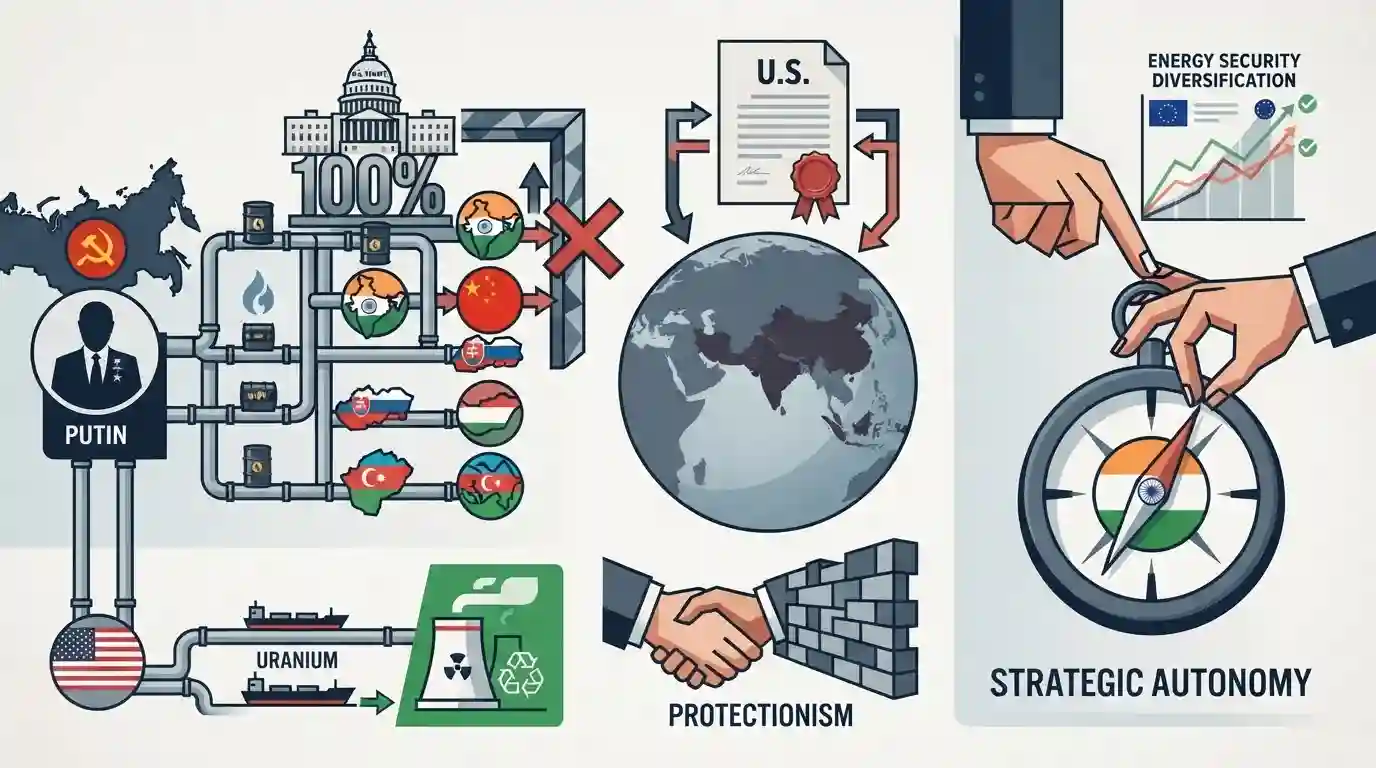
A bipartisan U.S. Senate bill, the 'Lindsey O. Graham Sanctioning Russia Act of 2026,' proposes imposing 100% tariffs on five countries—India, China, Slovakia, Hungary, and Azerbaijan—for continuing to purchase Russian oil and natural gas. The legislation aims to throttle Vladimir Putin's revenue for the ongoing war in Ukraine. Notably, the bill exempts European nations actively reducing their reliance on Russian gas and allows the U.S. to continue purchasing Russian uranium for nuclear reactors. If enacted, it would be the first time Congress authorizes tariffs explicitly as a geopolitical weapon, signaling a broader U.S. shift toward using protectionist trade measures (such as recent forced-labor tariffs) to enforce its global strategic objectives, directly challenging India's strategic autonomy and energy security.
মূল বিষয়
- A U.S. Senate bill proposes 100% tariffs on five nations, including India and China, for purchasing Russian crude oil and natural gas, aiming to cut off revenue for the Ukraine war.
- The bill exempts European nations that are actively reducing their reliance on Russian gas, as well as U.S. imports of Russian uranium and bilateral space/nuclear cooperation.
- If enacted, the bill would mark the first time the U.S. Congress explicitly authorizes the use of tariffs as a geopolitical weapon to punish countries indirectly financing a foreign war.
- The move follows a recent U.S. proposal for a 12.5% tariff on goods from 54 countries (including India) over alleged forced labor, indicating a rising trend of leveraging trade barriers for strategic goals.
- The proposed legislation increases diplomatic pressure on New Delhi, testing India's strategic autonomy and highlighting the friction between U.S. geopolitical objectives and India's energy security needs.
গুরুত্বপূর্ণ শব্দ
Lindsey O. Graham Sanctioning Russia Act of 2026

A bipartisan U.S. legislative proposal to impose up to 100% tariffs on the top five importers of Russian energy—including India and China—to disrupt Russia's war financing.
UPSC context
Vital for GS Paper 2 (International Relations). Highlights US attempts to weaponize trade and coerce India's independent foreign policy and energy security decisions.
U.S. Congress
The bicameral legislature of the United States, composed of the Senate and House of Representatives. It holds constitutional authority to enact economic sanctions, tariffs, and foreign policy directives.
UPSC context
GS Paper 2 (Comparative Constitutions). Illustrates how legislative bodies in global superpowers can unilaterally impact the economic stability of developing nations like India.
U.S. Senate
The upper chamber of the U.S. Congress. It wields significant influence over American foreign policy, including the power to confirm international appointments and pass sweeping international sanctions.
UPSC context
GS Paper 2 (Bilateral Relations). Shows how bipartisan Senate actions, such as the 2026 Russia sanctions bill, can directly pressure India's strategic autonomy.
প্রিলিমস ফাঁদ
Secondary sanctions and geopolitical trade tariffs apply uniformly to all third-party countries trading with a sanctioned nation.
The proposed US legislation exempts European nations based on import thresholds and carve-outs like uranium, demonstrating that secondary sanctions are highly selective rather than uniform rules.
সংযুক্ত স্থির ধারণা
What is the difference between Primary and Secondary Sanctions?
- Primary sanctions: Directly restrict citizens and domestic companies of the sanctioning nation from trading with the targeted country.
- Secondary sanctions: Target third-party foreign entities or countries doing business with the target nation, forcing them to choose between markets.
- Enforcement tools: Typically utilize financial system bans, asset freezes, or—as newly proposed—punitive import tariffs on third-party goods.
What is Section 301 of the US Trade Act of 1974?
- USTR authority: Empowers the US Trade Representative to investigate and respond to foreign trade practices deemed unfair or discriminatory.
- Unilateral remedies: Allows the US to impose duties or import restrictions unilaterally without requiring prior WTO dispute settlement approval.
- Evolving scope: Originally used for intellectual property rights, now increasingly leveraged to enforce labor and environmental standards.
আন্তঃবিষয় প্যাটার্ন
Secondary sanctions vs. Strategic Autonomy
India balances its energy security needs (discounted Russian crude) against vital export revenues from the US, testing the structural limits of strategic autonomy.
Geopolitical tariffs and WTO legality
Using tariffs as secondary sanctions bypasses WTO consensus-based dispute mechanisms, signaling a shift from economic protectionism to the outright weaponization of trade.

Unilateral tariffs used as secondary sanctions will likely feature as a core GS-2/GS-3 question on strategic autonomy and WTO challenges.
সংযুক্ত PYQ · 4
সংযুক্ত PYQ · 4
- 2019MainsGS2
‘What introduces friction into the ties between India and the United States is that Washington is still unable to find for India a position in its global strategy, which would satisfy India's national self-esteem and ambitions.’ Explain with suitable examples.
- 2025MainsGS2
"Energy security constitutes the dominant kingpin of India's foreign policy, and is linked with India's overarching influence in Middle Eastern countries.” How would you integrate energy security with India's foreign policy trajectories in the coming years?
- 2025MainsGS3
What are the challenges before the Indian economy when the world is moving away from free trade and multilateralism to protectionism and bilateralism? How can these challenges be met?
- 2018MainsGS3
How would the recent phenomena of protectionism and currency manipulations in world trade affect macroeconomic stability of India?
