Ukraine US Security Pact Finalized Awaiting Congressional Ratification
Source:Indian Express ↗
Why It Matters
The article provides a crucial update on the ongoing diplomatic efforts to end the Russia-Ukraine war, highlighting potential peace frameworks, the evolving US stance under incoming administrations, and the overarching themes of global security agreements and territorial sovereignty.
Summary
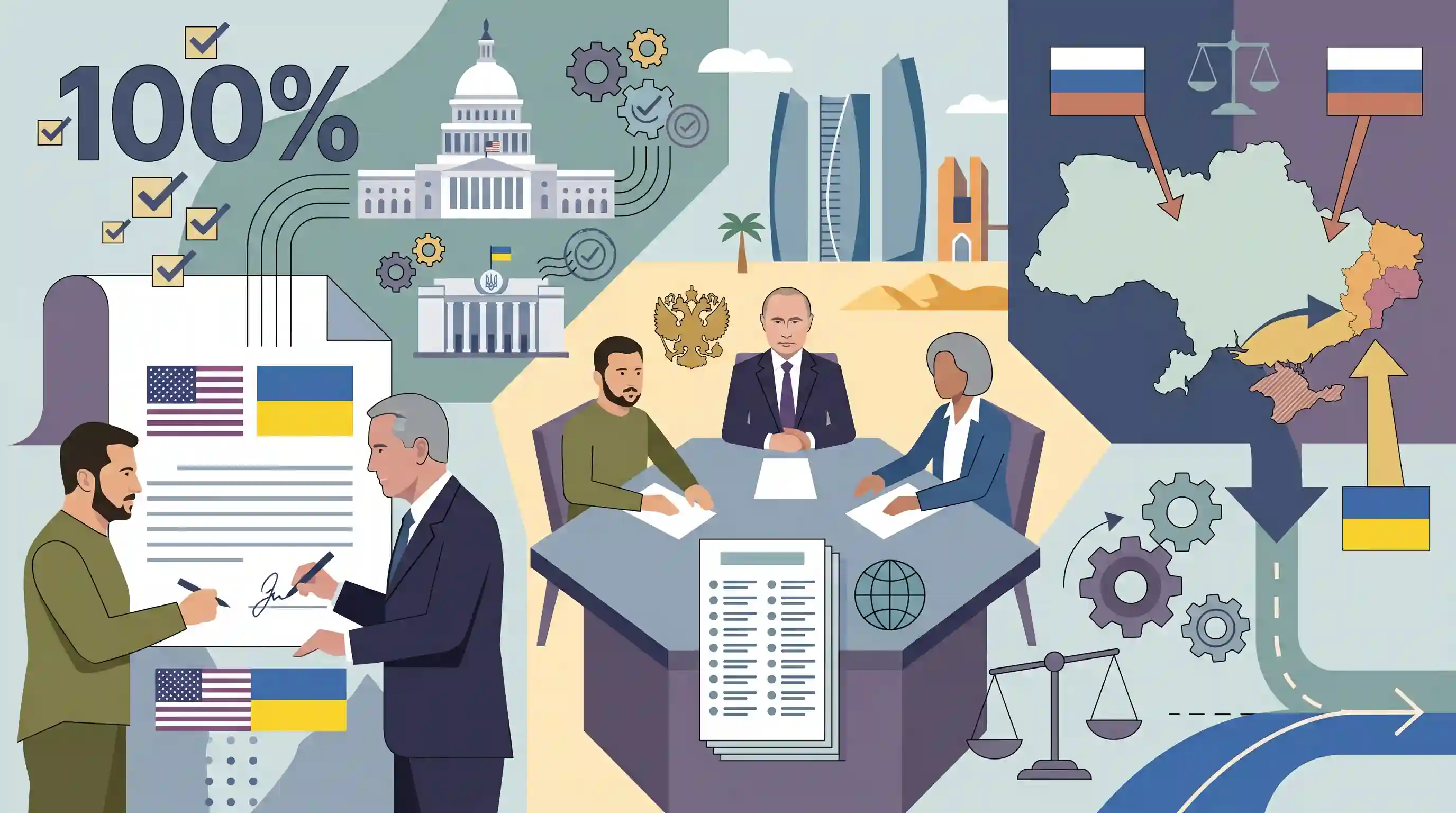
Ukrainian President Volodymyr Zelenskyy has announced that a comprehensive US security agreement for Ukraine is "100% ready" and awaiting signatures, after which it will be sent to the US Congress and the Ukrainian parliament for ratification. Concurrently, a critical trilateral meeting between Russia, Ukraine, and the US is scheduled in Abu Dhabi to negotiate President-elect Donald Trump's 20-point framework aimed at ending the Russia-Ukraine conflict. While Russia demands the concession of eastern Ukrainian territories, Ukraine continues to assert its territorial integrity, underscoring the complex diplomatic compromises required to achieve a durable peace and reshape global geopolitics.
Key Points
- Ukrainian President Volodymyr Zelenskyy confirmed that the US security agreement for Ukraine is completely finalized and awaits signatures.
- The security pact will require ratification by both the US Congress and the Ukrainian parliament to become operational.
- A trilateral summit involving the US, Russia, and Ukraine will take place in Abu Dhabi to discuss Donald Trump's 20-point framework to end the conflict.
- Negotiations face significant hurdles, with Russia demanding territorial concessions in eastern Ukraine while Kyiv insists on preserving its territorial integrity.
Important Terms
Bilateral Security Agreement (Ukraine-US)

A 10-year pact (initially signed 2024) formalizing long-term US military aid, intelligence sharing, and defense cooperation with Ukraine. It serves as a 'bridge to NATO' without providing collective defense (Article 5) guarantees.
UPSC context
GS II: Bilateral agreements. Tests understanding of 'Security Guarantees' vs. 'Military Alliances' and their impact on regional stability.
Trump’s 20-Point Framework
A peace proposal aimed at ending the Russia-Ukraine war, involving compromises on NATO membership, caps on military size, and potential territorial 'freezes' or concessions in exchange for security guarantees.
UPSC context
GS II: Global Geopolitics. Tests ability to analyze diplomatic trade-offs and the role of third-party mediation in resolving major conflicts.
Territorial Integrity
The principle under international law (UN Charter Article 2) that prohibits states from using force against the borders of another. It is the core of Ukraine’s refusal to cede occupied land.
UPSC context
GS II: International Law. A fundamental concept for questions on sovereignty, border disputes, and the UN's role in conflict resolution.
Trilateral Diplomacy
A diplomatic format involving three parties (e.g., US, Russia, and Ukraine in Abu Dhabi) to negotiate a settlement, often used when direct bilateral talks have stalled or require a powerful mediator.
UPSC context
GS II: Diplomacy. Tests knowledge of various negotiation formats (Bilateral, Trilateral, Multilateral) in the context of global peace-building.
Ratification
The formal process by which a nation’s legislature (e.g., US Congress or Verkhovna Rada) approves a treaty or agreement, making it legally binding under domestic and international law.
UPSC context
GS II: Indian Constitution/Polity. Relevant for comparing the executive’s power to sign treaties versus the legislature’s power to approve them (Article 253).
Prelims Trap
International treaties in India require prior parliamentary approval for ratification, similar to the US Congress.
In India, treaty-making is an executive power (Article 73). Parliament's role (Article 253) is strictly limited to implementing legislation, unlike the US where Senate ratification is mandatory.
Static Concepts Connected
How do treaty-making powers differ between India and the United States?
- India (Executive): Treaty-making and ratification are executive actions under Article 73. Prior parliamentary approval is not required to enter into a treaty.
- India (Legislative): Under Article 253, Parliament has exclusive power to enact laws to implement international treaties, giving it control over domestic enforcement but not the initial signing.
- United States: The President negotiates treaties, but they require a two-thirds supermajority vote in the Senate for formal ratification before becoming binding.
What is the geographical and economic significance of the Donbas region?
- Location: Located in eastern Ukraine, it primarily comprises the Donetsk and Luhansk oblasts, sharing a direct and highly contested border with Russia.
- Economic base: Historically an industrial powerhouse, it is known for massive coal mining reserves, heavy metallurgy, and manufacturing infrastructure.
- Conflict zone: It has been a heavily fortified separatist conflict zone since 2014, forming the core geographic flashpoint for Russian territorial demands.
Cross-Topic Patterns
Gulf diplomacy replacing traditional mediators
The UAE hosting Russia-Ukraine-US talks highlights the Middle East's shift from being mere energy suppliers to active global diplomatic powerbrokers, filling the void left by paralyzed UN mechanisms.
Minilaterals bypassing the UN system
Trilateral peace frameworks reflect a growing trend where rigid UN Security Council deadlocks force critical global security negotiations into ad-hoc, state-mediated minilateral summits.

Expect a GS2 Mains question comparing UAE/Gulf mediation in global conflicts vs traditional Western/UN-led peacebuilding frameworks.
Linked PYQs · 3
Linked PYQs · 3
- 2023PrelimsGS1
Consider the following pairs: Area of conflict mentioned in news Country where it is located 1. Donbas : Syria 2. Kachin : Ethiopia 3. Tigray : North Yemen How many of the above pairs are correctly matched?
- 2023PrelimsGS1
Consider the following pairs: Regions often mentioned in news Reason for being in news 1. North Kivu and Ituri : War between Armenia and Azerbaijan 2. Nagorno-Karabakh : Insurgency in Mozambique 3. Kherson and Zaporizhzhia : Dispute between Israel and Lebanon How many of the above pairs are correctly matched?
- 2025MainsGS2
"With the waning of globalization, post-Cold War world is becoming a site of sovereign nationalism.” Elucidate.
