United States Section 301 Tariffs and Bilateral Trade
Source:Indian Express ↗
Why It Matters
Understanding US trade policies like Section 301 is essential for grasping the challenges India faces in its export sector and bilateral negotiations, reflecting a significant syllabus theme on the effects of liberalization and changes in global trade policies.
Summary
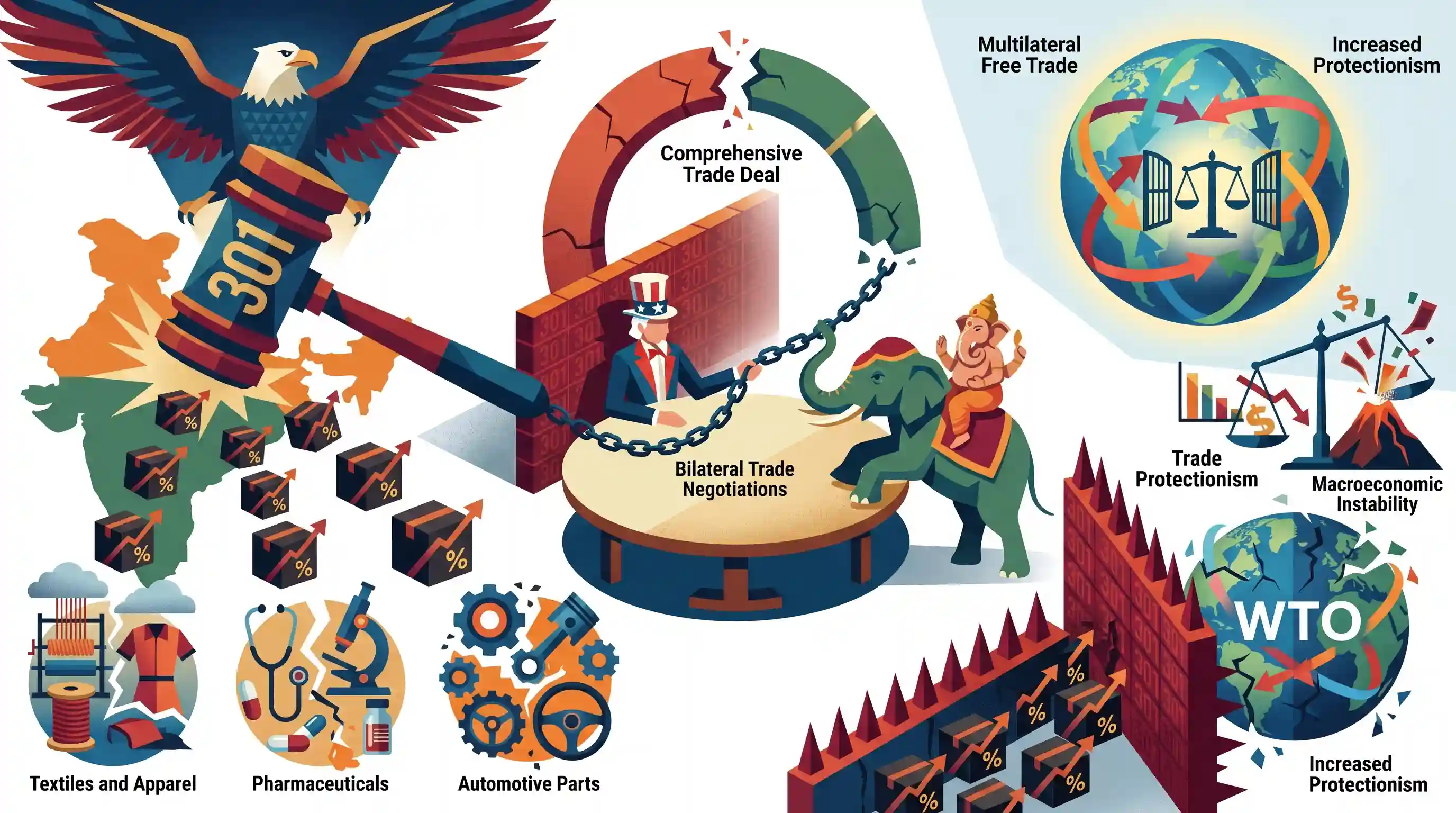
The article explains the implications of the US invoking Section 301 of the Trade Act of 1974 to impose unilateral tariffs on Indian exports. It analyzes how these protectionist measures are utilized as leverage by the US in bilateral trade negotiations, potentially complicating or derailing a comprehensive India-US trade deal. The potential tariffs pose a risk to key Indian export sectors and underscore a broader global shift away from multilateral free trade under the WTO towards increased protectionism.
Key Points
- Section 301 of the US Trade Act of 1974 empowers the US to unilaterally impose tariffs and retaliatory measures on countries it accuses of engaging in unfair or discriminatory trade practices.
- The threat or application of such tariffs on India is often used by the US as leverage to extract concessions in ongoing bilateral trade negotiations, hindering the finalization of a comprehensive trade deal.
- Elevated US tariffs would negatively impact key Indian export sectors, potentially affecting overall macroeconomic stability and export growth.
- The increasing reliance on unilateral tariff measures reflects a broader global shift away from WTO-led multilateral free trade toward bilateralism and protectionism.
Important Terms
Section 301 of the US Trade Act of 1974

A domestic law authorizing the US President to investigate and unilaterally retaliate against foreign trade practices deemed unfair, unreasonable, or discriminatory to US commerce without multilateral approval.
UPSC context
GS Paper 2 & 3: International Relations and Economy. Tests knowledge of unilateralism vs. multilateralism in global trade governance.
Office of the United States Trade Representative (USTR)
The US federal agency responsible for developing and coordinating international trade policy, conducting Section 301 investigations, and leading bilateral and multilateral trade negotiations.
UPSC context
GS Paper 2: International Relations. Relevant for understanding the institutional framework of India-US trade friction.
Most-Favoured-Nation (MFN) Principle
A core WTO principle (Article I of GATT) requiring members to treat all other members equally, ensuring that any trade concession granted to one is extended to all.
UPSC context
GS Paper 3: Indian Economy. Key concept in discussions on the erosion of global trade rules and multilateralism.
World Trade Organization (WTO)
An intergovernmental organization that regulates international trade. It provides a framework for negotiating trade agreements and a dispute settlement process for member nations.
UPSC context
GS Paper 2 & 3. Foundational for topics involving global trade architecture and its current crisis of relevance.
Structural Excess Capacity
A condition where a nation's production capability significantly exceeds domestic demand, leading to government-supported export surges that may harm industries in importing countries.
UPSC context
GS Paper 3: Indian Economy (Industrial Policy). Key allegation in the US 301 probe targeting India's solar and steel sectors.
Generalized System of Preferences (GSP)
A US trade program designed to promote economic growth in developing countries by providing duty-free entry for thousands of products; India's status was withdrawn in 2019.
UPSC context
GS Paper 2: International Relations. Essential historical context for current trade tensions and market access negotiations.
Prelims Trap
"Section 301 is a WTO-approved mechanism enabling countries to impose retaliatory tariffs against unfair trade practices."
Section 301 is a US domestic law utilized specifically to bypass the WTO dispute settlement mechanism, representing unilateralism rather than multilateral trade law.
Static Concepts Connected
What are the three WTO-compliant trade remedy measures?
- Anti-dumping duties: Imposed to offset the margin of dumping when a foreign country exports goods at a price below their normal domestic value.
- Countervailing duties: Tariffs levied to neutralize the negative effects of specific subsidies provided by the exporting country's government to its domestic producers.
- Safeguard measures: Temporary restrictions, such as tariffs or quotas, applied to restrict imports of a product that are surging unexpectedly and threatening domestic industry.
How does the Triffin Dilemma explain structural US trade deficits?
- Reserve Currency Paradox: The country supplying the global reserve currency must run persistent current account deficits to inject sufficient liquidity into the global economy.
- Triffin Dilemma: It highlights the fundamental conflict between a reserve-currency nation's short-term domestic monetary policy goals and its long-term international liquidity responsibilities.
Cross-Topic Patterns
Social clauses as Non-Tariff Barriers
Developed nations increasingly use environmental norms (like EU CBAM) and labor standards (ILO forced labor conventions) to erect sophisticated non-tariff barriers (NTBs) against exports from developing economies like India.
Triffin Dilemma + Rupee Internationalization
India's defense—that persistent US deficits are a byproduct of Dollar hegemony—links to the 'Triffin Dilemma' and contextualizes the RBI's push for Rupee internationalization to shield against unilateral trade shocks.

Expect a 2026 multi-statement question combining US Section 301 unilateralism, WTO dispute settlement paralysis, and ILO-linked NTBs.
Linked PYQs · 3
Linked PYQs · 3
- 2025MainsGS3
What are the challenges before the Indian economy when the world is moving away from free trade and multilateralism to protectionism and bilateralism? How can these challenges be met?
- 2018MainsGS3
How would the recent phenomena of protectionism and currency manipulations in world trade affect macroeconomic stability of India?
- 2012MainsGS2
Discuss the likely negative impact of the protectionist measures proposed by the US on India's software industry.
