India-US Bilateral Ties and Indo-Pacific Strategy Focus of Rubio Visit
Source:The Hindu ↗
Why It Matters
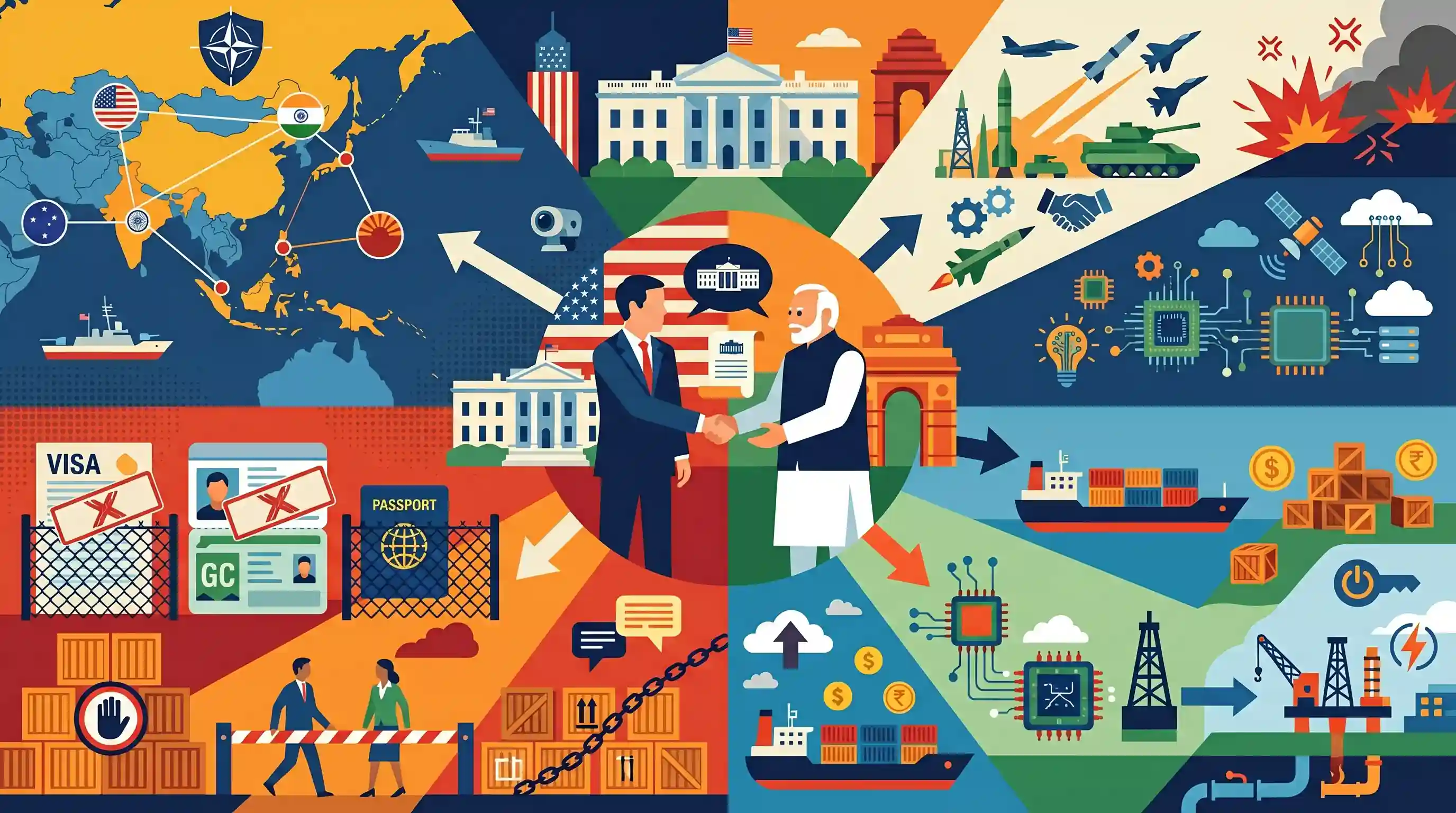
The diplomatic visit encapsulates the complex dynamics of the India-U.S. comprehensive global strategic partnership. It highlights both critical cooperative elements (Indo-Pacific strategy, Quad consolidation, energy trade) and significant friction points (H-1B visa restrictions, trade tariffs, diplomatic narratives), making it essential for answering GS Paper 2 questions on international relations, regional groupings, and the Indian diaspora.
Summary
U.S. Secretary of State Marco Rubio’s maiden official visit to India aims to reinvigorate the India-U.S. strategic partnership and the Quad alliance in the Indo-Pacific. Meeting with Prime Minister Narendra Modi, Rubio delivered an invitation from President Trump for a White House visit, while holding comprehensive dialogues on defense, technology, trade, and energy security. The diplomatic engagement underscores Washington's vision of India as central to its Indo-Pacific strategy and offers American energy exports to offset market disruptions caused by conflicts involving Iran. However, the visit also occurs against the backdrop of strained ties stemming from new restrictive U.S. immigration policies—specifically concerning H1-B visas and Green Card regulations that disadvantage Indian professionals—as well as ongoing friction over tariffs and geopolitical narratives.
Key Points
- U.S. Secretary of State Marco Rubio met PM Modi, extending an invitation from President Trump to visit the White House and emphasizing India's pivotal role in the U.S. Indo-Pacific policy.
- Rubio's visit includes bilateral talks with External Affairs Minister S. Jaishankar and participation in the Quad Foreign Ministers' Meeting to renew strategic engagement alongside Australia and Japan.
- Discussions covered defense, strategic technologies, trade, investment, and energy security, with the U.S. offering its energy products to help India diversify its supply amid tensions with Iran.
- Despite strategic convergence, structural friction remains over stringent new U.S. restrictions on H1-B visas and Green Card processing, alongside earlier disagreements on tariffs and American claims of mediating an India-Pakistan ceasefire.
Important Terms
Quad (Quadrilateral Security Dialogue)

An informal strategic forum comprising India, the United States, Japan, and Australia, focused on ensuring a free, open, and rules-based Indo-Pacific region through maritime and technological cooperation.
UPSC context
GS-II (International Relations); key grouping for regional security and balancing power dynamics in the Indo-Pacific.
H-1B Visa
A U.S. non-immigrant visa allowing domestic companies to temporarily employ foreign workers in 'specialty occupations' requiring technical expertise, a cornerstone of the Indian IT diaspora's mobility.
UPSC context
GS-II (Indian Diaspora); significant for services-led trade and the economic interests of Indian professionals abroad.
Permanent Resident Card (Green Card)
An official document granting a non-citizen permanent residency in the U.S.; recent policy changes requiring applicants to 'return home' to apply have become a significant bilateral friction point.
UPSC context
GS-II (Effect of policies of developed countries on India's interests); tests understanding of diaspora-related diplomatic challenges.
Indo-Pacific
A geostrategic construct linking the Indian and Pacific Oceans, viewed as the primary theatre for global power competition and a central pillar of India-U.S. maritime security cooperation.
UPSC context
GS-II (Bilateral/Global Groupings); foundational for maritime strategy and India's 'Act East' and 'SAGAR' initiatives.
Comprehensive Global Strategic Partnership
The highest-level bilateral relationship framework between India and the U.S., formalized in 2020 to cover defense, technology, trade, and energy security under long-term national interests.
UPSC context
GS-II (India and its neighborhood-relations); represents the institutionalized multi-sector cooperation between New Delhi and Washington.
Prelims Trap
The Quad is a formalized military alliance with a mutual defense pact.
The Quad (Quadrilateral Security Dialogue) is an informal strategic diplomatic partnership, not a military alliance like NATO. It has no formal charter or mutual defense treaty.
Static Concepts Connected
How do US H-1B visa policies relate to the WTO's GATS framework?
- GATS Mode 4: Issues concerning H-1B visas fall under Mode 4 of GATS, which governs the temporary movement of natural persons to supply services in another country.
- Non-Immigrant Nature: It is a non-immigrant visa allowing US employers to temporarily employ foreign workers in specialty occupations that require theoretical or technical expertise.
- Dual Intent: Unlike many temporary visas, H-1B is a 'dual intent' visa, meaning holders can legally seek permanent residency (Green Card) while on the visa.
What is India's strategy for energy diversification amid geopolitical sanctions?
- Import Dependence: India imports over 85% of its crude oil and ~45% of its natural gas (as LNG). Sanctions on Iran have forced India to find alternative suppliers.
- US Emergence: The US has emerged as a major exporter of crude oil and LNG to India, helping New Delhi diversify its energy basket away from Middle East volatility.
- Strategic Reserves: India is expanding its Strategic Petroleum Reserves (ISPRL) and has explored overseas storage partnerships with the US to ensure energy security during supply shocks.
Cross-Topic Patterns
Diaspora visas and Forex inflows
Restrictive US immigration policies directly threaten India's remittance economy (the highest globally) and dilute the soft-power leverage of the Indian diaspora in shaping US bilateral policy.
Sanctions and Energy Diversification
Western sanctions on major suppliers like Iran force India to pivot to US energy exports (LNG), increasing structural dependency on Washington while navigating strategic autonomy.

Expect a 2026 Mains question balancing US-India strategic convergence in the Indo-Pacific against structural economic & immigration frictions
Linked PYQs · 4
Linked PYQs · 4
- 2020MainsGS2
What is the significance of Indo-US defence deals over Indo-Russian defence deals? Discuss with reference to stability in the Indo-Pacific region.
- 2012MainsGS2
How have the US sanctions against Iran affected India's bilateral relations with Iran?
- 2020MainsGS2
Indian diaspora has a decisive role to play in the politics and economy of America and European Countries'. Comment with examples.
- 2023MainsGS2
Indian diaspora has scaled new heights in the West. Describe its economic and political benefits for India.
