Indo-US Bilateral Cooperation and Indo Pacific Strategy
Source:The Hindu ↗
Why It Matters
This development is central to understanding the current trajectory of Indo-US relations. It touches upon vital GS2 themes including the strategic significance of the Quad, geopolitical maneuvering in the Indo-Pacific, energy security diplomacy, and the impact of US domestic policies (tariffs, visas) on Indian interests.
Summary
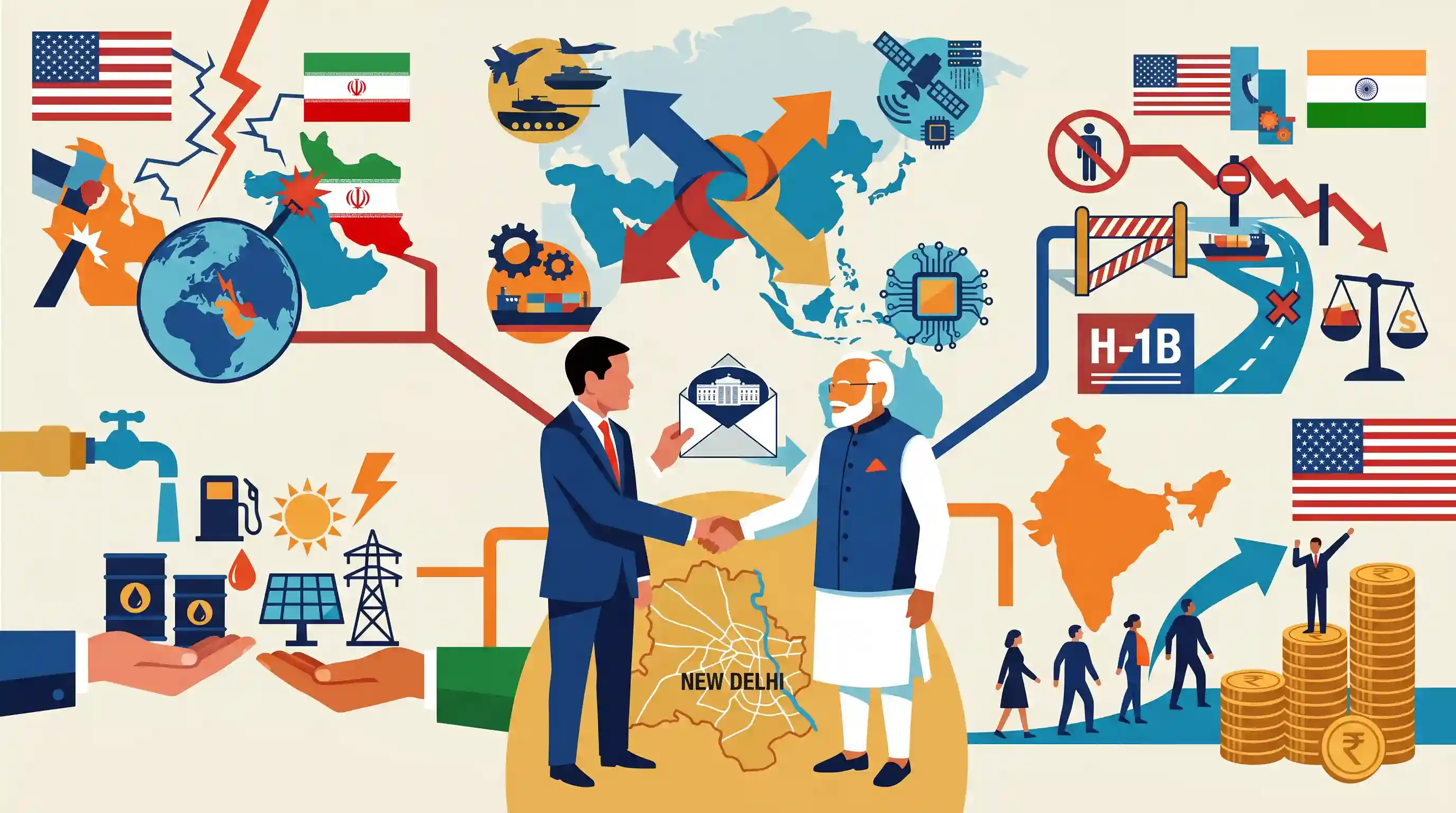
US Secretary of State Marco Rubio met with Prime Minister Narendra Modi in New Delhi, delivering an invitation to the White House from President Donald Trump. The leaders discussed advancing the Indo-Pacific strategy, strengthening the Quad partnership, and deepening bilateral cooperation in defence, trade, and strategic technologies. Addressing the geopolitical fallout of the US-Iran conflict, the US offered to help India diversify its energy imports. The meeting took place against a backdrop of complex bilateral issues, including restrictive US immigration policies (such as H-1B regulations), trade tariffs, and recent diplomatic frictions, even as Indian investments in the US reached $20.5 billion.
Key Points
- US Secretary of State Marco Rubio visited New Delhi and invited PM Modi to Washington on behalf of President Donald Trump.
- Discussions focused heavily on the Indo-Pacific strategy, maritime security, and strengthening the Quad partnership alongside Australia and Japan.
- The US proposed supplying energy products to help India diversify its energy sources and reduce dependence amidst the ongoing US-Iran conflict.
- Despite strong strategic ties, friction points remain regarding US tariffs, sanctions, H-1B visa restrictions, and recent US claims about mediating India-Pakistan relations.
- Indian companies have increasingly invested in the US, committing $20.5 billion at the 'Select USA' investment summit, highlighting deep economic interlinkages.
Important Terms
H-1B Visa Program

A U.S. non-immigrant visa allowing employers to hire foreign workers in 'specialty occupations' (e.g., IT, STEM) requiring a bachelor's degree or higher.
UPSC context
GS Paper-II: Effect of policies of developed countries on India’s interests and Indian diaspora (remittances and brain drain).
Quad (Quadrilateral Security Dialogue)
A diplomatic and security partnership between India, the U.S., Japan, and Australia focused on ensuring a free, open, and rules-based Indo-Pacific region.
UPSC context
GS Paper-II: Bilateral and global groupings involving India. Tests understanding of regional security and maritime cooperation.
Indo-Pacific Strategy
A geostrategic framework covering the Indian and Pacific Oceans, emphasizing maritime security, freedom of navigation, and a stable regional balance of power.
UPSC context
GS Paper-II: Regional interests and global groupings. Tests India's role as a 'net security provider' and its Act East policy.
iCET (Initiative on Critical and Emerging Technology)
A bilateral framework to deepen India-U.S. cooperation in sensitive sectors like AI, semiconductors, space, and defense technologies while addressing regulatory barriers.
UPSC context
GS Paper-II & III: Strategic partnerships and S&T. Tests knowledge of high-tech defense industrial cooperation and supply chain resilience.
Strategic Autonomy
India's foreign policy principle of making independent decisions based on national interest without becoming a formal ally of any specific superpower or bloc.
UPSC context
GS Paper-II: India's foreign policy. Crucial for understanding how India balances ties between the U.S. and Russia/Iran.
Energy Diversification
The strategic policy of expanding energy import sources (e.g., U.S., Russia) to reduce dependence on volatile regions and ensure national supply stability.
UPSC context
GS Paper-III: Energy security. Tests India's response to geopolitical conflicts and management of Strategic Petroleum Reserves.
Prelims Trap
"The Quad is a formal military alliance with a mutual defense treaty among the US, India, Japan, and Australia."
The Quad is an informal strategic forum, not a treaty-based military alliance like NATO, despite its heavy focus on Indo-Pacific maritime security.
Static Concepts Connected
What is CAATSA and how does it affect India?
- Core Objective: A US federal law designed to penalize countries engaging in significant transactions with the defense or intelligence sectors of Russia, Iran, and North Korea.
- Strategic Friction: It threatens secondary sanctions on India for strategic purchases like the Russian S-400 missile system, complicating India's strategic autonomy and defense procurement.
How do H-1B visas relate to the WTO's GATS framework?
- Mode 4 Definition: Under the WTO's General Agreement on Trade in Services (GATS), Mode 4 covers the temporary movement of natural persons across borders to provide services.
- Non-Tariff Barrier: India frequently argues that restrictive US H-1B visa policies act as non-tariff barriers, hindering its IT sector's global service delivery and violating free trade principles.
Cross-Topic Patterns
Energy Security + Strait of Hormuz chokepoint
US-Iran tensions threaten Gulf oil supplies via the Strait of Hormuz, accelerating India's pivot to US shale gas and strategic petroleum reserves to ensure energy security.
Reverse FDI flows + Economic Diplomacy
Indian firms committing $20.5B at SelectUSA marks a shift from traditional inbound FDI to outbound capital, highlighting the economic heft of Indian MNCs and the diaspora.

Expect a 2026 multi-statement Prelims question pairing Quad maritime initiatives (IPMDA) with US-India tech (iCET) and CAATSA waivers.
Linked PYQs · 3
Linked PYQs · 3
- 2020MainsGS2
Quadrilateral Security Dialogue (Quad)' is transforming itself into a trade bloc from a military alliance, in present times - Discuss.
- 2020MainsGS2
What is the significance of Indo-US defence deals over Indo-Russian defence deals? Discuss with reference to stability in the Indo-Pacific region.
- 2021MainsGS2
The newly tri-nation partnership AUKUS is aimed at countering China's ambitions in the Indo-Pacific region. Is it going to supersede the existing partnerships in the region? Discuss the strength and impact of AUKUS in the present scenario.
