Strait of Hormuz Blockade and US Evaluation of Iran Proposal
Source:The Hindu ↗
Why It Matters
The Strait of Hormuz is a vital maritime choke point; any disruption heavily impacts global energy flows and prices. For India, which relies heavily on West Asian oil, stability in the Strait is a core energy security and foreign policy priority. The issue also touches upon international legal frameworks governing transit passage through global straits.
Summary
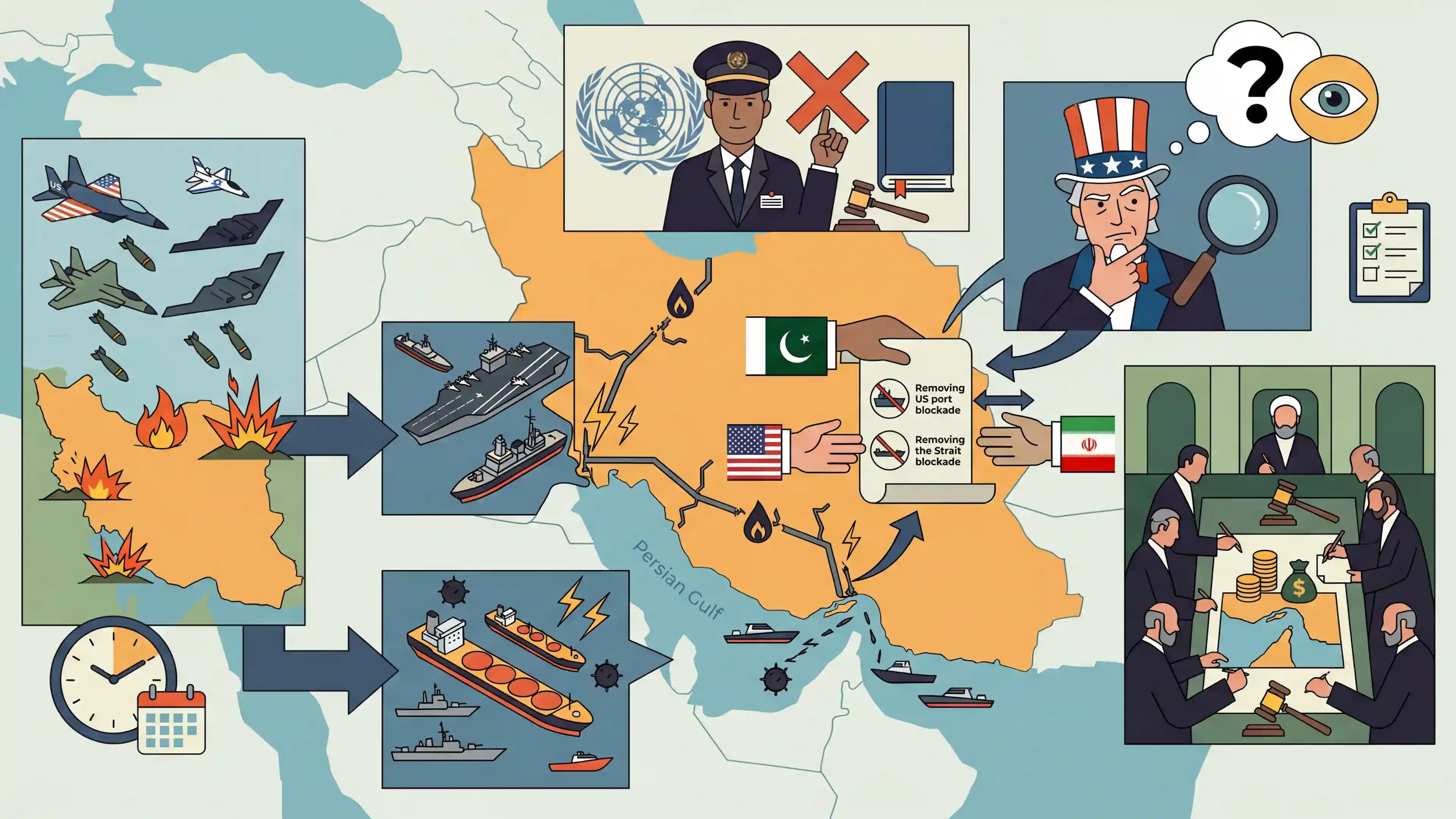
The United States is evaluating a proposal from Iran, mediated by Pakistan, to lift its two-month blockade of the Strait of Hormuz in exchange for the US ending its blockade on Iranian ports. The crisis began following a US-Israeli military offensive against Iran. While US officials see the proposal as a starting point, they remain skeptical of Iran's intentions. Concurrently, the Iranian parliament is drafting legislation to charge transit fees for ships passing through the Strait, a move the UN's maritime agency head stated lacks legal basis under international maritime law. The developments highlight the ongoing volatility in West Asia and the strategic vulnerability of global energy supply routes.
Key Points
- Iran has proposed a mutual lifting of blockades—unblocking the Strait of Hormuz if the US lifts its retaliatory blockade on Iranian ports—with Pakistan acting as mediator.
- The Strait of Hormuz blockade by Iran, a critical choke point for global oil and gas, was initiated in response to a US-Israeli offensive.
- The US administration is evaluating the proposal, though Secretary of State Marco Rubio questioned the genuineness of the Iranian offer.
- Iran's parliament is considering a law to grant its armed forces oversight of the Strait and to impose transit fees payable in Iranian rials.
- The UN maritime agency chief stated there is no legal basis for Iran to charge transit fees on an international waterway.
Important Terms
Strait of Hormuz

A critical maritime chokepoint between the Persian Gulf and Gulf of Oman, carrying approximately 20% of global oil supply. It is a strategic bottleneck where Iranian and Omani territorial waters overlap.
UPSC context
GS Paper 1 (Geography) and Paper 2 (International Relations). Tests knowledge of maritime chokepoints and energy security vulnerabilities.
UNCLOS
An international treaty (1982) establishing a legal framework for all marine and maritime activities, defining territorial waters, Exclusive Economic Zones (EEZ), and rights of passage.
UPSC context
GS Paper 2 (International Relations/Laws). Crucial for understanding maritime disputes and freedom of navigation.
Transit Passage
A UNCLOS regime allowing ships and aircraft continuous and expeditious navigation through international straits. Unlike 'innocent passage,' it cannot be suspended by littoral states during peacetime or conflict.
UPSC context
GS Paper 2 (International Law). Differentiates navigation rights in strategic straits vs. general territorial waters.
International Maritime Organization (IMO)
A specialized UN agency responsible for the safety and security of shipping and the prevention of marine pollution. It sets global standards for maritime regulations.
UPSC context
GS Paper 2 (International Bodies). Tests knowledge of global governance in the maritime sector.
Energy Security
The uninterrupted availability of energy sources at an affordable price. For India, this includes diversifying imports and securing maritime routes like Hormuz for oil and LNG.
UPSC context
GS Paper 3 (Economy/Environment). Central to discussions on India's strategic autonomy and economic growth.
West Asia Geopolitics
The study of the effects of geography on international politics and relations in West Asia, a region vital for India due to energy, trade, and its large diaspora.
UPSC context
GS Paper 2 (International Relations). Tests understanding of regional power dynamics (Iran-Saudi-US) and India's 'Look West' policy.
Prelims Trap
Under UNCLOS, Iran holds the sovereign right to levy transit fees on commercial vessels passing through the Strait of Hormuz.
UNCLOS guarantees 'transit passage' through international straits. Coastal states are strictly prohibited from hampering this passage or levying tolls solely for navigation.
Static Concepts Connected
What constitutes the geographic and strategic profile of the Strait of Hormuz?
- Connecting waters: It links the Persian Gulf to the Gulf of Oman and the broader Arabian Sea.
- Bordering nations: Bounded by Iran to the north and Oman (Musandam Peninsula) and the UAE to the south.
- Global significance: Acts as a critical chokepoint, facilitating the transit of roughly 20% of the world's seaborne crude oil.
How does 'Transit Passage' differ from 'Innocent Passage' under UNCLOS?
- Transit Passage: Applies to international straits. Cannot be suspended by coastal states; allows submarines to travel submerged.
- Innocent Passage: Applies to territorial seas. Can be temporarily suspended for security; requires submarines to navigate on the surface.
- Levying fees: Under both regimes, coastal states cannot charge tolls or fees merely for a vessel passing through the waters.
Cross-Topic Patterns
Chokepoints & Strategic Petroleum Reserves
A Hormuz blockade severely threatens India's crude imports, directly linking West Asian maritime volatility to the urgency of expanding India's Phase-II Strategic Petroleum Reserves (SPR).
Chabahar Port under Sanctions Shadow
Renewed US-Iran hostility and port blockades test India's geopolitical tightrope regarding the INSTC and the sustainability of US sanction waivers for the Chabahar Port.

Expect a 2026 multi-statement question linking maritime chokepoints (Hormuz, Bab-el-Mandeb) to bordering nations and UNCLOS passage rights.
Linked PYQs · 4
Linked PYQs · 4
- 2018MainsGS2
In what ways would the ongoing US-Iran Nuclear Pact Controversy affect the national interest of India? How should India respond to this situation?
- 2012MainsGS2
How have the US sanctions against Iran affected India's bilateral relations with Iran?
- 2017MainsGS2
The question of India's Energy Security constitutes the most important part of India's economic progress. Analyze India's energy policy cooperation with West Asian countries.
- 2025MainsGS2
"Energy security constitutes the dominant kingpin of India's foreign policy, and is linked with India's overarching influence in Middle Eastern countries.” How would you integrate energy security with India's foreign policy trajectories in the coming years?
