US China Deal to Expedite Rare Earth Exports
Source:Indian Express ↗
Why It Matters
China's dominance in the processing and export of rare earth elements makes it a critical node in global supply chains for green tech and defense. The use of export curbs as retaliation in trade wars demonstrates the weaponization of trade and resource monopolies, which is highly relevant to UPSC GS2 (International Relations) and GS3 (Economy and Supply Chains).
Summary
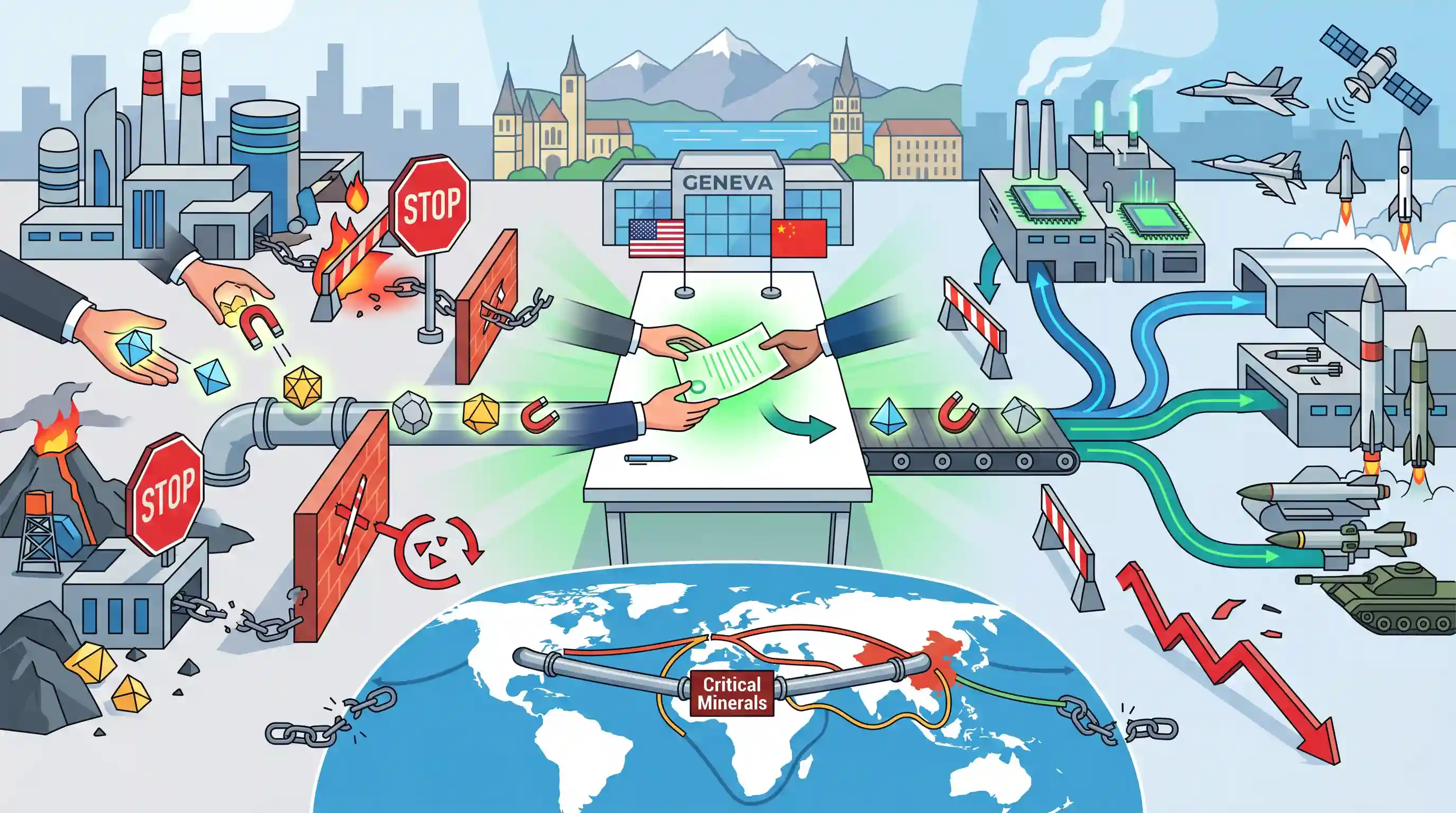
The United States announced a trade consensus reached in Geneva with China, under which Beijing will expedite the export of rare earth elements and magnets to the US. China had previously restricted these critical mineral exports as a retaliatory measure in the ongoing US-China trade war, causing disruptions in global supply chains for advanced technologies, including semiconductors, aerospace, and military hardware. In response to the deal, the US indicated it would take down some of its trade countermeasures, signaling a temporary de-escalation of economic hostilities while highlighting the strategic vulnerability of depending on a single nation for critical minerals.
Key Points
- The United States and China have reached an agreement in Geneva to expedite the export of Chinese rare earth minerals and magnets to the US.
- China had previously restricted these critical exports in retaliation against US tariffs, escalating the ongoing trade war between the two nations.
- Rare earths are crucial for global supply chains, powering high-tech industries like semiconductors, aerospace, electric vehicles, and military equipment.
- The US plans to lift some of its trade countermeasures as a reciprocal step toward implementing the bilateral consensus.
Important Terms
Rare Earth Elements (REEs)

A group of 17 metallic elements (15 lanthanides plus scandium and yttrium) essential for high-tech applications like permanent magnets, electric vehicle motors, and defense systems due to their unique magnetic and luminescent properties.
UPSC context
GS Paper 1 (Resources) and GS Paper 3 (Science & Technology/Economy); tests knowledge of strategic resource distribution and import dependency.
Critical Minerals
Elements essential for economic development and national security whose supply is at risk of disruption. India identifies 30 such minerals, including lithium and cobalt, vital for the green energy transition.
UPSC context
GS Paper 3 (Economy); relevant to India's Critical Minerals Mission and self-reliance (Atmanirbhar Bharat) in high-tech manufacturing.
Economic Statecraft
The use of economic instruments—such as trade policy, sanctions, and investment—as tools of foreign policy to achieve strategic geopolitical objectives and influence the behavior of other states.
UPSC context
GS Paper 2 (International Relations); explores the weaponization of trade and geoeconomic competition between major powers.
Geneva Trade Talks Consensus
A 2026 trade understanding between the US and China aiming to de-escalate tensions by expediting Chinese rare earth exports in exchange for the removal of certain US export restrictions.
UPSC context
GS Paper 2 (International Relations); tests understanding of bilateral trade diplomacy and its impact on global supply chain stability.
Supply Chain Resilience
The adaptive capacity of a supply chain to anticipate, resist, and recover from disruptions caused by geopolitical conflicts, pandemics, or natural disasters through diversification and strategic stockpiling.
UPSC context
GS Paper 3 (Economy/Internal Security); relevant to the Supply Chain Resilience Initiative (SCRI) and reducing single-source dependencies.
Permanent Magnets
Powerful magnets, often made from neodymium or samarium-cobalt, that retain their magnetism without an external power source; they are critical components in wind turbines, EVs, and precision-guided missiles.
UPSC context
GS Paper 3 (Science & Technology); focuses on the industrial applications of rare earths in strategic and green technologies.
Prelims Trap
Rare earth elements are highly scarce in the Earth's crust and India completely lacks domestic REE reserves.
REEs are relatively abundant globally. Furthermore, India holds the world's 5th largest REE reserves (primarily monazite sand), but relies heavily on China due to a lack of domestic processing capacity.
Static Concepts Connected
What are Rare Earth Elements (REEs) and where are they found in India?
- 17 Minerals: Comprises 15 lanthanides plus scandium and yttrium. They are indispensable for semiconductors, EV batteries, and aerospace components.
- Abundant not rare: Despite the name, most REEs are abundant globally. The 'rare' refers to the extreme difficulty of finding economically viable, concentrated deposits.
- Monazite sands: In India, REEs are primarily found in Monazite, a radioactive beach sand mineral concentrated in the coastal areas of Kerala, Tamil Nadu, and Odisha.
What is the Minerals Security Partnership (MSP)?
- US-led alliance: A US-led plurilateral grouping aimed at building secure, diverse, and sustainable critical mineral supply chains to mitigate global reliance on Chinese monopolies.
- India's membership: India joined the MSP in 2023 to secure strategic minerals like lithium, cobalt, and REEs, which are vital for its electric vehicle and green energy transitions.
Cross-Topic Patterns
Critical Minerals & Panchamrit Targets
India's ambitious 500 GW non-fossil fuel capacity target by 2030 relies heavily on REEs (e.g., neodymium for wind turbines), making supply chain security a strict climate imperative.
Supply Chain Weaponization & WTO
Restricting critical mineral exports often invokes the WTO's 'National Security Exception' (Article XXI of GATT), a loophole increasingly exploited by global powers during economic statecraft.

Expect a 2026 Prelims question pairing Rare Earth properties and Indian reserves with India's role in the Minerals Security Partnership.
Linked PYQs · 5
Linked PYQs · 5
- 2021MainsGS2
“The USA is facing an existential threat in the form of a China, that is much more challenging than the erstwhile Soviet Union.” Explain.
- 2012MainsGS2
Discuss the likely negative impact of the protectionist measures proposed by the US on India's software industry.
- 2025PrelimsGS1
Consider the following statements : Statement I: Some rare earth elements are used in the manufacture of flat television screens and computer monitors. Statement II : Some rare earth elements have phosphorescent properties. Which one of the following is correct in respect of the above statements?
- 2025PrelimsGS1
Consider the following statements : I. India has joined the Minerals Security Partnership as a member. II. India is a resource-rich country in all the 30 critical minerals that it has identified. III. The Parliament in 2023 has amended the Mines and Minerals (Development and Regulation) Act, 1957 empowering the Central Government to exclusively auction mining lease and composite license for certain critical minerals. Which of the statements given above are correct?
- 2012PrelimsGS1
Recently, there has been a concern over the short supply of a group of elements called 'rare earth metals'. Why? 1. China, which is the largest producer of these elements, has imposed some restrictions on their export. 2. Other than China, Australia, Canada and Chile, these elements are not found in any country. 3. Rare earth metals are essential for the manufacture of various kinds of electronic items and there is a growing demand for these elements. Which of the statements given above is/are correct?
