Chabahar Port Sanctions Expiration and Regional Connectivity Corridors
Source:The Hindu ↗
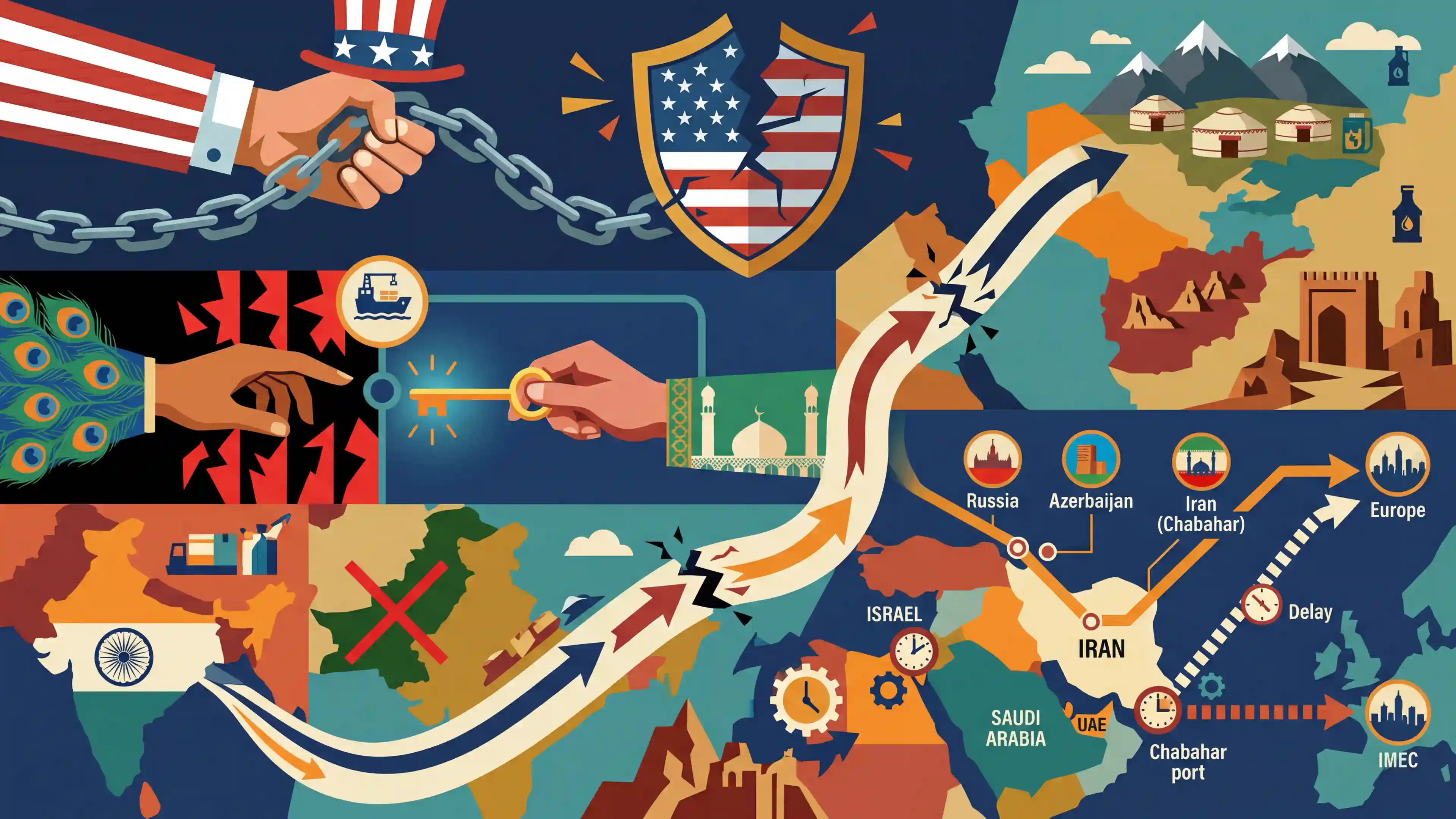
Why It Matters
The end of the sanctions waiver tests India's strategic autonomy and its ability to balance relations with the US and Iran. It directly impacts India's access to Central Asia via Chabahar (a recurrent UPSC theme) and highlights geopolitical hurdles in operationalizing mega-connectivity infrastructure like INSTC and IMEC.
Summary
The impending expiration of the U.S. sanctions waiver on Iran's Chabahar port on April 26 poses a significant challenge to India's strategic connectivity projects in the region. To protect its investments and circumvent secondary sanctions, India is exploring a tactical workaround that includes transferring its stake in the India Ports Global Chabahar Free Zone (IPGCFZ) to an Iranian entity. This development threatens India's vital access route to Afghanistan and Central Asia, which bypasses Pakistan. The geopolitical friction, driven by U.S. mandates like NSPM-2, also casts a shadow over broader trade corridors such as the International North-South Transport Corridor (INSTC), elevating the strategic urgency of Chabahar amid delays in other projects like the India-Middle East-Europe Economic Corridor (IMEC).
Key Points
- The U.S. sanctions waiver allowing India to develop Iran's Chabahar port is set to expire on April 26, threatening India's 23-year-old connectivity plans.
- To safeguard its assets, India is negotiating a tactical work-around involving the temporary transfer of its stake in the operating company (IPGCFZ) to a local Iranian firm.
- Chabahar port is critical for India to bypass Pakistan and secure direct land/sea access to Afghanistan and the resource-rich Central Asian Republics.
- The reimposition of sanctions mandated by the U.S. NSPM-2 complicates India's broader regional connectivity goals, particularly the INSTC, amidst concurrent delays in the alternative IMEC project.
Important Terms
International North-South Transport Corridor (INSTC)

A 7,200-km multi-modal (ship, rail, road) network connecting India to Russia and Europe via Iran and Azerbaijan, aiming to reduce transit time and costs significantly compared to the Suez Canal route.
UPSC context
GS Paper II: International Relations/Connectivity projects. Tests knowledge of regional trade routes and India's 'Connect Central Asia' policy.
Chabahar Port
A strategic deep-sea port in Iran's Sistan-Baluchistan province, offering India a direct maritime trade route to Afghanistan and Central Asia while bypassing Pakistan's land blockade.
UPSC context
GS Paper II: Strategic autonomy and neighborhood relations. Crucial for understanding India-Iran-Afghanistan trilateral cooperation and counter-balancing Gwadar.
India-Middle East-Europe Economic Corridor (IMEC)
A proposed corridor connecting India to Europe via the UAE, Saudi Arabia, Jordan, and Israel, intended to integrate rail and shipping networks to boost trade and compete with China's BRI.
UPSC context
GS Paper II/III: Global trade corridors and economic diplomacy. Evaluates India's role in shifting West Asian geopolitics.
Secondary Sanctions
Economic penalties imposed by a country (often the US) on foreign entities (non-citizens) for transacting with sanctioned nations, effectively forcing third-party countries to choose between their trade partners.
UPSC context
GS Paper II: Impact of global policies on India's sovereignty. Tests understanding of 'maximum pressure' tactics and strategic hedging.
National Security Presidential Memorandum-2 (NSPM-2)
A 2025 US Presidential directive reinstating 'maximum pressure' on Iran, specifically targeting the rescission of sanctions waivers for projects like the Chabahar port to isolate the Iranian economy.
UPSC context
GS Paper II: Effect of policies of developed countries. Illustrates shifts in US foreign policy and their ripple effects on Indian investments.
India Ports Global Chabahar Free Zone (IPGCFZ)
The Indian Special Purpose Vehicle (subsidiary of India Ports Global Ltd) responsible for managing and operating the Shahid Beheshti terminal at Iran's Chabahar Port.
UPSC context
GS Paper III: Infrastructure and Overseas Investments. Relates to India's first foreign port management venture and technical strategic execution.
Prelims Trap
The US sanctions waiver for India covers the entire International North-South Transport Corridor (INSTC) passing through Iran.
The US waiver strictly applied only to the development of Chabahar port and its railway link to Afghanistan, not to the broader INSTC.
Static Concepts Connected
Where is Chabahar Port located relative to key maritime chokepoints?
- Gulf of Oman: Located in Iran's Sistan-Balochistan province on the Makran coast, opening directly into the Gulf of Oman.
- Outside Hormuz: Unlike Bandar Abbas, it sits outside the congested Strait of Hormuz, minimizing risks from maritime chokepoint blockades.
- Gwadar proximity: Strategically located roughly 170 km west of Pakistan's Gwadar port, acting as India's counter-balance to China's CPEC.
What are secondary sanctions in international relations?
- Third-party penalty: Measures that penalize foreign countries, entities, or individuals (third parties) for conducting business with a primarily sanctioned state.
- Extra-territorial reach: They apply domestic laws extraterritorially, forcing third parties to choose between trading with the sanctioned state and accessing the US financial system.
- Impact on India: Compels India to use legal workarounds, like Special Purpose Vehicles or local entity transfers, to protect strategic assets without triggering SWIFT lockouts.
Cross-Topic Patterns
Corridor Geopolitics: INSTC vs IMEC
Delays in the US-backed IMEC due to West Asian instability elevate the urgency of the INSTC, making Chabahar vital for India's strategic hedging.
Bypassing SWIFT & Secondary Sanctions
India's temporary stake transfer to an Iranian firm mirrors past economic workarounds like the Rupee-Rial payment mechanism used to shield sovereign assets from US sanctions.

A 2026 map-based question will likely juxtapose the nodal ports of IMEC (Haifa, Jebel Ali) against INSTC/Chabahar (Bandar Abbas).
Linked PYQs · 4
Linked PYQs · 4
- 2012MainsGS2
How have the US sanctions against Iran affected India's bilateral relations with Iran?
- 2017PrelimsGS1
What is the importance of developing Chabahar Port by India?
- 2025PrelimsGS1
India is one of the founding members of the International North-South Transport Corridor (INSTC), a multimodal transportation corridor, which will connect
- 2024MainsGS2
Critically analyse India's evolving diplomatic, economic and strategic relations with the Central Asian Republics (CARs) highlighting their increasing significance in regional and global geopolitics.
