Chabahar Port Sanctions Waiver Withdrawal and Indian Interests
Source:Indian Express ↗
Why It Matters
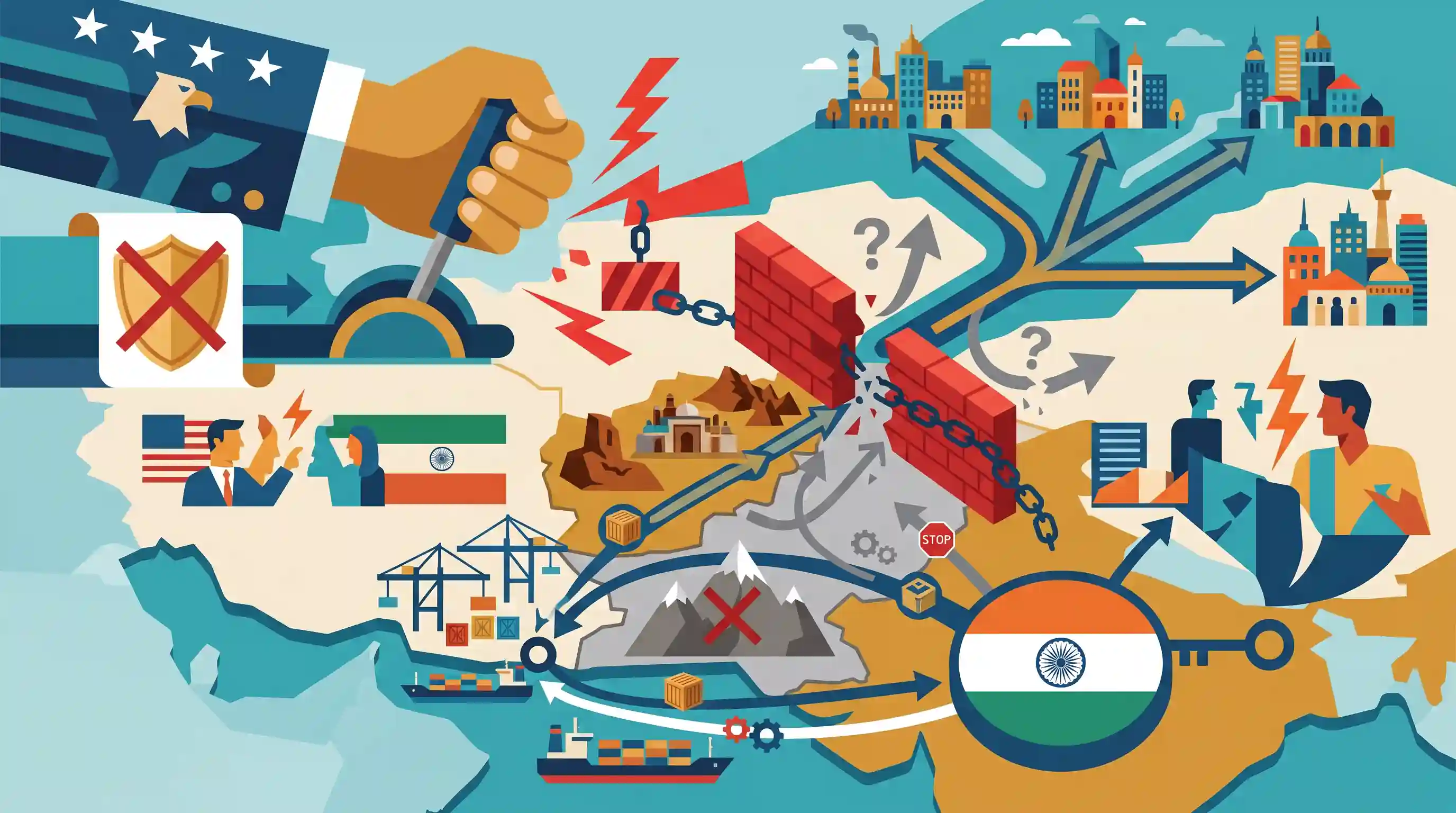
The withdrawal of the US sanctions waiver for Chabahar directly impacts India's foreign policy and strategic connectivity projects. It requires aspirants to understand the interplay between US sanctions, India-Iran bilateral relations, and India's broader geopolitical objectives in Central Asia and Afghanistan.
Summary
The United States' decision to withdraw the sanctions waiver for the Chabahar Port in Iran poses a significant challenge to India's strategic interests. Chabahar is a cornerstone of India's regional connectivity strategy, providing critical access to Afghanistan and Central Asia while bypassing Pakistan, and serving as a key node in the International North-South Transport Corridor (INSTC). The revocation of the waiver exposes India's geopolitical vulnerabilities to the ongoing US-Iran standoff and threatens to delay or disrupt a vital transit route essential for India's trade and strategic outreach in Eurasia.
Key Points
- The United States has decided to withdraw the sanctions waiver previously granted for the development of the Chabahar Port in Iran.
- India has been actively developing Chabahar Port to secure a strategic transit route to Afghanistan and Central Asia that bypasses Pakistan.
- The withdrawal of the waiver complicates India's regional connectivity ambitions, including its role in the International North-South Transport Corridor (INSTC).
- This development underscores the vulnerability of India's strategic overseas infrastructure projects to US-Iran geopolitical tensions and American secondary sanctions.
Important Terms
International North-South Transport Corridor (INSTC)

A 7,200 km multi-modal transportation network linking India to Russia and Europe via Iran. It utilizes rail, road, and sea routes to bypass Pakistan and reduce transit time by 40%.
UPSC context
GS Paper II: Regional connectivity, trade diversification, and India's strategic bypass of Pakistan. Key for infrastructure and IR topics.
Shahid Beheshti Terminal
The primary terminal within Iran's Chabahar Port that India has contracted to develop and operate for 10 years (signed May 2024) to facilitate trade with Central Asia.
UPSC context
GS Paper II: Bilateral relations (India-Iran) and regional infrastructure projects. Often tested in the context of CPEC/Gwadar counter-balancing.
India Ports Global Limited (IPGL)
An Indian public sector enterprise formed to manage and develop port projects overseas, specifically responsible for India's operations at the Chabahar Port in Iran.
UPSC context
GS Paper III: Infrastructure development and government agencies. Relevant for topics on India's global maritime footprint.
US Sanctions Waiver
A specific legal exemption granted by the US government allowing India to invest in and operate the Chabahar port without facing CAATSA or other secondary sanctions targeting Iran.
UPSC context
GS Paper II: Effect of policies of developed countries (USA) on India's interests. Tests understanding of secondary sanctions and diplomacy.
Strategic Autonomy
India's foreign policy principle of making independent decisions based on national interests without being coerced by other major powers or formal alliances.
UPSC context
GS Paper II: Core principle of Indian Foreign Policy. Tested in the context of balancing relations with the US, Russia, and Iran.
Ashgabat Agreement
A multi-modal transport agreement between India, Oman, Iran, Turkmenistan, Uzbekistan, and Kazakhstan to create an international transport and transit corridor for Central Asian trade.
UPSC context
GS Paper II: Regional groupings and agreements. Crucial for understanding India's 'Connect Central Asia' policy.
Prelims Trap
Chabahar Port is located in the Persian Gulf and is subjected to UN-mandated secondary sanctions.
Chabahar is located on the Gulf of Oman (bypassing the Strait of Hormuz). Furthermore, US secondary sanctions are unilateral actions by Washington, not UN-mandated restrictions.
Static Concepts Connected
What is the International North-South Transport Corridor (INSTC)?
- Network: A 7,200-km multi-modal freight network connecting India, Iran, Azerbaijan, and Russia to Europe and Central Asia.
- Significance: Reduces carriage cost by 30% and transit time by 40% compared to the traditional Suez Canal route.
- Core Nodes: Mumbai (India), Bandar Abbas/Chabahar (Iran), Baku (Azerbaijan), and Astrakhan (Russia).
How do unilateral secondary sanctions function?
- Primary Sanctions: Restrict domestic entities (e.g., US companies) from engaging commercially with the sanctioned nation.
- Secondary Sanctions: Target foreign third parties (e.g., Indian port operators) by threatening to block their access to the US financial system.
- CAATSA: Countering America's Adversaries Through Sanctions Act (CAATSA) is the primary US law threatening secondary sanctions.
Cross-Topic Patterns
Chabahar vs. Gwadar proximity
Chabahar acts as India’s strategic counterweight to China’s CPEC-funded Gwadar port in Pakistan, located just 72km away on the Makran coast.
De-dollarization & Vostro Accounts
US sanctions on critical trade nodes like Iran and Russia compel India to operationalize Special Rupee Vostro Accounts (SRVAs) to bypass the SWIFT system and dollar reliance.
INSTC & Ashgabat Agreement Synergy
India’s accession to the Ashgabat Agreement aligns with INSTC and Chabahar, marking a cohesive 'Connect Central Asia' policy to bypass Pakistan and counter China's BRI.

Expect a 2026 map-based question pairing Chabahar, Duqm, and Gwadar with their respective water bodies and transport corridor frameworks.
Linked PYQs · 5
Linked PYQs · 5
- 2024MainsGS2
Critically analyse India's evolving diplomatic, economic and strategic relations with the Central Asian Republics (CARs) highlighting their increasing significance in regional and global geopolitics.
- 2018MainsGS2
A number of outside powers have entrenched themselves in Central Asia, which is a zone of interest to India. Discuss the implications, in this context, of India's joining the Ashgabat Agreement, 2018.
- 2017PrelimsGS1
What is the importance of developing Chabahar Port by India?
- 2012MainsGS2
How have the US sanctions against Iran affected India's bilateral relations with Iran?
- 2018MainsGS2
In what ways would the ongoing US-Iran Nuclear Pact Controversy affect the national interest of India? How should India respond to this situation?
