US sanctions on Russian oil and domestic shale industry
Source:Indian Express ↗
Why It Matters
Understanding the hidden domestic economic drivers behind international sanctions is crucial for grasping the realities of global geopolitics and energy security, themes frequently tested in GS-II (International Relations) and GS-I/GS-III (Resource Distribution and Economy).
Summary
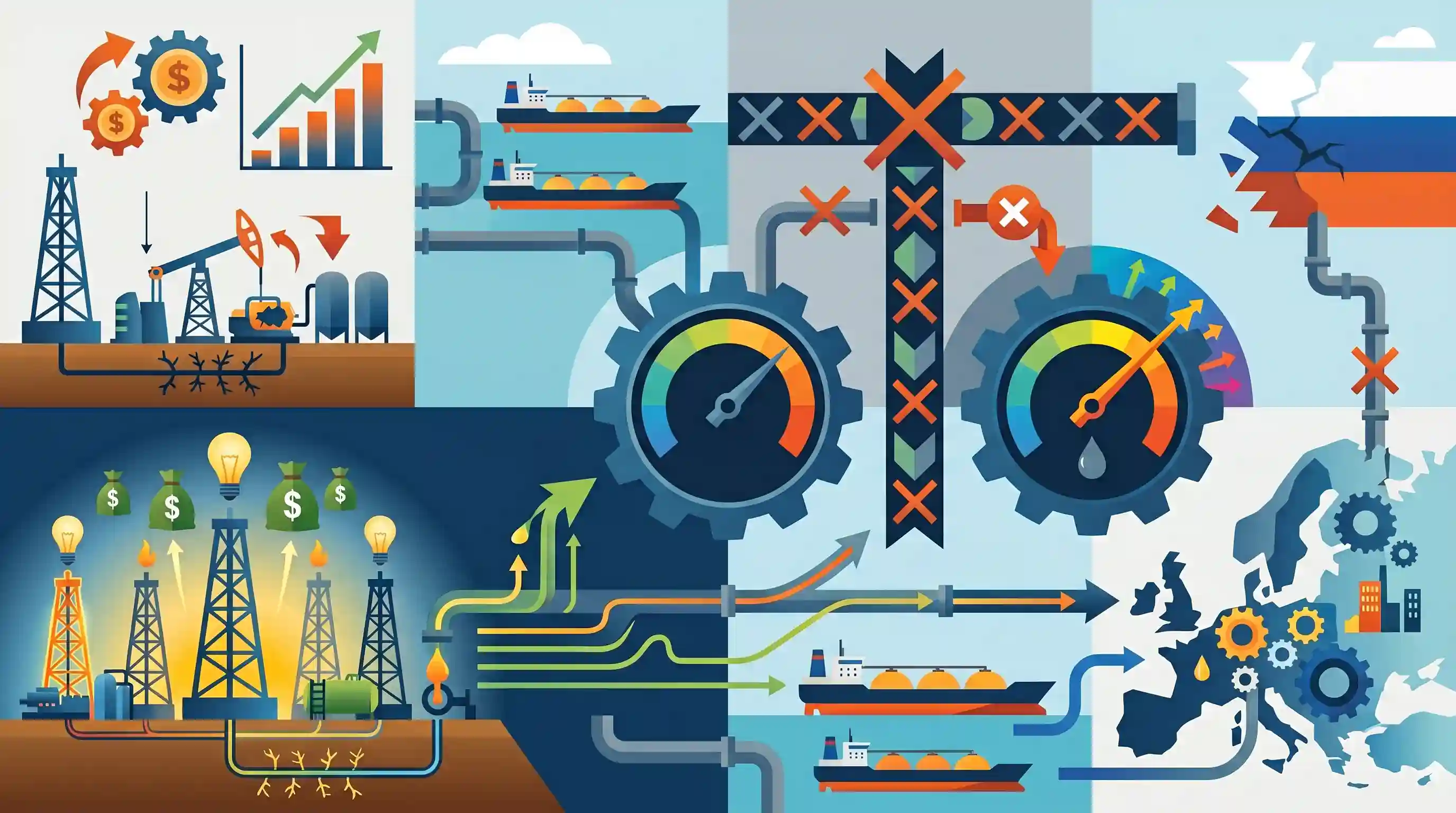
The article argues that the primary driver behind US sanctions on Russian oil is not solely to penalize Russia for its invasion of Ukraine, but rather to protect and boost the domestic US shale industry. Because US shale extraction has higher break-even costs, it requires higher global oil prices to remain viable. By removing substantial volumes of Russian oil from the global market, the US prevents a price collapse that would devastate its domestic producers. Furthermore, European efforts to decouple from Russian energy have transformed the continent into a captive market for American LNG and crude, showcasing how geopolitical crises and sanctions are utilized to advance domestic economic interests.
Key Points
- While US sanctions on Russian oil are framed as a response to the Ukraine war, they strategically benefit the American domestic shale oil and gas industry.
- By restricting the global supply of cheaper Russian crude, the US effectively supports global oil prices, keeping them above the higher break-even costs required by American shale producers.
- The sanctions have forced Europe to decouple from Russian energy, creating a lucrative, captive market for US Liquefied Natural Gas (LNG) and crude exports.
- This dynamic illustrates the weaponization of economic sanctions, where foreign policy and moral narratives are leveraged to secure domestic commercial advantages and dominate the global energy landscape.
Important Terms
Economic Sanctions

Commercial and financial penalties applied by states or international organizations against others to influence behavior, strategic decisions, or foreign policy.
UPSC context
GS Paper II (International Relations). Tests understanding of non-military coercive tools and their impact on global trade and bilateral ties.
Shale Oil
Unconventional crude oil produced from shale rock fragments through hydraulic fracturing (fracking); typically carries higher extraction costs than conventional oil.
UPSC context
GS Paper I (Resources) and GS III (Energy). Relevant for global resource distribution and unconventional energy extraction technologies.
Energy Security
The uninterrupted availability of energy sources at an affordable price, balancing accessibility, availability, and affordability for national stability.
UPSC context
GS Paper III (Economy/Environment). Critical for India’s development; tests strategies to mitigate import dependence and global supply shocks.
Liquefied Natural Gas (LNG)
Natural gas (primarily methane) cooled to -160°C to enable efficient long-distance transportation via specialized ships where pipelines are unfeasible.
UPSC context
GS Paper III (Infrastructure/Energy). Crucial for diversifying energy baskets and transitioning toward cleaner fuels in the industrial and transport sectors.
Break-even Price
The minimum market price level required for an energy producer to cover all extraction and operational costs without incurring a financial loss.
UPSC context
GS Paper III (Economy). Tests understanding of market viability for domestic industries against fluctuating global commodity prices.
Geopolitics
The study of how geographical factors—such as location and natural resources—shape international politics, state power, and strategic competition.
UPSC context
GS Paper II (International Relations). Core to analyzing how resource distribution drives global alliances, conflicts, and regional shifts.
Prelims Trap
The G7 price cap was designed as a total embargo to completely remove Russian oil from the global supply chain.
The G7 cap intentionally kept Russian oil flowing to avoid catastrophic global inflation; it merely banned Western shipping/insurance services if oil was sold above $60/barrel.
Static Concepts Connected
How does shale oil extraction differ from conventional crude?
- Low Permeability: Shale rock formations hold oil and gas but lack permeability, meaning hydrocarbons cannot flow easily to the wellbore without intervention.
- Hydraulic Fracturing: Extraction requires fracking—injecting water, sand, and chemicals at high pressure to fracture the rock and release the trapped oil.
- Environmental Cost: Fracking is highly water-intensive, consuming thousands of cubic meters of freshwater per well, and carries severe risks of groundwater contamination.
How does the G7 oil price cap function?
- Service Denial: It blocks Western maritime services (insurance, shipping, finance) for Russian seaborne crude unless it is sold at or below the $60 per barrel price cap.
- Market Balance: It was designed to simultaneously reduce Russian export revenues while preventing a global supply shock that would otherwise spike international crude prices.
Cross-Topic Patterns
Energy + India's Strategic Autonomy
Sanctions on Russian crude forced a structural realignment of trade routes. This enabled India to exercise strategic autonomy, absorbing discounted oil to insulate its domestic economy from global inflation.
Weaponization of Trade & Finance
Using maritime insurance and financial networks to enforce the oil price cap highlights the vulnerability of global supply chains to Western geopolitical and domestic economic agendas.

Expect a Prelims question comparing conventional vs shale oil extraction, emphasizing fracking's water intensity and economic break-even.
Linked PYQs · 4
Linked PYQs · 4
- 2021MainsGS1
Discuss the multi-dimensional implications of uneven distribution of mineral oil in the world.
- 2013MainsGS1
It is said that India has substantial reserves of shale oil and gas, which can feed the needs of the country for quarter century. However, tapping of the resource does not appear to be high on the agenda. Discuss critically the availability and issues involved.
- 2025MainsGS2
"Energy security constitutes the dominant kingpin of India's foreign policy, and is linked with India's overarching influence in Middle Eastern countries.” How would you integrate energy security with India's foreign policy trajectories in the coming years?
- 2025MainsGS2
"The reform process in the United Nations remains unresolved, because of the delicate imbalance of East and West and entanglement of the USA vs. Russo-Chinese alliance.” Examine and critically evaluate the East-West policy confrontations in this regard.
