US Sanctions on International Criminal Court Officials and Law
Source:The Hindu ↗
ఇది ఎందుకు ముఖ్యం
The clash between the U.S. and the ICC is crucial for GS-2 (International Relations) as it highlights the limitations of international multilateral institutions, the debate over the jurisdiction of the Rome Statute, and the use of unilateral sanctions by global powers to protect their strategic allies.
సారాంశం
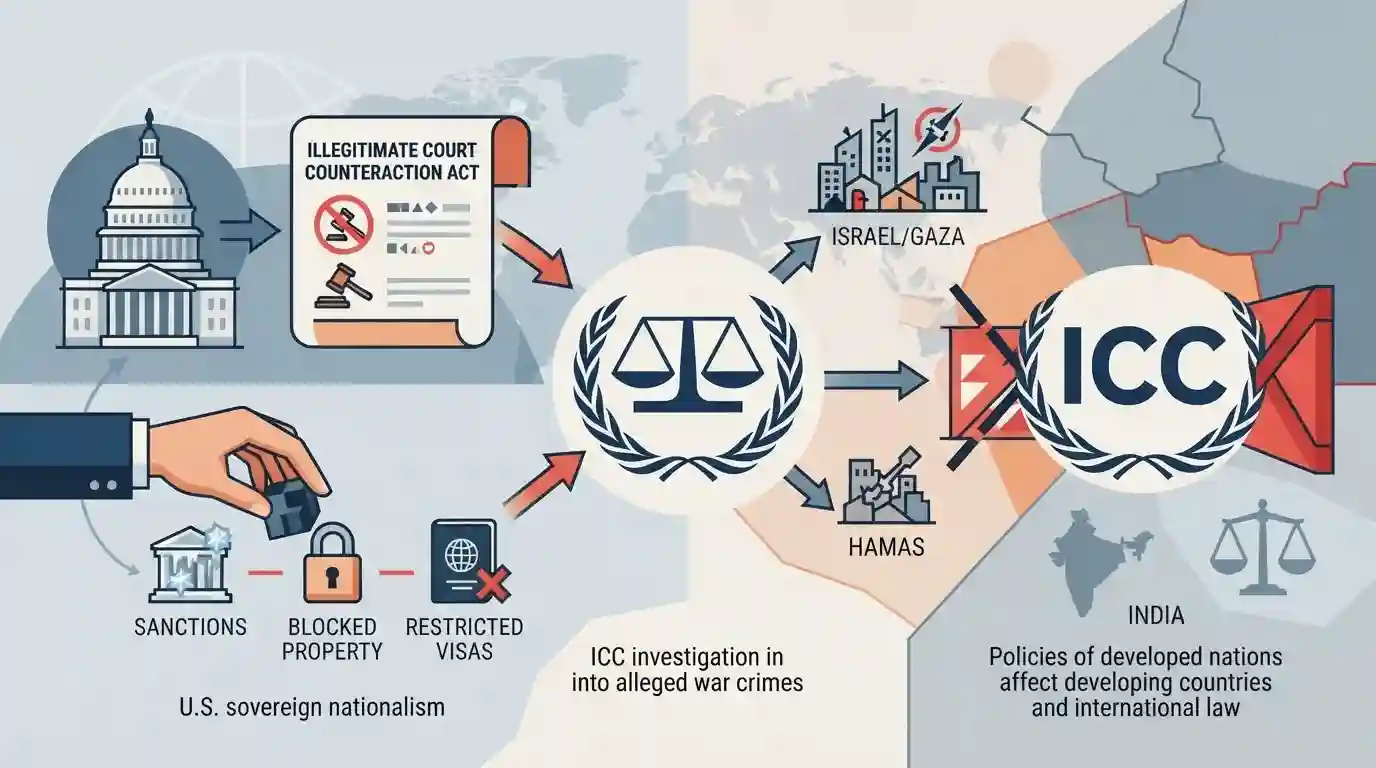
The U.S. House of Representatives passed the Illegitimate Court Counteraction Act to impose sanctions on International Criminal Court (ICC) officials. This retaliatory move follows the ICC prosecutor's decision to seek arrest warrants for Israeli and Hamas leaders over alleged war crimes in the Gaza conflict. The legislation aims to block property and restrict visas for those involved in investigating the U.S. or its allies. As a non-signatory to the Rome Statute, the U.S. action underscores the tension between sovereign nationalism and the jurisdiction of multilateral global justice institutions.
ముఖ్య అంశాలు
- The U.S. House of Representatives passed legislation to impose sanctions on International Criminal Court (ICC) officials.
- The move is a retaliatory response to ICC Prosecutor Karim Khan's request for arrest warrants against top Israeli officials (including PM Benjamin Netanyahu) and Hamas leaders for alleged war crimes in Gaza.
- The bill proposes property blocking and visa restrictions against anyone involved in ICC investigations or prosecutions of personnel from the U.S. or its non-member allies.
- The U.S., like India and Israel, is not a state party to the Rome Statute, and frequently argues that the ICC lacks jurisdiction over non-member state citizens.
- This development exemplifies the ongoing clash between sovereign national interests and the authority of global multilateral justice institutions.
ముఖ్యమైన పదాలు
International Criminal Court (ICC)

A permanent international tribunal established to investigate and prosecute individuals accused of the most serious global offenses, including genocide, war crimes, crimes against humanity, and aggression.
UPSC context
GS Paper II (International Institutions); crucial for analyzing global judicial governance, sovereignty issues, and India's non-member status.
Rome Statute
The 1998 international treaty that established the International Criminal Court (ICC), outlining its jurisdiction, structure, and the core crimes it is authorized to prosecute.
UPSC context
GS Paper II (Bilateral & Global Treaties); tests understanding of global justice frameworks, state sovereignty, and why India did not sign.
Illegitimate Court Counteraction Act
A U.S. legislative act designed to impose sanctions, including visa bans and asset freezes, on International Criminal Court officials who investigate or prosecute U.S. personnel or allies.
UPSC context
GS Paper II (Effect of policies of developed nations); tests international legal conflicts, unilateral sanctions, and the US-ICC geopolitical dynamic.
ప్రిలిమ్స్ ఉచ్చు
The International Criminal Court is a principal UN organ with automatic jurisdiction over all UN member states.
The ICC is an independent body, not a UN organ. It only exercises jurisdiction if crimes occurred on a member state's territory or by its nationals (unless referred by UNSC).
అనుసంధానమైన స్థిర భావనలు
What are the core operational differences between the ICJ and the ICC?
- Subject Matter: Resolves state-to-state legal disputes (ICJ) versus prosecuting individual criminal liability for genocide, war crimes, and crimes against humanity (ICC).
- UN Relationship: ICJ is an official principal organ of the UN, whereas the ICC is an independent treaty-based body created by the Rome Statute.
- Enforcement Power: ICJ relies on the UN Security Council for enforcement, while the ICC relies strictly on voluntary cooperation of its state parties for arrests.
Why has India abstained from signing the Rome Statute of the ICC?
- Sovereignty Concerns: India objects to subordinating its sovereign national judiciary to the review of an external international court.
- UNSC Overreach: Opposes the discriminatory powers granted to the UN Security Council to initiate, trigger, or block ICC prosecutions.
- Definition Gaps: Objects to the exclusion of cross-border terrorism and weapons of mass destruction (nuclear weapons) from the treaty's definition of war crimes.
అంతర-అంశ నమూనాలు
Sovereignty vs. Multilateral Judicial Overreach
India's refusal to sign the Rome Statute mirrors its stance on trade tribunals, prioritizing sovereign domestic judicial supremacy over external legal arbitration.
Unilateral sanctions and international law
US domestic laws penalizing ICC officials showcase the realist struggle where major powers bypass multilateral frameworks to protect bilateral security allies.

Multi-statement questions on ICJ vs ICC jurisdiction, combined with India's specific structural objections to the Rome Statute, are likely.
అనుసంధాన PYQలు · 3
అనుసంధాన PYQలు · 3
- 2025MainsGS2
"With the waning of globalization, post-Cold War world is becoming a site of sovereign nationalism.” Elucidate.
- 2018PrelimsGS1
"Rule of Law Index" is released by which of the following?
- 2015PrelimsGS1
Amnesty International is
