US Sanctions on Iranian Shadow Fleet and Energy Geopolitics
Source:Indian Express ↗
Why It Matters
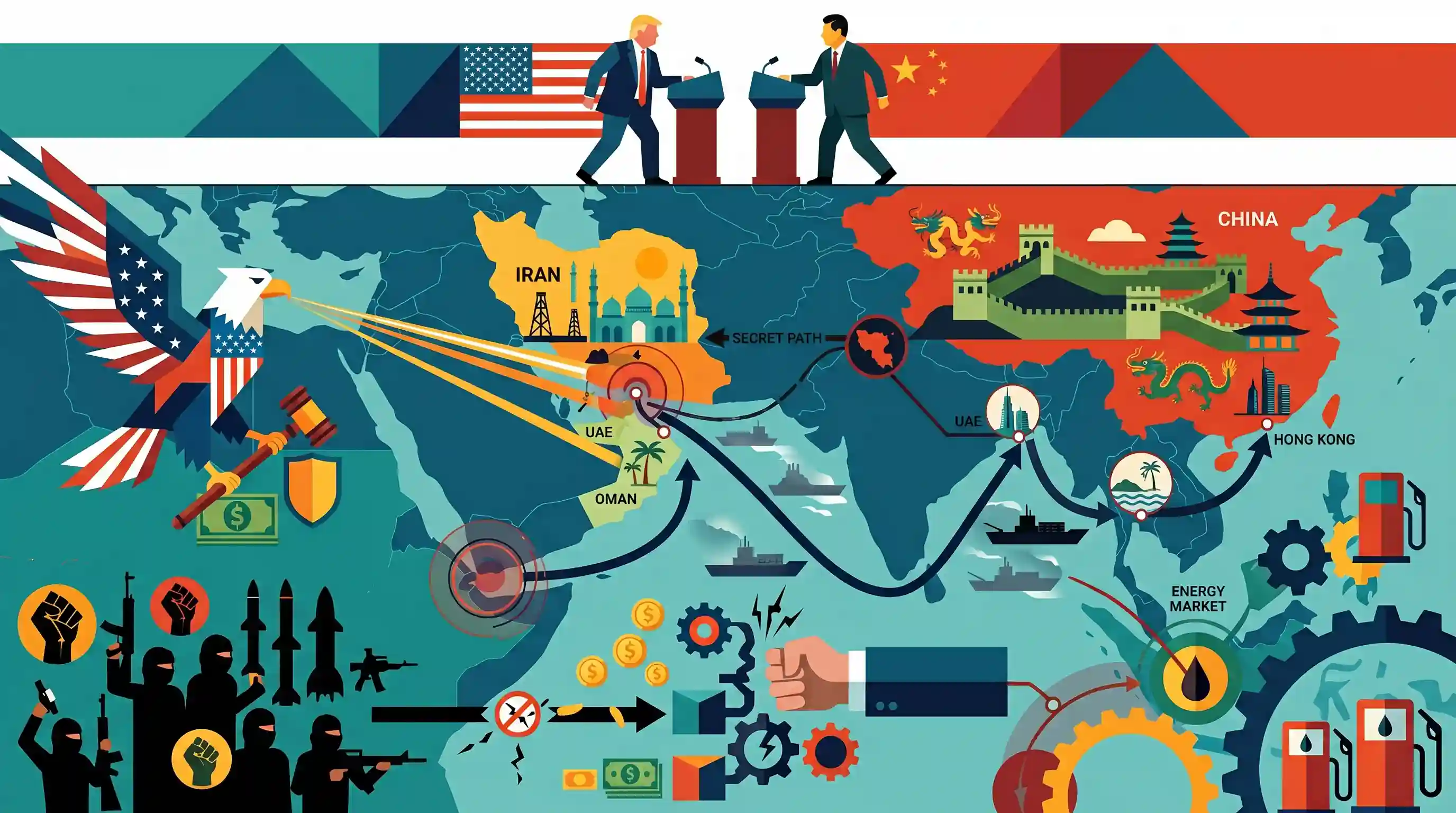
Demonstrates the strategic use of economic sanctions in geopolitics and highlights how US-Iran tensions disrupt global energy supply chains, specifically around critical chokepoints like the Strait of Hormuz. It also underscores the complex triangular dynamics between the US, China, and Iran.
Summary
The United States has imposed new sanctions on a "shadow fleet" of 12 individuals and entities across Hong Kong, the UAE, and Oman for allegedly facilitating secret Iranian oil shipments to China. According to the US Treasury, these networks channel revenue to Iran's Islamic Revolutionary Guard Corps (IRGC) to fund weapons programs and proxy groups. Announced by Treasury Secretary Scott Bessent under the banner of continuing "Economic Fury," the sanctions arrive just days before a summit between US President Donald Trump and Chinese President Xi Jinping. The ongoing US-Iran conflict and sanctions regime continue to impact global energy markets, especially strategic transit routes like the Strait of Hormuz.
Key Points
- The US sanctioned 12 individuals and entities in Hong Kong, the UAE, and Oman for forming a 'shadow fleet' to facilitate secret Iranian oil shipments to China.
- The networks allegedly channel oil revenues to Iran's Islamic Revolutionary Guard Corps (IRGC) to fund weapons programs and proxy groups.
- US Treasury Secretary Scott Bessent stated that 'Economic Fury' and sanctions will continue alongside military pressure to deprive the Iranian regime of funding.
- The sanctions were announced just days before a scheduled summit between US President Donald Trump and Chinese President Xi Jinping in Beijing.
- The sanctions and broader US-Iran conflict have implications for global energy markets, particularly affecting the strategic Strait of Hormuz oil transit route.
Important Terms
Islamic Revolutionary Guard Corps (IRGC)

A parallel branch of the Iranian Armed Forces reporting directly to the Supreme Leader. It manages internal security, safeguards the Islamic system, and supports regional proxy groups like Hezbollah and Hamas.
UPSC context
GS Paper II (IR); tests understanding of West Asian geopolitics, state-sponsored non-state actors, and regional security dynamics affecting India.
Shadow Fleet
A network of aging tankers using deceptive practices—such as disabling tracking systems (AIS), GPS spoofing, and opaque ownership—to transport oil from sanctioned nations (Iran, Russia) to global markets.
UPSC context
GS Paper III (Economy/Security); tests knowledge of global trade vulnerabilities, sanctions evasion tactics, and maritime security risks.
Economic Sanctions
Commercial and financial penalties applied by states or international bodies against countries, entities, or individuals to compel changes in behavior or strategic decisions without resorting to direct military force.
UPSC context
GS Paper II (IR); core tool of modern diplomacy; tests international law, bilateral relations (US-India-Iran), and global economic governance.
Strait of Hormuz
A strategic maritime chokepoint between the Persian Gulf and the Gulf of Oman. It is the world's most critical oil transit route, handling approximately 20% of global petroleum and LNG trade.
UPSC context
GS Paper I (Geography)/II (IR); vital for energy security; tests awareness of strategic chokepoints and their impact on global oil prices.
U.S. Department of the Treasury
The US executive department responsible for federal finances and international financial enforcement. Its Office of Foreign Assets Control (OFAC) implements and manages economic sanctions to advance foreign policy goals.
UPSC context
GS Paper II (IR); relevant for understanding global financial enforcement mechanisms and the extraterritorial impact of U.S. policy on international trade.
Prelims Trap
Secondary sanctions on Iran's oil trade are legally binding under UN Security Council resolutions.
These are US unilateral sanctions leveraging its domestic financial system. UN sanctions require UNSC consensus, which China and Russia would effectively veto regarding this specific oil trade.
Static Concepts Connected
What constitutes the geographic footprint of the Strait of Hormuz?
- Connecting Waters: It connects the Persian Gulf to the Gulf of Oman and the broader Arabian Sea.
- Bordering Nations: It is flanked by Iran to the north and the Musandam Peninsula (Oman) and UAE to the south.
- Strategic Chokepoint: It serves as an exclusive, narrow sea passage facilitating approximately 20% of global oil supply, making it a critical chokepoint.
What is the 'Flags of Convenience' (FoC) practice in maritime shipping?
- Definition: Registering a merchant ship in a sovereign state different from that of the ship's actual owners (e.g., Liberia, Panama, Marshall Islands).
- Regulatory Arbitrage: Shipowners use FoC to exploit lenient maritime regulations, lower taxes, and minimal labor oversight in the registering country.
- Evasion Tactic: It obscures true ownership, enabling 'shadow fleets' to turn off AIS trackers and transport sanctioned crude without immediate detection.
Cross-Topic Patterns
Weaponization of global finance
Secondary sanctions rely heavily on the dominance of the US dollar and the SWIFT network. Entities trading with Iran risk losing access to the US financial system, enforcing compliance globally.
India's Chabahar balancing act
Intensifying US-Iran friction impacts India's strategic investments in Iran's Chabahar port, which historically required specific US sanctions waivers to maintain operational viability and access to Central Asia.

Shadow fleets + secondary sanctions + Strait of Hormuz mapping likely to form a composite multi-statement question in 2026.
Linked PYQs · 3
Linked PYQs · 3
- 2012MainsGS2
How have the US sanctions against Iran affected India's bilateral relations with Iran?
- 2018MainsGS2
In what ways would the ongoing US-Iran Nuclear Pact Controversy affect the national interest of India? How should India respond to this situation?
- 2024PrelimsGS1
Consider the following statements : Statement-I : Sumed pipeline is a strategic route for Persian Gulf oil and natural gas shipments to Europe. Statement-II : Sumed pipeline connects the Red Sea with the Mediterranean Sea. Which one of the following is correct in respect of the above statements?
