ISS Space Crew Return and International Scientific Cooperation
Source:The Hindu ↗
Why It Matters
The continuous cooperation between the USA and Russia on the ISS is a key example of how scientific exploration and space diplomacy can operate independently of terrestrial geopolitical conflicts. It provides context for questions related to global space governance, space station logistics (like the Soyuz capsule), and forms a backdrop for India's own plans for the Bharatiya Antariksha Station.
Summary
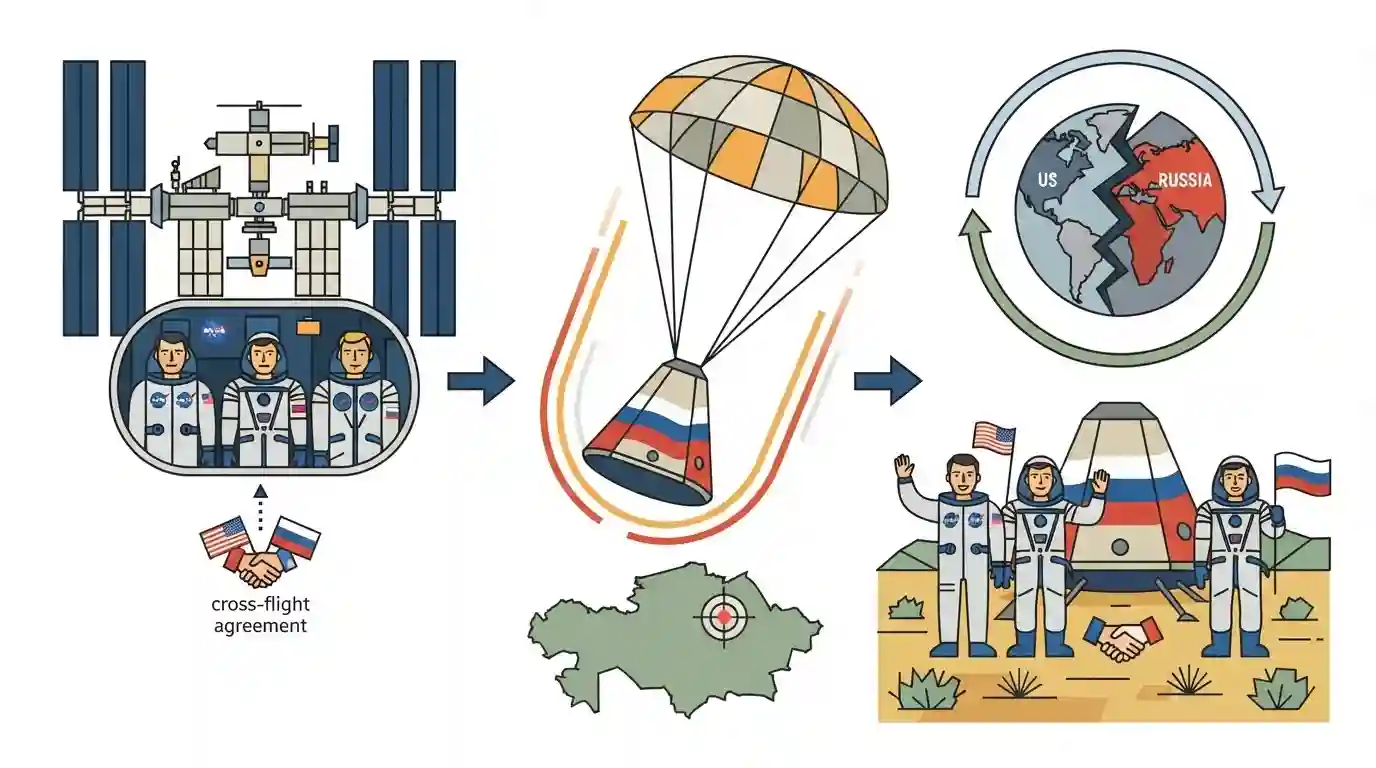
A U.S.-Russian space crew consisting of one NASA astronaut and two Roscosmos cosmonauts safely returned to Earth, landing in Kazakhstan in a Russian Soyuz capsule after spending eight months on the International Space Station (ISS). The mission underscored the ongoing practical cooperation between the U.S. and Russia in space exploration, enabled by a bilateral 'cross-flight' agreement. This collaboration persists despite severe geopolitical tensions regarding the war in Ukraine, highlighting the necessity of mutual reliance for the continuous operation of the ISS.
Key Points
- A joint U.S.-Russian crew safely landed in Kazakhstan after an 8-month stint on the International Space Station (ISS).
- The crew—comprising NASA astronaut Chris Williams and Roscosmos cosmonauts Sergei Kud-Sverchkov and Sergei Mikaev—returned aboard a Russian Soyuz capsule.
- They were initially sent as a backup crew after the prior crew's spacecraft suffered a coolant leak due to a micrometeoroid strike.
- Despite ongoing geopolitical tensions arising from the Ukraine conflict, NASA and Roscosmos continue their 'cross-flight' agreement, exchanging seats on American and Russian spacecraft to ensure ISS functionality.
Important Terms
International Space Station (ISS)

An international collaborative low Earth orbit space station serving as a microgravity research laboratory, co-managed by NASA, Roscosmos, ESA, JAXA, and CSA.
UPSC context
GS Paper III (Space Technology). Tests knowledge of multilateral scientific platforms and orbital technologies.
Cross-flight program
A bilateral agreement between NASA and Roscosmos to launch integrated crews, allowing American astronauts to fly on Russian Soyuz and Russian cosmonauts on U.S. spacecraft.
UPSC context
GS Paper II (International Relations). Tests geopolitics of space cooperation and science diplomacy amidst bilateral tensions.
Roscosmos
The Russian State Space Corporation responsible for space flight programs, aerospace research, and cosmonautics for the Russian Federation.
UPSC context
GS Paper III (Space Technology). Tests awareness of major international space administration bodies and collaborative missions.
NASA
The National Aeronautics and Space Administration, an independent agency of the United States federal government responsible for civil space, aeronautics, and space research.
UPSC context
GS Paper III (Space Technology). Tests knowledge of global space leaders, technology transfers, and collaborative interplanetary missions.
Soyuz MS-28
A Russian manned spacecraft mission under the Soyuz program that safely transported a joint U.S.-Russian crew back from the ISS in July 2026.
UPSC context
GS Paper III (Space Technology). Tests awareness of contemporary crewed space missions and orbital logistics.
Prelims Trap
All three modules of the modular Soyuz spacecraft are designed to survive atmospheric re-entry and return to Earth.
Only the Descent Module is designed with a heat shield to survive atmospheric re-entry; the Orbital and Instrumentation modules are discarded and burn up completely in the atmosphere.
Static Concepts Connected
Which five space agencies jointly operate the International Space Station (ISS)?
- Primary Partners: NASA (US), Roscosmos (Russia), JAXA (Japan), ESA (Europe), and CSA (Canada).
- Strategic Exclusions: China (CNSA) is excluded by US law; India (ISRO) is not a partner, choosing to build its own independent space station.
- Legal Framework: Governed by the 1998 Space Station Intergovernmental Agreement (IGA), which establishes a international legal framework.
What is Kessler Syndrome and its threat to orbital infrastructure?
- Definition: A cascading chain reaction where collisions between objects in Low Earth Orbit (LEO) generate self-propagating debris clouds.
- Operational Threat: Can catastrophically destroy vital communication, weather, and science satellites in LEO, rendering orbits unusable.
- Indian Response: ISRO mitigates this risk through Project NETRA and active participation in the Inter-Agency Space Debris Coordination Committee (IADC).
Cross-Topic Patterns
Outer Space Diplomacy vs Geopolitical Sanctions
Shows how shared critical infrastructure forces functional bilateral cooperation (like 'cross-flights') between adversaries, insulating scientific missions from terrestrial warfare sanctions.
BAS and Strategic Space Autonomy
India's push for the Bharatiya Antariksha Station (BAS) by 2035 reflects a transition away from reliance on foreign joint platforms like the ISS.

India's BAS-01 module roadmap and ISS operational exit timelines are highly likely to feature in 2026 Space Technology questions.
Linked PYQs · 4
Linked PYQs · 4
- 2019MainsGS3
What is India's plan to have its own space station and how will it benefit our space programme?
- 2008PrelimsGS1
Which one of the following is a spacecraft?
- 2014PrelimsGS1
Which of the following pairs is/are correctly matched? Spacecraft Purpose 1. Cassini-Huygens : Orbiting the Venus and transmitting data to the Earth 2. Messenger : Mapping and investigating the Mercury 3. Voyager 1 and 2 : Exploring the outer solar system Select the correct answer using the code given below.
- 2020PrelimsGS1
"The experiment will employ a trio of spacecraft flying in formation in the shape of an equilateral triangle that has sides one million kilometres long, with lasers shining between the craft." The experiment in question refers to
