US Iran Military Escalation and Strait of Hormuz Energy Chokepoint
Source:The Hindu ↗
Why It Matters
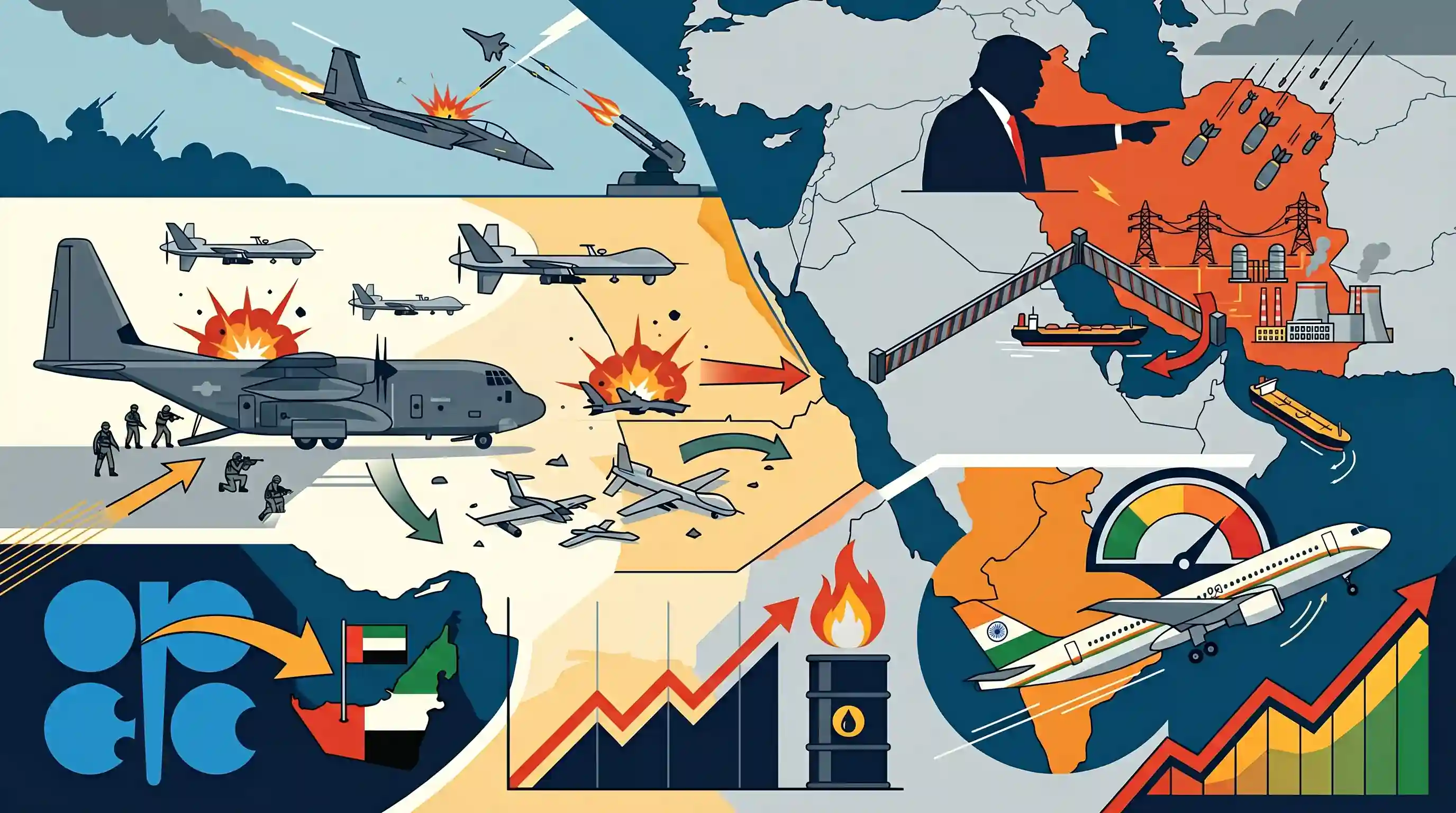
The escalation of the US-Iran conflict and the blockade of the Strait of Hormuz directly threaten India\'s energy security and macroeconomic stability. It demonstrates the profound vulnerability of global trade chokepoints and how modern geopolitical warfare—including the use of advanced military UAVs—creates immediate ripple effects on domestic sectors like aviation and fuel supplies.
Summary
The U.S. military conducted a major search and rescue operation in Iran to retrieve an airman whose F-15E was shot down amid an ongoing U.S.-Israel war with Iran. The operation saw heavy use of advanced military hardware, including MC-130J transports and MQ-9 Reaper drones, with both sides claiming significant equipment casualties. Concurrently, U.S. President Donald Trump has threatened to bomb Iran\'s power infrastructure if the Strait of Hormuz is not reopened. The strategic blockade has severe global energy security implications, causing oil prices to surge, prompting the UAE\'s exit from OPEC, and threatening the viability of the Indian aviation sector due to skyrocketing fuel costs.
Key Points
- The U.S. and Israel engaged in an escalated war with Iran beginning in late February 2026, leading to intense military engagements in Iranian airspace.
- The U.S. military executed a complex, high-stakes search and rescue operation to retrieve a downed F-15E pilot in Iran, utilizing MC-130J transport aircraft, Black Hawk helicopters, and advanced UAVs.
- The conflict has triggered a blockade of the Strait of Hormuz, a critical maritime chokepoint, severely threatening global energy supply chains.
- U.S. President Donald Trump issued an ultimatum threatening to bomb Iran\'s power infrastructure and bridges if the Strait of Hormuz is not reopened.
- The geopolitical fallout has caused significant economic disruptions, including a fuel rush in India, the UAE\'s exit from OPEC, and Indian airlines (Air India, IndiGo, SpiceJet) warning of a potential halt in operations due to soaring Aviation Turbine Fuel (ATF) costs.
Important Terms
Strait of Hormuz

A critical maritime chokepoint between Iran and Oman connecting the Persian Gulf to the Arabian Sea; it facilitates approximately 20% of global oil and LNG transit.
UPSC context
GS-2 (IR)/GS-3 (Security). Tests knowledge of global trade chokepoints and India's energy dependency on the West Asian region.
OPEC
An intergovernmental organization of oil-exporting nations that coordinates petroleum policies to stabilize global markets and ensure steady supplies for consumers and fair returns for producers.
UPSC context
GS-2 (International Orgs). Tests understanding of global energy cartels and their impact on India's fiscal health and inflation.
Islamic Revolutionary Guard Corps (IRGC)
An elite branch of the Iranian Armed Forces, separate from the regular army, tasked with defending Iran's revolutionary system and overseeing regional proxy operations.
UPSC context
GS-2 (International Relations). Essential for analyzing West Asian geopolitical stability and its security implications for Indian interests.
MQ-9 Reaper drone
An advanced, long-endurance, remotely piloted aircraft (UAV) used for high-altitude intelligence, surveillance, and precision-strike missions; recently procured by India's tri-services.
UPSC context
GS-3 (Security/S&T). Relevant for defense modernization, the India-US strategic partnership, and indigenization of surveillance technology.
Khatam al-Anbiya Central Headquarters
The highest joint operational command center of the Iranian Armed Forces, responsible for coordinating military operations between the regular army (Artesh) and the IRGC.
UPSC context
GS-2 (International Security). Relevant for understanding foreign military command structures during regional conflicts that threaten global energy security.
Elbit Hermes-900 drone
A medium-altitude long-endurance (MALE) UAV of Israeli origin, manufactured in India via a joint venture, used for maritime reconnaissance and border surveillance.
UPSC context
GS-3 (Security). Tests knowledge of defense indigenization (Atmanirbhar Bharat) and bilateral strategic cooperation with Israel.
Prelims Trap
The Strait of Hormuz connects the Persian Gulf directly to the Red Sea.
Aspirants frequently confuse Hormuz with Bab el-Mandeb. Hormuz connects the Persian Gulf to the Gulf of Oman, while Bab el-Mandeb links the Red Sea to the Gulf of Aden.
Static Concepts Connected
What are the key maritime chokepoints in West Asia?
- Strait of Hormuz: Connects the Persian Gulf to the Gulf of Oman and the Arabian Sea, handling ~20% of global oil trade.
- Bab el-Mandeb: Connects the Red Sea to the Gulf of Aden and the Indian Ocean.
- Suez Canal: An artificial sea-level waterway in Egypt connecting the Mediterranean Sea to the Red Sea.
Why is Aviation Turbine Fuel (ATF) highly vulnerable to price shocks in India?
- Outside GST: ATF is one of the five petroleum products currently kept entirely outside the Goods and Services Tax (GST) framework.
- Cascading Taxes: It is subject to Central Excise Duty and varying State-level Value Added Taxes (VAT), exacerbating the impact of global crude oil price spikes.
- SAF Integration: India is gradually introducing Sustainable Aviation Fuel (SAF) under the ATF Control Order to mitigate volatility and meet international emission targets.
Cross-Topic Patterns
MQ-9 Reapers & Defense Acquisitions
The intensive use of MQ-9 Reaper drones highlights their strategic value, directly relevant to India's recent acquisition of 31 MQ-9B variants via the US Foreign Military Sales route.
OPEC Fragmentation & Energy Security
UAE's exit from OPEC follows recent departures by Qatar and Angola, signaling a shift from cartel quotas to strategic autonomy. This directly impacts India's oil import diversification strategy.

Expect a multi-statement Prelims question pairing West Asian maritime chokepoints (Hormuz) with recent OPEC membership exits.
Linked PYQs · 3
Linked PYQs · 3
- 2017MainsGS2
The question of India's Energy Security constitutes the most important part of India's economic progress. Analyze India's energy policy cooperation with West Asian countries.
- 2025MainsGS2
"Energy security constitutes the dominant kingpin of India's foreign policy, and is linked with India's overarching influence in Middle Eastern countries.” How would you integrate energy security with India's foreign policy trajectories in the coming years?
- 2023MainsGS3
The use of unmanned aerial vehicles (UAVs) by our adversaries across the borders to ferry arms/ammunitions, drugs, etc., is a serious threat to the internal security. Comment on the measures being taken to tackle this threat.
