Proposed US Remittance Tax Threatens Indian Forex Inflows and Rupee
Source:The Hindu ↗
Why It Matters
This article is crucial for understanding the interplay between external shocks (U.S. domestic policy) and India's macroeconomic stability. Remittances are a vital component of India's Balance of Payments (invisible receipts) that help finance the trade deficit. A disruption directly impacts exchange rates, RBI monetary actions, and the socio-economic welfare of dependent households, making it a prime case study for GS3 (Economy) and GS2 (Indian Diaspora).
Summary
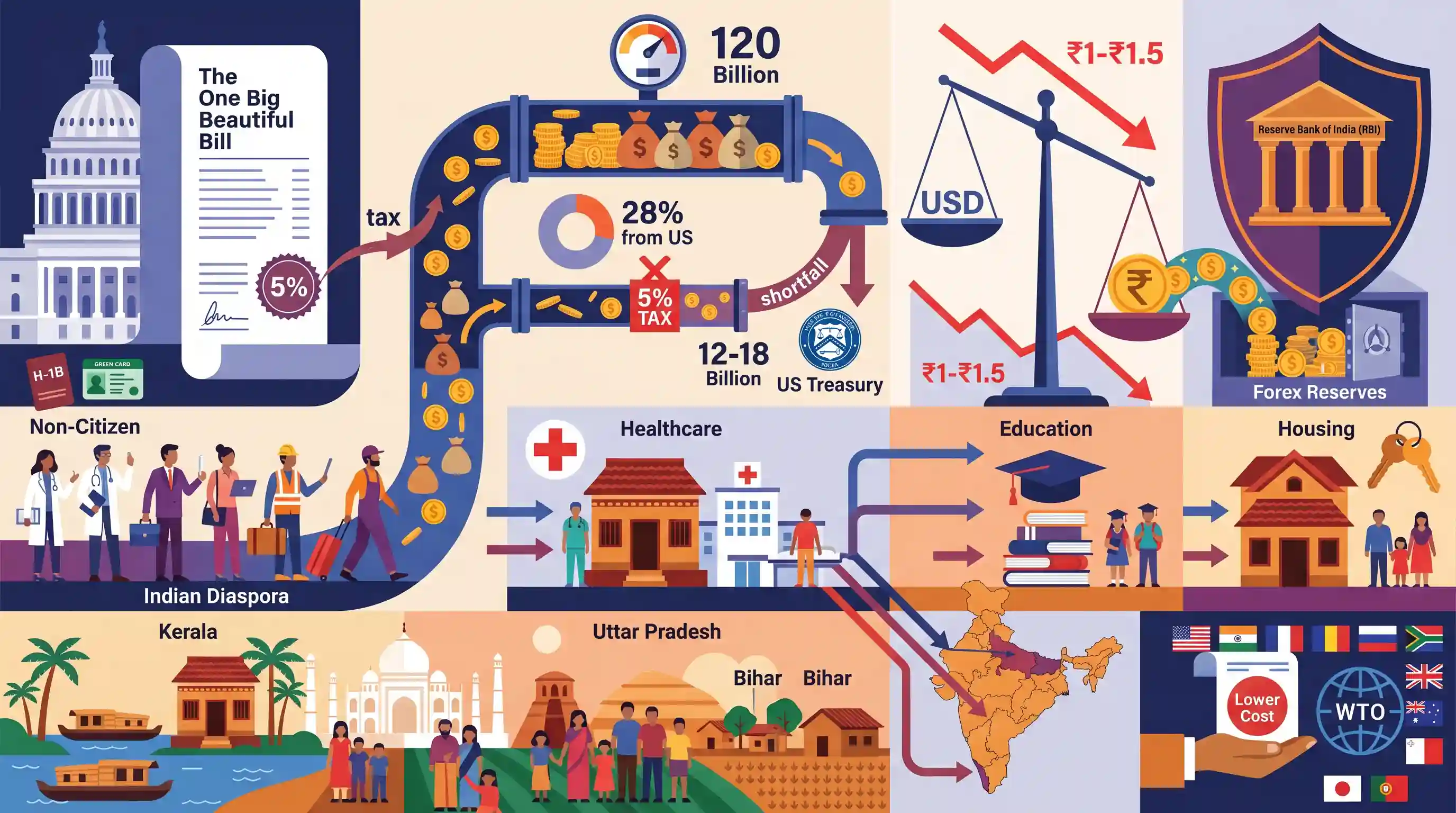
A proposed U.S. legislation, 'The One Big Beautiful Bill,' seeks to impose a 5% tax on remittances sent by non-citizens, raising significant economic concerns for India. According to the Global Trade Research Initiative (GTRI), India, which received a record $120 billion in remittances in FY24 (28% from the U.S.), could face a $12-$18 billion shortfall if the tax reduces flows by 10-15%. This drop in dollar inflows would tighten domestic dollar supply, potentially depreciating the Indian rupee by ₹1 to ₹1.5 against the dollar and necessitating intervention by the Reserve Bank of India (RBI). Beyond macroeconomic impacts, the tax would directly harm households in states like Kerala, Uttar Pradesh, and Bihar that rely on remittances for healthcare, education, and housing. The issue also underscores India's past efforts at the WTO to lower cross-border remittance costs.
Key Points
- A proposed U.S. bill seeks to impose a 5% tax on remittances sent by non-citizens, directly impacting Indian diaspora workers.
- India received $120 billion in remittances in FY24 (the highest globally), with nearly 28% coming from the United States.
- GTRI estimates the tax could cause a 10-15% drop in remittance flows, leading to a $12-$18 billion shortfall in India's forex inflows.
- This dollar shortfall could depreciate the Indian rupee by ₹1 to ₹1.5 against the US dollar and force the RBI to intervene to stabilize the currency.
- The drop in funds would severely impact dependent households in states like Kerala, UP, and Bihar, where remittances fund basic needs like healthcare and education.
- At the WTO, India has previously advocated for reducing the cost of cross-border remittance flows.
Important Terms
Remittances

Funds transferred by non-residents to their home country. India is the world's largest recipient (~$120 billion in FY24), with these inflows supporting millions of households and macroeconomic stability.
UPSC context
GS Paper 3: Indian Economy; essential for understanding Current Account Dynamics and the role of the external sector.
Balance of Payments (BoP)
A comprehensive record of a country's economic transactions with the rest of the world. Remittances are categorized as 'unilateral transfers' within the Current Account, helping offset trade deficits.
UPSC context
GS Paper 3: Economy; tests knowledge of external sector components and exchange rate stability.
The One Big Beautiful Bill
A proposed US federal statute (Act of 2025) containing various tax policies, including a controversial excise tax on international money transfers sent by non-citizens to foreign recipients.
UPSC context
GS Paper 2: International Relations; impacts of global legislation on Indian interests and diaspora.
Global Trade Research Initiative (GTRI)
A New Delhi-based think tank and research group focusing on trade policy, climate change, and technology. It provides analysis on how global trade shifts affect India's economy.
UPSC context
GS Paper 3: Economy; relevant for tracking trade-related policy analysis and impact assessments.
Indian Diaspora
The community of over 32 million persons of Indian origin living abroad. They are the primary source of remittances and act as a bridge for soft power and investment.
UPSC context
GS Paper 2: International Relations; focuses on the role and impact of the diaspora on India's interests.
Prelims Trap
"Remittances from the diaspora are classified under the Capital Account as they augment foreign exchange reserves."
Remittances are private, one-way transfers with no repayment liability. Therefore, they are recorded under the "Invisibles" segment of the Current Account, not the Capital Account.
Static Concepts Connected
Where do remittances figure in India's Balance of Payments?
- Current Account: They are recorded under the 'Invisibles' category (along with services and income) as private transfers.
- No liability: Unlike capital account inflows like FDI or external commercial borrowings (ECBs), remittances are unilateral transfers creating no future debt or repayment obligation.
How does the RBI stabilize a depreciating rupee?
- Dollar selling: The RBI sells US dollars from its forex reserves in the spot market to increase dollar supply, thereby supporting the rupee's value.
- Sterilization: Selling dollars absorbs domestic rupee liquidity. The RBI may use Open Market Operations to inject rupees back into the economy to maintain stability.
Cross-Topic Patterns
SDG 10.c meets WTO diplomacy
India's push at the WTO to reduce cross-border remittance costs aligns with UN SDG 10.c (target <3%), linking international trade negotiations directly with global poverty and inequality reduction goals.
Macro shocks to state-level safety nets
Similar to the Gulf pandemic crisis, global remittance taxes disproportionately hit specific states (Kerala, UP, Bihar), acting as a severe shock to their localized healthcare, education, and real estate sectors.

Expect a multi-statement question in 2026 linking US remittance taxes to India's Current Account invisibles and RBI forex sterilization.
Linked PYQs · 4
Linked PYQs · 4
- 2022PrelimsGS1
With reference to the Indian economy, consider the following statements: 1. If the inflation is too high, Reserve Bank of India (RBI) is likely to buy government securities. 2. If the rupee is rapidly depreciating, RBI is likely to sell dollars in the market. 3. If interest rates in the USA or European Union were to fall, that is likely to induce RBI to buy dollars. Which of the statements given above are correct?
- 2019PrelimsGS1
Which one of the following is not the most likely measure the Government/RBI takes to stop the slide of Indian rupee?
- 2020MainsGS2
Indian diaspora has a decisive role to play in the politics and economy of America and European Countries'. Comment with examples.
- 2023MainsGS2
Indian diaspora has scaled new heights in the West. Describe its economic and political benefits for India.
