FTC Investigation into AI Chatbots and Child Safety Risks
Source:The Hindu ↗
Why It Matters
The intersection of generative AI and child safety is a critical emerging governance issue. It highlights the ethical and regulatory challenges posed by new technologies (relevant to GS3 S&T and GS4 Ethics) and the protection of vulnerable populations like children in cyberspace (relevant to GS2 Social Justice and GS3 Internal Security). It directly connects with recent UPSC questions on the challenges children face in the digital era and the privacy implications of AI.
Summary
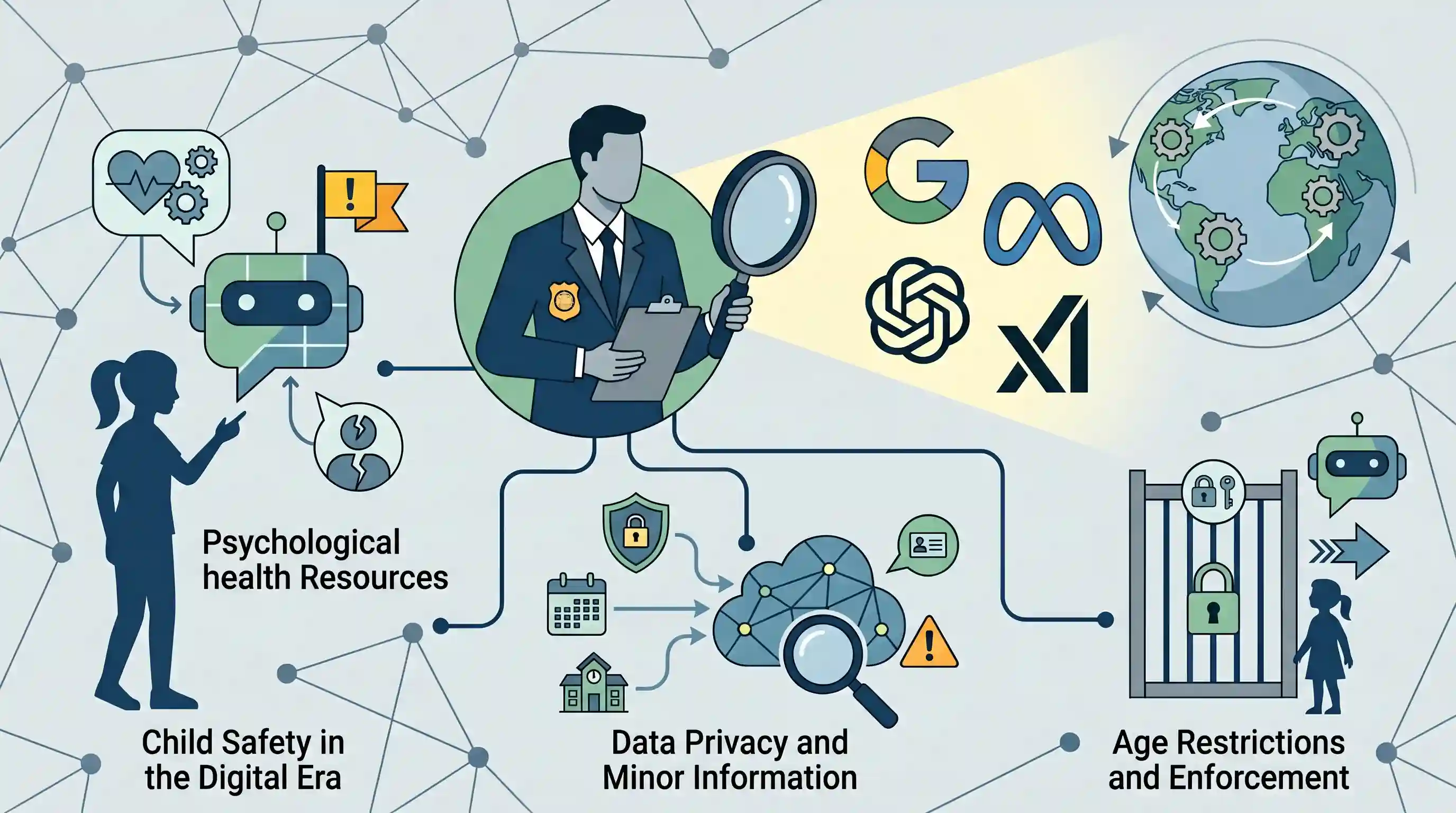
The U.S. Federal Trade Commission (FTC) has launched an investigation into major technology companies—including Alphabet, Meta, OpenAI, and xAI—over the safety of generative AI chatbots for children and teenagers. The probe aims to determine how these companies monitor and mitigate negative psychological impacts, handle the personal information of minors, and enforce age restrictions. This regulatory scrutiny follows concerns over chatbots acting as human-like digital companions, highlighted by incidents where AI failed to provide adequate mental health resources to vulnerable users. The inquiry reflects increasing global efforts to regulate emerging AI technologies and protect youth in the digital era.
Key Points
- The U.S. Federal Trade Commission (FTC) is investigating major tech companies regarding the risks their generative AI chatbots pose to children and teenagers.
- Companies under scrutiny include Alphabet, Meta, OpenAI, Snap, Character.AI, and xAI.
- The probe focuses on how these platforms mitigate negative psychological impacts, handle minors' personal data, and enforce age restrictions.
- The regulatory action underscores growing concerns over AI chatbots acting as 'digital companions' and their potential to cause harm, such as providing dangerous instructions or failing to offer mental health resources.
- The investigation aligns with a broader global push to regulate Artificial Intelligence and ensure digital spaces are safe for vulnerable populations.
Important Terms
Federal Trade Commission (FTC)

Independent U.S. agency (est. 1914) tasked with enforcing antitrust laws and protecting consumers from unfair or deceptive business practices. It serves as a primary regulator for the global technology sector.
UPSC context
GS Paper 2/3: Global regulatory frameworks and comparisons with India's Competition Commission (CCI) regarding Big Tech oversight.
OpenAI
AI research organization and developer of ChatGPT. It leads the development of Large Language Models (LLMs) and aims to create safe, beneficial Artificial General Intelligence (AGI).
UPSC context
GS Paper 3: Science & Technology; ethical challenges of Generative AI and global standards for AI safety.
Meta
Parent company of Facebook, Instagram, and WhatsApp. A major developer of open-source AI (Llama), it faces scrutiny over user data privacy and the psychological impact of social media.
UPSC context
GS Paper 2/3: Data privacy regulations, the DPDP Act 2023, and platform accountability for minor safety.
Alphabet
Parent company of Google and DeepMind. It dominates global search, cloud infrastructure, and AI development (Gemini), frequently facing antitrust investigations regarding market dominance.
UPSC context
GS Paper 3: Economy and S&T; issues of digital monopolies, algorithmic bias, and technological indigenization.
xAI
AI startup founded by Elon Musk in 2023 to develop "truth-seeking" AI like Grok. It focuses on high-level reasoning and challenges established AI norms from OpenAI and Google.
UPSC context
GS Paper 3: S&T; competitive dynamics in AI and the risks of unregulated or unfiltered chatbot outputs.
Character.AI
AI platform allowing users to interact with human-like chatbot personas. It is a focal point in debates over AI-driven "digital companions" and their psychological effects on children.
UPSC context
GS Paper 2: Social Justice; mental health implications of AI and the need for age-appropriate digital guardrails.
Prelims Trap
"The DPDP Act allows targeted advertising to minors if explicit parental consent is obtained."
The DPDP Act 2023 strictly prohibits tracking, behavioral monitoring, and targeted advertising directed at children, regardless of parental consent.
Static Concepts Connected
What are the provisions for children under India's Digital Personal Data Protection (DPDP) Act, 2023?
- Verifiable Consent: Data Fiduciaries must obtain verifiable, explicit consent from a parent or lawful guardian before processing a child's data.
- Prohibited Actions: The Act strictly bans tracking, behavioral monitoring, and targeted advertising directed at children (defined as anyone under 18).
- Conditional Exemptions: The government may lower the age threshold for specific platforms if they process data "verifiably safely."
What is the institutional mandate of NCPCR regarding digital safety?
- Statutory Basis: Set up under the CPCR Act, 2005 to ensure laws align with the UN Convention on the Rights of the Child (UNCRC).
- Cyber Safety Mandate: It monitors the POCSO Act's implementation, addressing online child sexual abuse materials (CSAM) and issuing digital safety guidelines for schools and parents.
Cross-Topic Patterns
DPDP Act + Algorithmic Training
AI chatbots scrape vast datasets for training. Under India's DPDP Act 2023, processing minors' data without verifiable parental consent creates severe legal and compliance hurdles for tech giants.
AI Ethics + Human-Like Companions
The anthropomorphization of AI (digital companions) tests GS4 concepts of emotional intelligence and corporate accountability, especially when vulnerable youth seek unverified mental health advice from algorithms.
Global AI Regulatory Divergence
While the EU enforces a rigid legislative model (EU AI Act), the U.S. relies on agency probes (FTC), contrasting with India's evolving, innovation-friendly DPDP framework.

Expect a GS2/GS4 question linking Generative AI 'digital companions' with child psychology risks and DPDP Act compliance.
Linked PYQs · 3
Linked PYQs · 3
- 2025MainsGS2
The National Commission for Protection of Child Rights has to address the challenges faced by children in the digital era. Examine the existing policies and suggest measures the Commission can initiate to tackle the issue.
- 2023MainsGS3
Introduce the concept of Artificial Intelligence (AI). How does Al help clinical diagnosis? Do you perceive any threat to privacy of the individual in the use of Al in healthcare?
- 2024MainsGS3
Social media and encrypting messaging services pose a serious security challenge. What measures have been adopted at various levels to address the security implications of social media? Also suggest any other remedies to address the problem.
