Multipolar Order and Global South Resistance to US Hegemony
Source:The Hindu ↗
Why It Matters
This highlights the ongoing geopolitical shift from unipolarity to multipolarity, marked by the weaponization of trade (tariffs/sanctions). It is crucial for understanding the rationale behind India's balancing act between Western partnerships and blocs like BRICS, as well as the macroeconomic implications of global protectionism.
Summary
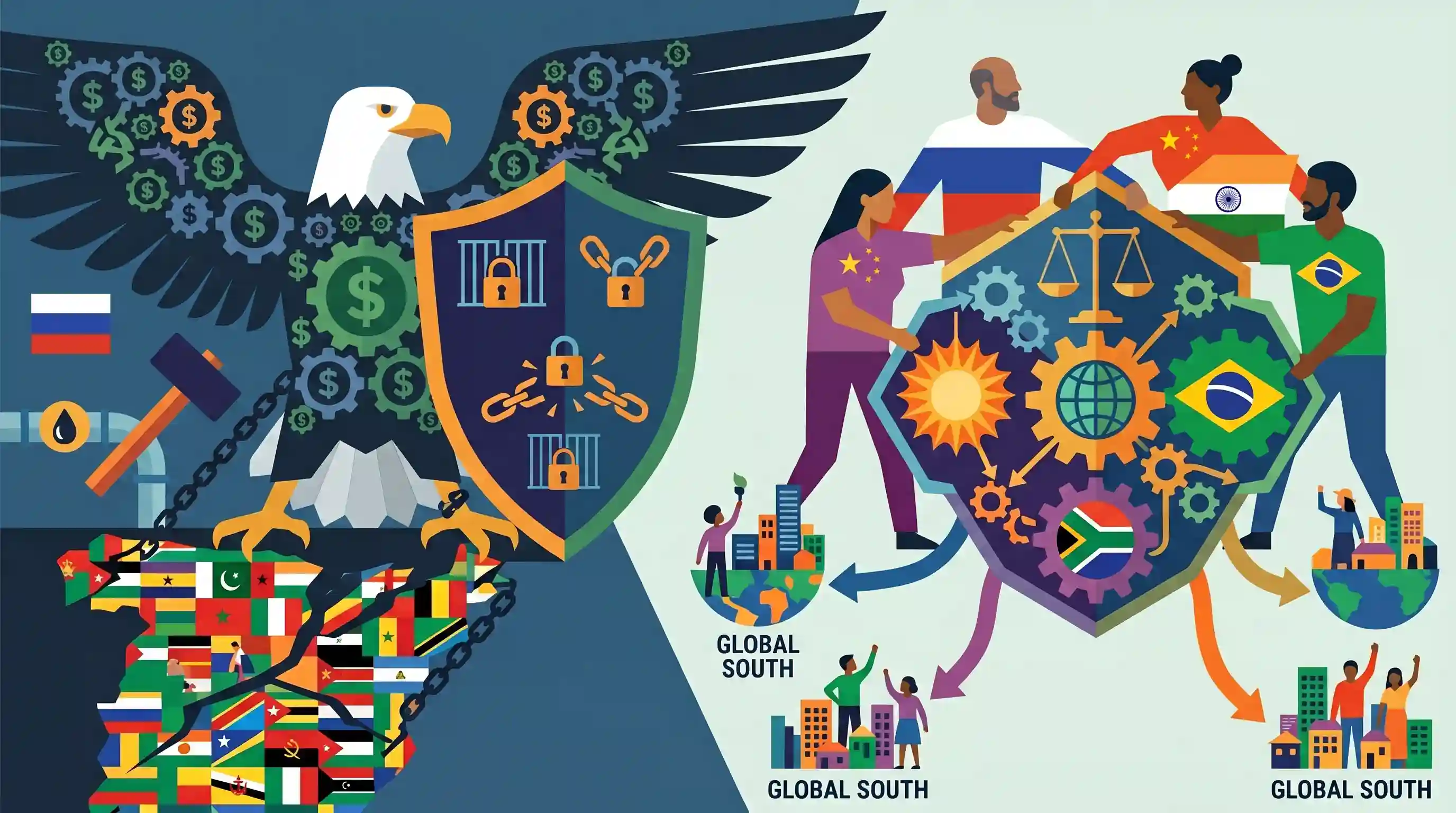
Russia has accused the United States of employing a "neocolonial policy" characterized by aggressive protectionism, sanctions, and arbitrary tariffs to maintain its global hegemony, particularly at the expense of Global South nations. Citing President Donald Trump's widespread tariff impositions—including actions against India for purchasing Russian oil—Moscow emphasized its commitment to strengthening cooperation with developing nations. Through platforms like BRICS, Russia is advocating for a multipolar, equal world order to counter Western dominance and bypass US-centric economic coercion.
Key Points
- Russia has condemned recent US trade policies, including sweeping tariffs and sanctions, as "neocolonial" tactics designed to maintain American global hegemony.
- US President Donald Trump has initiated widespread protectionist measures, including threats of high tariffs against countries bypassing the US dollar and specifically targeting India over its purchases of Russian oil.
- Moscow advocates for a shift towards a truly multilateral and equitable global order, prioritizing deeper engagement with the 'Global Majority' (developing nations).
- Russia highlighted the BRICS grouping as a critical platform for countries to safeguard their political and economic sovereignty and counter Western economic coercion.
Important Terms
BRICS

An intergovernmental group of major emerging economies (Brazil, Russia, India, China, South Africa, and recent expansion members) seeking to reform global governance.
UPSC context
GS Paper-II: Important international institutions and global groupings affecting India’s interests.
Global South
Nations in Africa, Asia, and Latin America with shared histories of colonization and common challenges in economic development and global representation.
UPSC context
GS Paper-II: India’s leadership role and agreements affecting the interests of developing nations.
Multipolar World Order
A global system where power is distributed among several major states or blocs, challenging unipolar dominance and promoting balanced global governance.
UPSC context
GS Paper-II: Evolving global power dynamics and India’s pursuit of strategic autonomy.
Neocolonialism
The indirect control or influence exerted by powerful nations over developing countries through economic pressure, financial leverage, or cultural dominance.
UPSC context
GS Paper-II: International relations theory and challenges to the sovereignty of developing nations.
Protectionism
Economic policies, such as tariffs and quotas, intended to restrict imports and shield a country's domestic industries from foreign competition.
UPSC context
GS Paper-III: Indian Economy and trade; GS Paper-II: Global trade wars and diplomacy.
US Hegemony
The military, economic, and cultural predominance of the United States in the international system, particularly defining the post-Cold War unipolar era.
UPSC context
GS Paper-II: Historical and contemporary global power structures and their impact on foreign policy.
Prelims Trap
"CAATSA is an internationally binding UN framework to impose sanctions on countries trading with Russia."
CAATSA is strictly a US domestic law. India does not recognize unilateral secondary sanctions, maintaining that it only adheres to UN-mandated international sanction frameworks.
Static Concepts Connected
What is "Strategic Autonomy" in India's Foreign Policy?
- Core Principle: Making sovereign foreign policy choices based purely on national interest, explicitly avoiding formal military alliances or blocs.
- Economic Independence: Securing domestic needs (e.g., buying discounted Russian crude oil) despite intense geopolitical pressure or the threat of Western secondary sanctions.
- Multi-alignment: Engaging concurrently with competing global powers (e.g., participating in the Quad with the US while active in SCO/BRICS with Russia).
How do Primary and Secondary Sanctions differ?
- Primary Sanctions: Prohibit citizens and companies of the sanctioning country from doing business directly with the targeted nation.
- Secondary Sanctions: Threaten third-party countries or foreign entities with penalties (e.g., denial of US financial markets) if they trade with the sanctioned country.
- Weaponization of Finance: Relies heavily on the dominance of the US dollar as the global reserve currency and control over networks like SWIFT.
Cross-Topic Patterns
De-dollarization & RBI's Vostro Accounts
The geopolitical push by BRICS to bypass US sanctions directly links to the RBI's framework allowing cross-border trade settlement in INR via Special Rupee Vostro Accounts (SRVAs).
Extraterritorial Sanctions vs WTO Rules
Aggressive unilateral tariffs and secondary sanctions challenge the WTO's Most-Favored-Nation (MFN) principle, raising frequent debates around the overuse of national security exceptions (Article XXI) in trade.

Expect a multi-statement Prelims question linking CAATSA's secondary sanctions, SWIFT bypass mechanisms, and RBI's Rupee Vostro accounts.
Linked PYQs · 4
Linked PYQs · 4
- 2025MainsGS2
"With the waning of globalization, post-Cold War world is becoming a site of sovereign nationalism.” Elucidate.
- 2025MainsGS2
"The reform process in the United Nations remains unresolved, because of the delicate imbalance of East and West and entanglement of the USA vs. Russo-Chinese alliance.” Examine and critically evaluate the East-West policy confrontations in this regard.
- 2025MainsGS3
What are the challenges before the Indian economy when the world is moving away from free trade and multilateralism to protectionism and bilateralism? How can these challenges be met?
- 2018MainsGS3
How would the recent phenomena of protectionism and currency manipulations in world trade affect macroeconomic stability of India?
