US Proposes Gaza Ceasefire and Hostage Exchange Plan
Source:The Hindu ↗
Why It Matters
The Israel-Palestine conflict is a core issue in Middle East geopolitics. The involvement of global powers (like the U.S.) and regional mediators (Egypt and Qatar) in peace processes is crucial for UPSC aspirants studying international relations, regional stability, and the impact of such conflicts on global security and humanitarian crises.
Summary
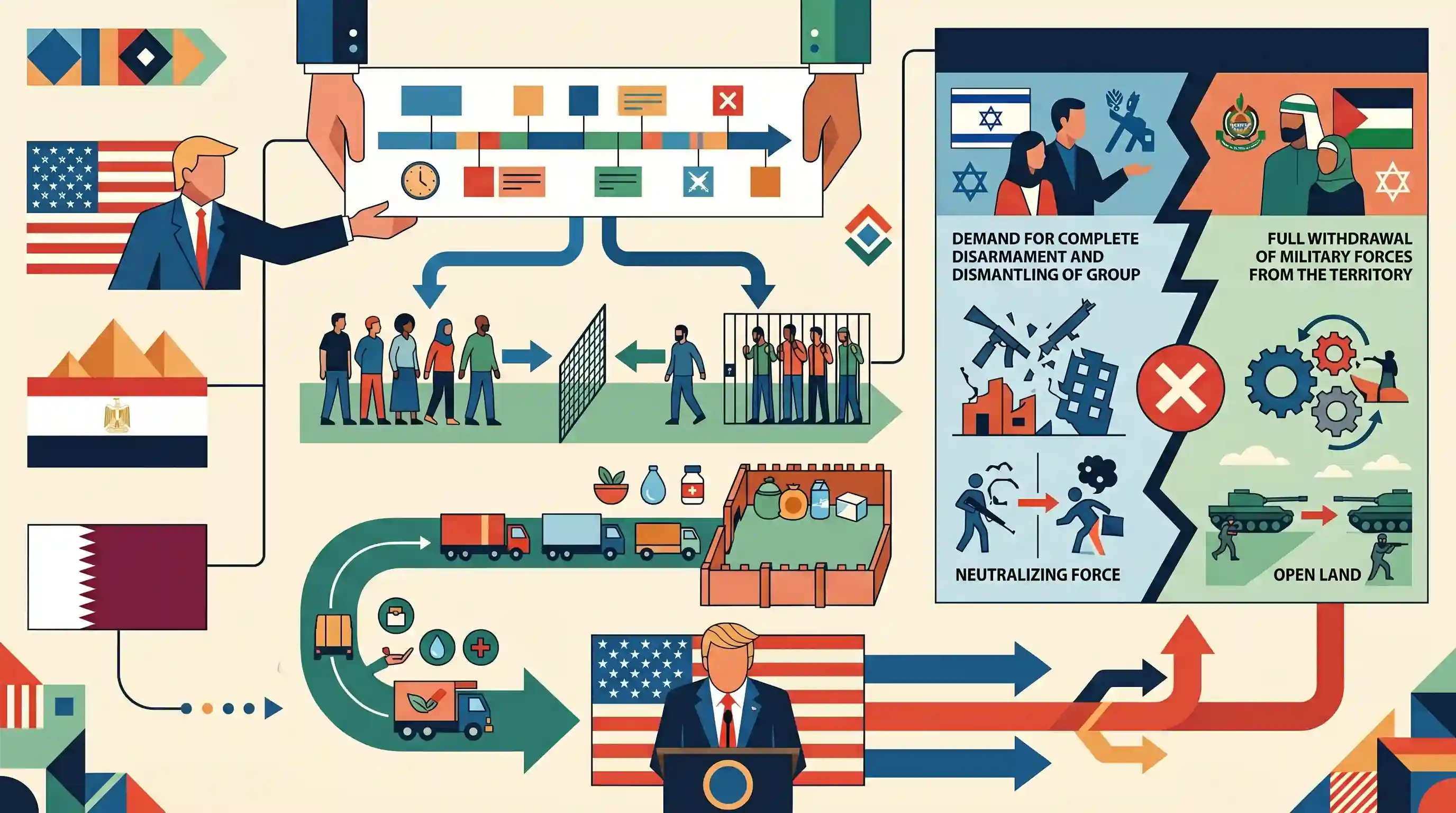
The United States, alongside mediators Egypt and Qatar, has proposed a 60-day ceasefire plan to halt the ongoing war in Gaza. The framework includes a phased exchange of Israeli hostages for Palestinian prisoners and ensures immediate humanitarian aid access to Gaza. Despite the diplomatic push, which involves backing from U.S. President Donald Trump, fundamental disagreements remain unresolved. Israel continues to demand the total disarmament and dismantling of Hamas, while Hamas insists on the complete withdrawal of Israeli forces from the territory.
Key Points
- The United States has presented a 60-day ceasefire proposal for Gaza, aimed at facilitating a hostage-prisoner exchange and pausing the conflict.
- The plan involves releasing 28 Israeli hostages in the first week in exchange for 125 Palestinian prisoners and the remains of 180 Palestinians.
- Significant humanitarian aid is promised to enter Gaza immediately upon Hamas signing the agreement.
- Major obstacles persist, particularly Israel's demand for the complete disarmament of Hamas and Hamas's insistence on a full Israeli troop withdrawal from Gaza.
- The diplomatic effort is mediated by Egypt, Qatar, and the U.S., with involvement from President Donald Trump, highlighting the geopolitical priority of Middle East stability.
Important Terms
Hamas

An Islamist political and military organization that has governed the Gaza Strip since 2007. It is a primary party to the current conflict with Israel.
UPSC context
GS Paper 2: International Relations; crucial for understanding non-state actors in West Asian security and India's regional diplomacy.
60-day ceasefire proposal
A diplomatic framework proposed by the US (specifically under Donald Trump) involving a phased hostage-for-prisoner exchange to halt hostilities and allow humanitarian aid.
UPSC context
GS Paper 2: Conflict Resolution; tests understanding of phased diplomatic agreements and the role of major powers in mediation.
Two-State Solution
The proposed long-term diplomatic resolution establishing an independent State of Palestine alongside the State of Israel, based on pre-1967 borders.
UPSC context
GS Paper 2: India's Foreign Policy; represents India's consistent stance on the Israel-Palestine issue.
International Stabilization Force (ISF)
A proposed multinational peacekeeping body, including Arab state participation, intended to maintain security and oversee Gaza's transition post-ceasefire.
UPSC context
GS Paper 2: International Institutions; relevant for questions on peacekeeping, regional security architectures, and international oversight.
Technocratic Administration
A proposed non-partisan Palestinian governing body composed of experts rather than politicians, designed to manage Gaza's reconstruction under external oversight.
UPSC context
GS Paper 2: Governance/International Relations; deals with transitional governance models in post-conflict zones.
Mediators
States or organizations (e.g., Egypt, Qatar, US) acting as intermediaries to facilitate negotiations between conflicting parties who do not talk directly.
UPSC context
GS Paper 2: Global Diplomacy; focuses on the strategic roles of regional powers in stabilizing West Asia.
Prelims Trap
The current Gaza ceasefire talks are primarily brokered by Saudi Arabia and the United Nations.
The official mediating troika comprises the US, Egypt, and Qatar. Qatar is crucial due to its unique channels with Hamas; Saudi Arabia is not formally mediating this specific ceasefire.
Static Concepts Connected
What are the exact geographical boundaries of the Gaza Strip?
- South-West: Shares a 13-km border with Egypt's Sinai Peninsula, historically controlled through the Rafah border crossing.
- East and North: Shares a heavily fortified 51-km land border entirely with Israel.
- West: The coastline opens strictly to the Mediterranean Sea, offering no access to the Red Sea.
What is the significance of the Oslo Accords in the Israel-Palestine conflict?
- Mutual Recognition: Marked the first time the State of Israel and the Palestine Liberation Organization (PLO) officially recognized each other's right to exist.
- Self-Governance: Created the Palestinian Authority (PA) to oversee limited self-rule in parts of the West Bank and the Gaza Strip.
- Final Status Issues: Deferred core issues like Jerusalem's status, borders, and Palestinian refugees to a permanent status treaty that never materialized.
Cross-Topic Patterns
Levant Geography & Conflict Maps
UPSC frequently tests Mediterranean border nations. The sustained Gaza conflict makes the Levant coast, Sinai Peninsula, and strategic choke points highly probable map-based questions for Prelims.
Middle Powers in Global Diplomacy
Qatar and Egypt's central mediating role underscores a global shift where regional "middle powers" increasingly anchor critical conflict resolution, mirroring Turkey's role in the Black Sea grain deal.

Expect a 2026 Prelims map question pairing Gaza/Levant bordering water bodies (Mediterranean) with regional crossings like Rafah.
Linked PYQs · 4
Linked PYQs · 4
- 2023PrelimsGS1
Consider the following statements: Statement-I: Israel has established diplomatic relations with some Arab States. Statement-II: The 'Arab Peace Initiative' mediated by Saudi Arabia was signed by Israel and Arab League. Which one of the following is correct in respect of the above statements?
- 2022PrelimsGS1
The term "Levant" often heard in the news roughly corresponds to which of the following regions?
- 2018MainsGS2
“India’s relations with Israel have, of late, acquired a depth and diversity, which cannot be rolled back.” Discuss.
- 2019MainsGS2
‘Too little cash, too much politics, leaves UNESCO fighting for life.’ Discuss the statement in the light of US' withdrawal and its accusation of the cultural body as being 'anti-Israel bias'.
