US Tariffs on Timber and Furniture Take Effect Under National Security
Source:The Hindu ↗
Why It Matters
The escalation of protectionist policies by the US, specifically invoking 'national security' to bypass standard free trade norms, signifies a structural shift in global trade dynamics. It heavily impacts global supply chains, international relations, and can disrupt the macroeconomic stability of developing nations by encouraging protectionist retaliation.
Summary
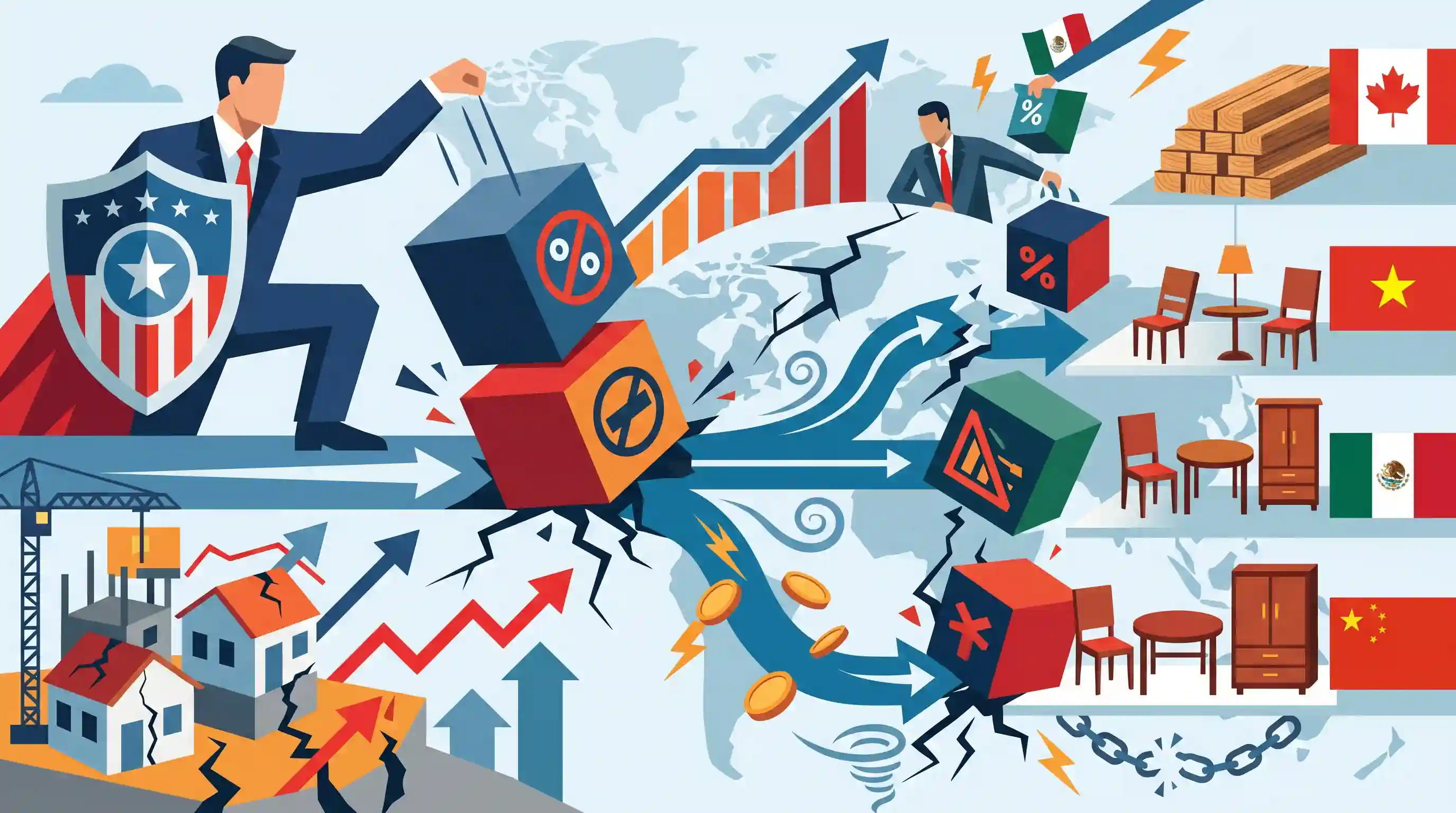
U.S. President Donald Trump has implemented new tariffs on imported timber, furniture, and kitchen cabinets, invoking national security under Section 232 of the Trade Expansion Act of 1962. Duties of 10% on softwood lumber and up to 50% on furniture are expected to strain the already-challenged U.S. housing market by increasing construction costs. The move significantly impacts top suppliers, including Canada for lumber, and Vietnam, Mexico, and China for furniture. This policy marks another escalation in Trump's broader global trade war, which has prompted retaliatory measures from multiple nations and increased geopolitical and economic uncertainty.
Key Points
- U.S. President Donald Trump imposed tariffs of 10% on softwood lumber and 25%-50% on upholstered furniture and kitchen cabinets.
- The tariffs were invoked under Section 232 of the Trade Expansion Act of 1962, citing national security, asserting that wood products are critical for defense infrastructure.
- The policy is expected to exacerbate challenges in the U.S. housing market by driving up construction and renovation costs.
- Major suppliers affected include Canada (lumber), and China, Vietnam, and Mexico (furniture).
- These tariffs are part of a broader, escalating global trade war characterised by retaliatory measures from trading partners and a shift away from multilateral free trade.
Important Terms
Section 232 of the Trade Expansion Act of 1962

A U.S. law empowering the President to impose tariffs or quotas if the Department of Commerce determines that imports threaten "national security."
UPSC context
GS Paper II/III; tests knowledge of protectionist legal frameworks and unilateral trade actions bypassing international norms.
World Trade Organization (WTO)
The global intergovernmental organization regulating international trade rules and resolving disputes among 164 member nations via a rules-based framework.
UPSC context
GS Paper II; central to discussions on multilateralism, the Marrakesh Agreement, and challenges to the rules-based global order.
Commerce Department (US)
The U.S. executive agency responsible for promoting industry and conducting investigations into whether foreign trade practices or imports harm domestic economic security.
UPSC context
GS Paper III; relevant for understanding the administrative processes behind trade barriers and their impact on global supply chains.
BRICS
An intergovernmental organization of major emerging economies (including India) focusing on economic cooperation and the promotion of a multipolar global trade system.
UPSC context
GS Paper II; critical for understanding India's strategic response to Western protectionism and the rise of alternative trade blocs.
European Union (EU)
A 27-member political and economic union that operates as a single market and a powerful bloc in global trade negotiations.
UPSC context
GS Paper II; highlights the role of regional groupings in retaliatory trade measures and transatlantic economic relations.
US Supreme Court
The highest U.S. judicial body, which adjudicates the constitutional limits of presidential authority to impose tariffs without express Congressional consent.
UPSC context
GS Paper II (Comparative Constitutions); relevant for studying the 'Separation of Powers' and judicial checks on executive trade policy.
Prelims Trap
The US imposed tariffs on timber under the WTO's anti-dumping and countervailing duty framework.
These are not standard trade remedies (anti-dumping/countervailing) meant to correct market distortions; they are unilateral tariffs imposed under a domestic 'national security' law, bypassing standard WTO protocols.
Static Concepts Connected
How does GATT Article XXI permit unilateral trade restrictions?
- Security Exception: Allows WTO members to breach trade obligations (like MFN principles) to protect their essential security interests.
- WTO Reviewability: Historically treated as self-judging, though recent WTO panels have asserted the right to review if actions genuinely relate to national security during emergencies.
- Risk of Misuse: Increasingly invoked by nations (e.g., US Section 232) to justify broad economic protectionism, weakening the multilateral rule-based trading system.
What are the 3 primary trade remedy measures allowed under WTO?
- Anti-Dumping Duties: Imposed on imports that are priced below their fair, normal market value in the exporting country, causing injury to domestic players.
- Countervailing Duties: Levied to neutralize the negative effects of unfair subsidies provided by the exporting country's government to its producers.
- Safeguard Measures: Temporary import restrictions applied to protect a specific domestic industry from a sudden, unforeseen surge in imports.
Cross-Topic Patterns
Import tariffs and imported inflation
Protectionist barriers on intermediate goods like timber disrupt supply chains, raising domestic manufacturing and construction costs. This structurally fuels 'imported inflation' and complicates central bank monetary policy.
Tariffs accelerating China-Plus-One shifts
Escalating US tariffs push global supply chains toward alternative hubs like Vietnam, Mexico, and India. This 'China-Plus-One' restructuring creates new FDI and export integration opportunities for developing economies.

Expect a GS3 Mains question evaluating how Western protectionism under 'national security' clauses accelerates China-Plus-One supply shifts.
Linked PYQs · 3
Linked PYQs · 3
- 2025MainsGS3
What are the challenges before the Indian economy when the world is moving away from free trade and multilateralism to protectionism and bilateralism? How can these challenges be met?
- 2018MainsGS3
How would the recent phenomena of protectionism and currency manipulations in world trade affect macroeconomic stability of India?
- 2025MainsGS2
"With the waning of globalization, post-Cold War world is becoming a site of sovereign nationalism.” Elucidate.
