US Imposes Sweeping Reciprocal Tariffs on Dozens of Trading Partners
Source:The Hindu ↗
Why It Matters
The shift from multilateral free trade to aggressive bilateral protectionism by the US is a critical issue for the Indian economy and its foreign policy. It impacts India's export competitiveness, strategic autonomy (e.g., buying Russian oil), and necessitates recalibration of international trade strategies.
Summary
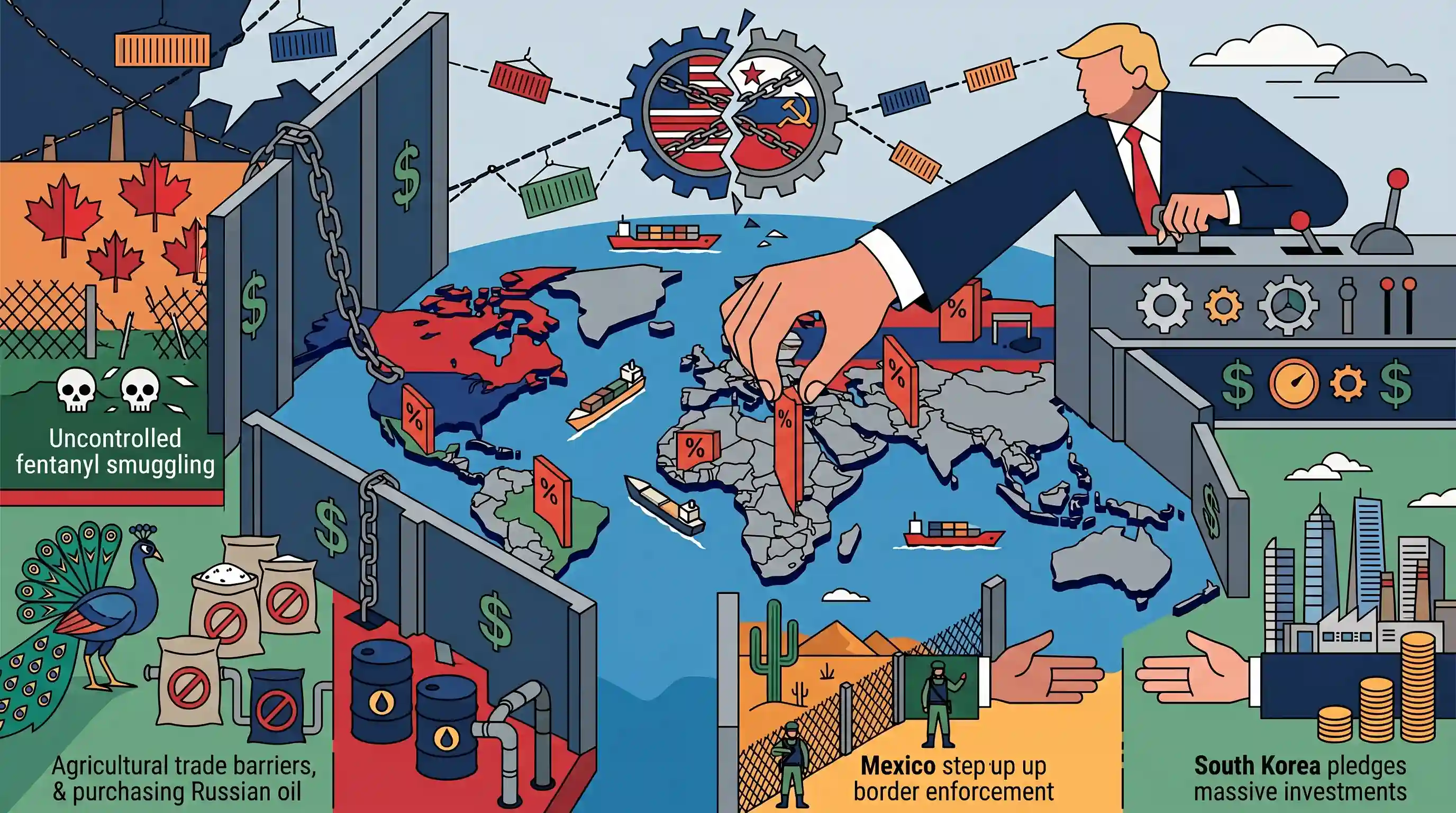
U.S. President Donald Trump has implemented a massive wave of trade protectionism by imposing steep "reciprocal tariffs" on 69 countries, leveraging trade to achieve geopolitical and economic demands. The tariffs, authorized under the 1977 International Emergency Economic Powers Act, include a 35% duty on Canada for failing to block fentanyl smuggling and a 25% tariff on India for maintaining agricultural trade barriers and purchasing Russian oil. Conversely, countries that negotiated concessions—such as Mexico stepping up border enforcement or South Korea pledging $350 billion in investments—received reprieves or reduced rates. This aggressive shift fundamentally challenges multilateral free trade agreements like the USMCA and forces export-oriented economies to navigate a heavily transactional and protectionist global order.
Key Points
- US President Donald Trump imposed reciprocal tariffs ranging from 10% to 41% on 69 trading partners, marking a major escalation in protectionist trade policies.
- Canada was hit with a 35% tariff over inadequate action to curb fentanyl flows into the US, effectively overriding USMCA free-trade provisions.
- India faced a 25% tariff due to disputes over US agricultural market access and as a penalty for its continued purchase of discounted Russian oil.
- Mexico received a 90-day reprieve from higher tariffs after committing to intercept fentanyl precursors, while South Korea negotiated a lower 15% tariff in exchange for $350 billion in US investment pledges.
- The sweeping tariff regime was authorized using the 1977 International Emergency Economic Powers Act, shifting global trade further from multilateralism to transactional bilateralism.
Important Terms
International Emergency Economic Powers Act (IEEPA)

A 1977 U.S. law granting the President authority to regulate international commerce during a declared "national emergency." Recently debated for its use in imposing tariffs, which was restricted by a 2026 U.S. Supreme Court ruling.
UPSC context
GS Paper 2 & 3: Executive power in global trade, legal challenges to protectionism, and impact on international economic relations.
USMCA (United States-Mexico-Canada Agreement)
A trilateral trade agreement between the U.S., Mexico, and Canada that replaced NAFTA in 2020. It includes stricter automotive rules of origin, increased dairy market access, and modernized labor and digital trade provisions.
UPSC context
GS Paper 2: Regional trade blocs and their impact on India’s export competitiveness and global supply chains.
World Trade Organization (WTO)
A global organization regulating trade rules between nations. It operates via negotiated agreements and a dispute settlement body, promoting the principle of non-discrimination through "Most Favoured Nation" status.
UPSC context
GS Paper 2 & 3: Challenges to multilateralism, trade wars, and the relevance of international institutions in a protectionist era.
Reciprocal Tariffs
A trade policy where a country imposes import duties that match the rates its trading partners charge on its own exports. It aims to equalize trade imbalances through product-by-product parity.
UPSC context
GS Paper 3: Modern trade strategies, bilateral negotiations, and departures from multilateral non-discriminatory norms.
Trade Protectionism
Economic policy of restricting imports from foreign countries through tariffs, quotas, or subsidies to shield domestic industries and workers from competition. It often prioritizes national interest over global efficiency.
UPSC context
GS Paper 3: Effects of globalization vs. de-globalization, impact on domestic manufacturing, and global economic growth.
Most Favoured Nation (MFN) Status
A WTO principle stating that a country must treat all its trading partners equally. If a country grants a special trade favor to one member, it must do the same for all.
UPSC context
GS Paper 3: Core principles of the multilateral trading system and the legal implications of non-reciprocal or targeted tariffs.
Prelims Trap
The International Emergency Economic Powers Act (IEEPA) is a WTO-mandated mechanism to enforce reciprocal tariffs.
IEEPA is a US domestic federal law from 1977, not a WTO instrument. The US is acting unilaterally, bypassing WTO multilateral dispute resolution entirely.
Static Concepts Connected
What are the key exceptions allowed under WTO agreements?
- Article XXI (GATT): Allows member countries to breach WTO obligations to protect their "essential security interests." Historically rarely used, now increasingly weaponized.
- Article XX (GATT): General exceptions for measures necessary to protect public morals, or human, animal or plant life or health.
- Enforcement crisis: Unilateral use of these exceptions is rising, exploiting the currently paralyzed WTO Appellate Body which cannot finalize dispute resolutions.
How do WTO trade remedy measures differ from unilateral tariffs?
- Trade Remedies: WTO-compliant measures like Anti-Dumping and Countervailing Duties that require transparent prior investigation to prove dumping or unfair subsidies.
- Unilateral Tariffs: Imposed outside WTO dispute mechanisms, often using domestic laws (like the US IEEPA) purely for geopolitical leverage or protectionism.
Cross-Topic Patterns
Geoeconomics: Trade as a security weapon
Linking trade tariffs to border security (fentanyl) and IR alignments (Russian oil) shows the complete collapse of the firewall between GS2 International Relations and GS3 Economy.
Extraterritoriality of domestic laws
The use of the US domestic IEEPA to punish countries parallels CAATSA, highlighting a recurring theme of US extraterritoriality overriding established UN and WTO frameworks.

Expect a 2026 Mains question on the shift from WTO-backed multilateralism to transactional bilateralism using domestic security laws.
Linked PYQs · 3
Linked PYQs · 3
- 2025MainsGS3
What are the challenges before the Indian economy when the world is moving away from free trade and multilateralism to protectionism and bilateralism? How can these challenges be met?
- 2019MainsGS2
‘What introduces friction into the ties between India and the United States is that Washington is still unable to find for India a position in its global strategy, which would satisfy India's national self-esteem and ambitions.’ Explain with suitable examples.
- 2018PrelimsGS1
Consider the following countries: 1. Australia 2. Canada 3. China 4. India 5. Japan 6. USA Which of the above are among the 'free-trade partners' of ASEAN?
