Bilateral Trade Friction and Strategic Energy Autonomy for India
Source:The Hindu ↗
Why It Matters
This issue sits at the cross-section of GS2 (Bilateral Relations, Foreign Policy) and GS3 (International Trade, Economy). It highlights the challenges India faces in navigating multipolar geopolitical rivalries, securing its energy interests, and dealing with rising protectionism from key trading partners.
Summary
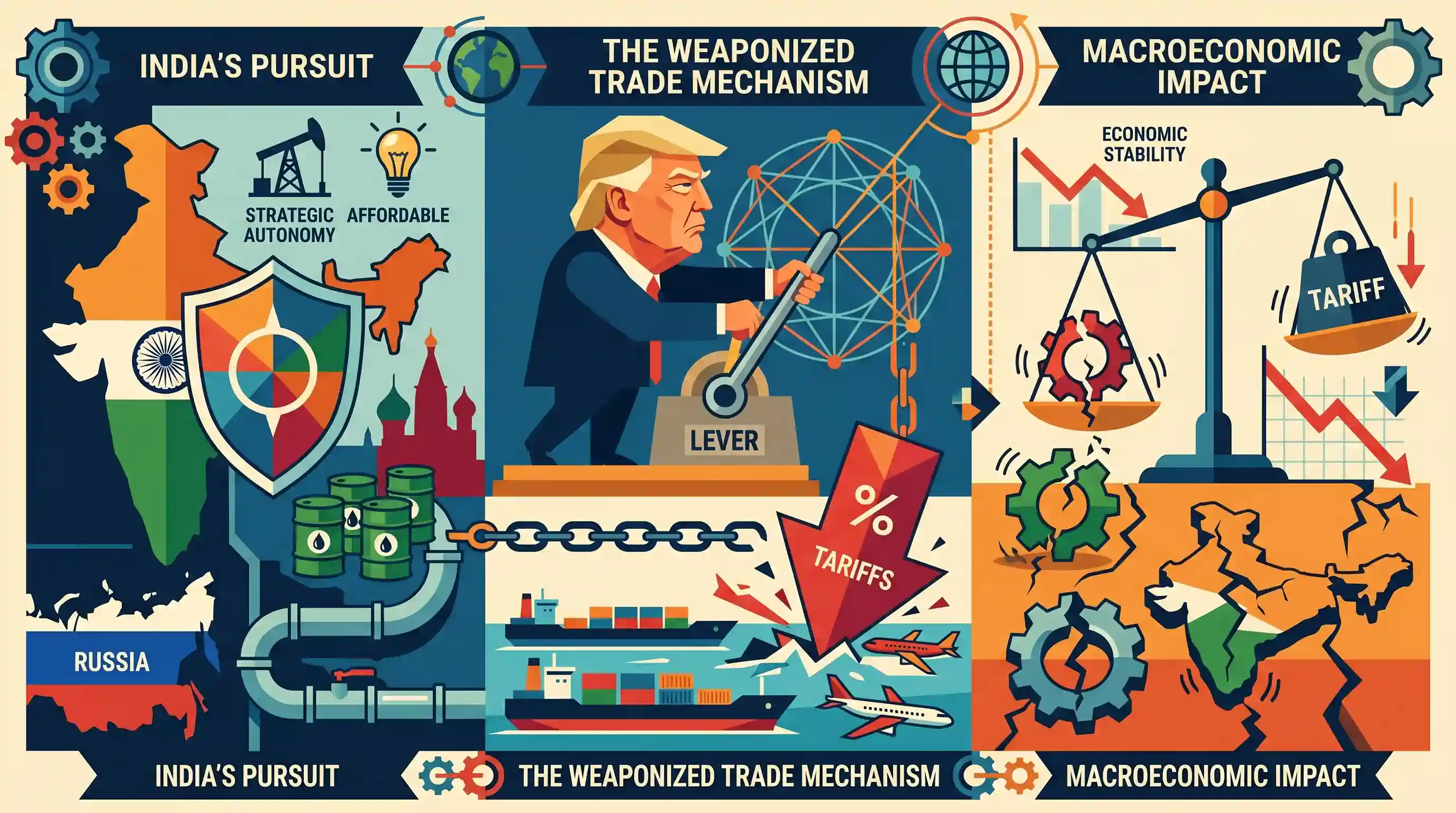
US President Donald Trump has stated his intention to significantly raise tariffs on goods from India in response to New Delhi's continued purchase of Russian oil. The development underscores the friction between the US administration's hardline geopolitical strategies—aimed at curtailing Russia's oil revenues—and India's pursuit of strategic autonomy to secure affordable energy resources. The threat of heightened tariffs also reflects a broader trend of weaponizing trade policies for geopolitical objectives, potentially impacting the macroeconomic stability of emerging economies like India.
Key Points
- US President Donald Trump announced intentions to substantially raise tariffs on Indian imports, citing India's ongoing purchases of Russian oil.
- The move represents an intersection of trade protectionism and geopolitical coercion, using economic levers to enforce Western stances against Russia.
- India has historically maintained strategic autonomy in its energy purchases, prioritizing national energy security despite Western pressure to limit economic ties with Russia.
- The threat of tariffs poses significant macroeconomic challenges to India's export-oriented sectors and escalates risks of a broader trade dispute.
Important Terms
Strategic Autonomy

Doctrine emphasizing sovereign decision-making in foreign affairs based on national interest, allowing India to engage with multiple rival powers (multi-alignment) without formal military alliances.
UPSC context
GS Paper 2 (IR); tests India’s multi-alignment posture and its resistance to external diplomatic pressure in a multipolar world.
Ministry of External Affairs (MEA)
Nodal government department responsible for formulating and implementing India’s foreign policy, conducting diplomacy, and representing the nation in international organizations like the United Nations.
UPSC context
GS Paper 2 (Governance/IR); tests knowledge of institutional frameworks managing India's foreign relations and diplomatic responses.
Geopolitics of Energy
The intersection of energy resource control, supply routes, and international politics, where access to energy influences global power dynamics and national security strategies.
UPSC context
GS Paper 2 (IR); essential for analyzing how energy dependencies shape India’s bilateral ties with global powers.
Trade Protectionism
Economic policy of restricting imports through methods like tariffs or quotas to protect domestic industries or as a tool of geopolitical coercion in trade disputes.
UPSC context
GS Paper 3 (Economy); tests the impact of global trade wars on India's export-led growth and macroeconomic stability.
Tariffs
Taxes or duties imposed by a government on imported goods, used to protect domestic producers, raise revenue, or as retaliatory measures against trading partners.
UPSC context
GS Paper 3 (Economy); fundamental to understanding trade policy, bilateral economic friction, and WTO-related disputes.
Energy Security
The uninterrupted availability of energy sources at an affordable price, which is critical for a nation's economic growth, industrial stability, and development.
UPSC context
GS Paper 3 (Infrastructure/Energy); key for discussions on resource diversification and national economic resilience against global supply shocks.
Prelims Trap
WTO rules strictly prohibit unilateral tariff hikes for geopolitical reasons.
Aspirants often forget GATT Article XXI (National Security Exception), which allows WTO members to breach trade obligations and impose unilateral tariffs to protect essential security interests.
Static Concepts Connected
What is the Generalized System of Preferences (GSP) in international trade?
- Preferential system: A US trade preference program intended to promote economic growth in developing countries by allowing duty-free entry for certain designated goods.
- Non-reciprocal: Developed countries grant tariff concessions to developing countries without expecting reciprocal market access in return.
- India's status: The US terminated India's designation as a beneficiary developing country under the GSP program in 2019, claiming lack of equitable market access.
What is the National Security Exception under the WTO framework?
- GATT Article XXI: Contained in GATT Article XXI, it allows member countries to bypass WTO obligations if deemed necessary for the protection of their essential security interests.
- Growing misuse: Increasingly invoked by major economies to justify unilateral tariffs, economic sanctions, and trade wars, often bypassing the traditional WTO dispute settlement mechanism.
Cross-Topic Patterns
From CAATSA to Tariff Weaponization
The US previously used CAATSA to threaten India over Russian S-400 defense systems. The shift to tariff threats over oil shows trade policy being heavily weaponized alongside defense diplomacy.
Strategic Autonomy vs Export Stability
India's quest for cheap Russian crude stabilizes domestic inflation but now threatens its macro-economic export stability if its largest trading partner (US) imposes retaliatory tariffs.

Mains 2026 will likely test how US trade weaponization (tariffs) challenges India's strategic autonomy in energy security.
Linked PYQs · 3
Linked PYQs · 3
- 2025MainsGS2
"Energy security constitutes the dominant kingpin of India's foreign policy, and is linked with India's overarching influence in Middle Eastern countries.” How would you integrate energy security with India's foreign policy trajectories in the coming years?
- 2025MainsGS3
What are the challenges before the Indian economy when the world is moving away from free trade and multilateralism to protectionism and bilateralism? How can these challenges be met?
- 2018MainsGS3
How would the recent phenomena of protectionism and currency manipulations in world trade affect macroeconomic stability of India?
