US Tariffs and Diplomatic Friction Over India Russia Ties
Source:The Hindu ↗
Why It Matters
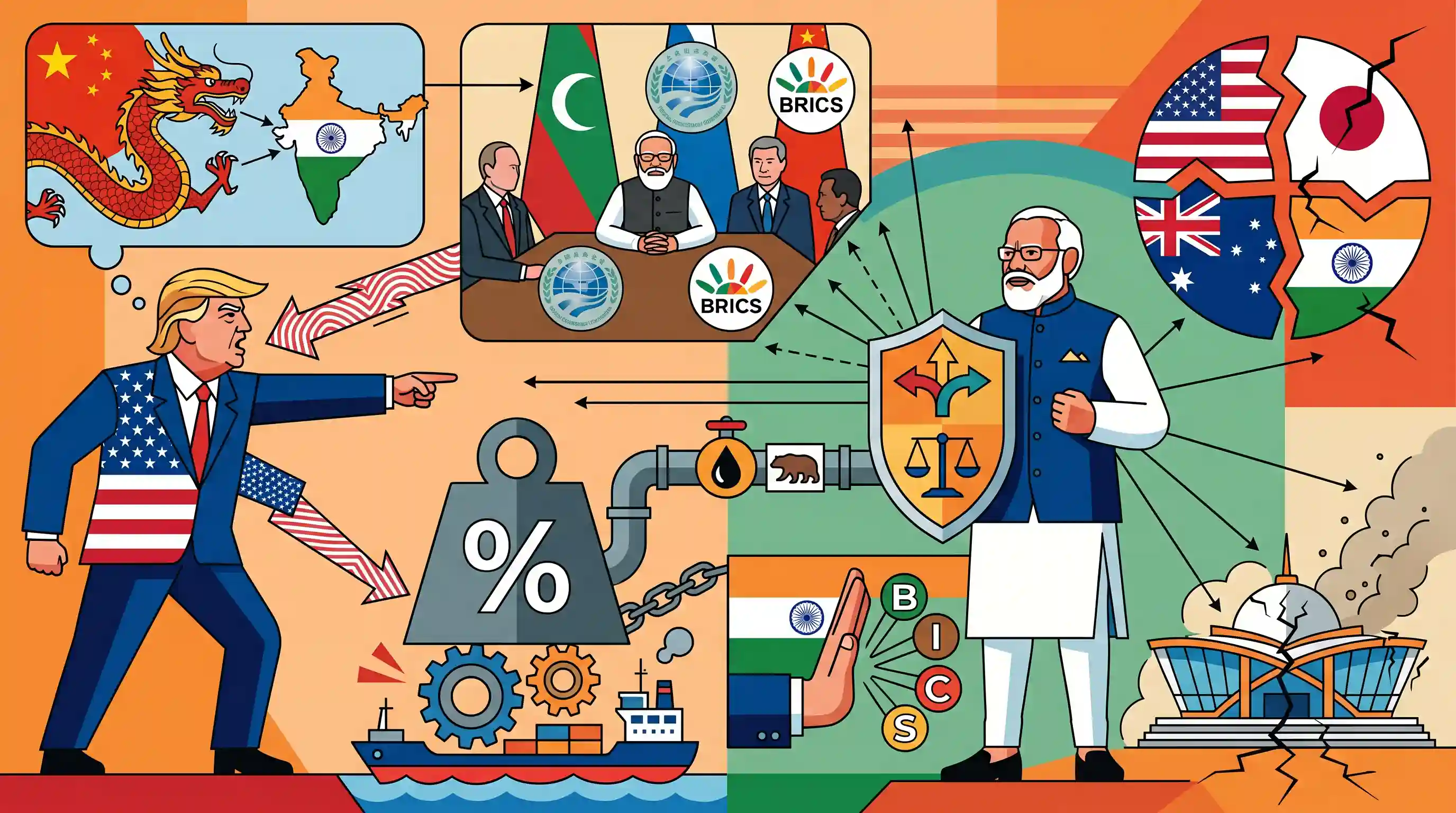
The article highlights the complexities and friction points in India-US ties when Washington pressures New Delhi over its strategic autonomy. It provides a real-world example of how India's multi-alignment strategy—balancing Western partnerships (Quad) with non-Western platforms (SCO, BRICS)—is tested by aggressive trade protectionism and geopolitical polarization.
Summary
U.S. President Donald Trump claimed the U.S. has "lost" India to China, pointing to PM Modi's attendance at the SCO summit. Amidst growing diplomatic strain, the Trump administration imposed a 50% tariff on Indian imports over its Russian oil trade and urged New Delhi to leave BRICS. The Ministry of External Affairs dismissed the statements as a miscalculation of India's strategic autonomy and multi-aligned foreign policy. The escalating rift has cast uncertainty over the future of the Quad, with doubts surrounding the upcoming leaders' summit scheduled to be hosted by India.
Key Points
- U.S. President Donald Trump claimed the U.S. has "lost" India to China, citing PM Modi's participation alongside Russian and Chinese leaders at the SCO summit in Tianjin.
- The U.S. imposed a 50% punitive tariff on Indian imports, explicitly targeting India's purchase of discounted Russian crude oil amidst the Ukraine conflict.
- U.S. Commerce Secretary Howard Lutnick pressured India to exit BRICS, while trade aide Peter Navarro controversially accused Indians of "profiteering" from the Russian oil trade.
- India's MEA dismissed the U.S. claims as a "miscalculation" of India's position, firmly defending its traditional strategic autonomy and multi-aligned foreign policy.
- The diplomatic row casts uncertainty over the upcoming Quad leaders' summit to be hosted by India, with doubts over whether President Trump will attend.
Important Terms
Strategic Autonomy

India’s ability to make independent foreign policy and defense decisions based on national interest, without being bound by external pressures or formal military alliances.
UPSC context
GS-II: Indian Foreign Policy. Tests understanding of sovereignty and independent decision-making in a multipolar world.
Multi-alignment
A pragmatic foreign policy approach involving engagement with multiple, often competing, global powers and blocs simultaneously to maximize national leverage.
UPSC context
GS-II: International Relations. Relevant for analyzing India's participation in both Western-led and non-Western forums.
Shanghai Cooperation Organisation (SCO)
A Eurasian intergovernmental organization focused on regional security, counter-terrorism, and economic cooperation; India became a full member in 2017.
UPSC context
GS-II: Regional Groupings. Important for topics on regional security, counter-terrorism (RATS), and Central Asian connectivity.
BRICS
A group of major emerging economies (originally Brazil, Russia, India, China, South Africa) acting as a platform for the Global South.
UPSC context
GS-II: Global Groupings. Tests knowledge of South-South cooperation and alternatives to Western-led financial institutions.
Quad (Quadrilateral Security Dialogue)
An informal strategic partnership between India, US, Japan, and Australia aimed at ensuring a free and open Indo-Pacific.
UPSC context
GS-II: Regional Groupings. Essential for topics concerning maritime security and balancing China's regional influence.
Ministry of External Affairs (MEA)
The Indian government department responsible for managing foreign relations, diplomatic missions, and representing the country in international organizations.
UPSC context
GS-II: Indian Constitution/Institutions. Tests understanding of the executive’s role in shaping and implementing foreign policy.
Prelims Trap
India is a founding member of the Shanghai Cooperation Organisation (SCO).
India and Pakistan were not founding members; they joined as full members in 2017 at the Astana Summit. The SCO was founded in 2001.
Static Concepts Connected
How does 'Multi-alignment' differ from traditional 'Non-Alignment' (NAM)?
- Non-Alignment: Focused historically on remaining equidistant and detached from Cold War power blocs to preserve political independence.
- Multi-alignment: Proactive, concurrent engagement with multiple, often competing, global poles (e.g., US, Russia, China) to maximize national interests.
- Issue-based pragmatism: Multi-alignment focuses on aligning with different groupings for specific goals (e.g., Quad for maritime security, BRICS for economic multi-polarity).
What are the core components and membership of the SCO?
- Origins: Created in 2001 by China, Russia, Kazakhstan, Kyrgyzstan, Tajikistan, and Uzbekistan (evolving from the Shanghai Five).
- RATS Framework: The Regional Anti-Terrorist Structure (RATS), headquartered in Tashkent, is a permanent organ combating terrorism, separatism, and extremism.
- Recent Expansions: India and Pakistan joined in 2017; Iran joined in 2023, and Belarus in 2024, significantly expanding its Eurasian footprint.
Cross-Topic Patterns
Weaponization of Trade & WTO Exceptions
US imposing 50% tariffs over oil trade relies on domestic laws rather than WTO mechanisms, highlighting the increasing use of GATT Article XXI (National Security Exception) for geopolitical coercion.
Energy Security vs. Macroeconomic Stability
India's defense of Russian crude purchases links its foreign policy directly to macroeconomics—securing discounted energy is critical to managing domestic inflation and the current account deficit.

Expect a 2026 Mains question assessing the limits of India's 'multi-alignment' doctrine amid severe US-China bipolarity and trade tariffs.
Linked PYQs · 3
Linked PYQs · 3
- 2019MainsGS2
‘What introduces friction into the ties between India and the United States is that Washington is still unable to find for India a position in its global strategy, which would satisfy India's national self-esteem and ambitions.’ Explain with suitable examples.
- 2021MainsGS2
Critically examine the aims and objectives of SCO. What importance does it hold for India?
- 2020MainsGS2
Quadrilateral Security Dialogue (Quad)' is transforming itself into a trade bloc from a military alliance, in present times - Discuss.
