US Tech Exemptions from Semiconductor Tariffs and AI Policy
Source:The Hindu ↗
Why It Matters
The article highlights the intersection of industrial policy, geopolitics, and emerging technologies. For UPSC aspirants, understanding how nations balance protectionist trade measures (like tariffs) with the need to dominate in strategic sectors like AI and semiconductors is crucial for GS2 (International Relations) and GS3 (Economy and S&T).
Summary
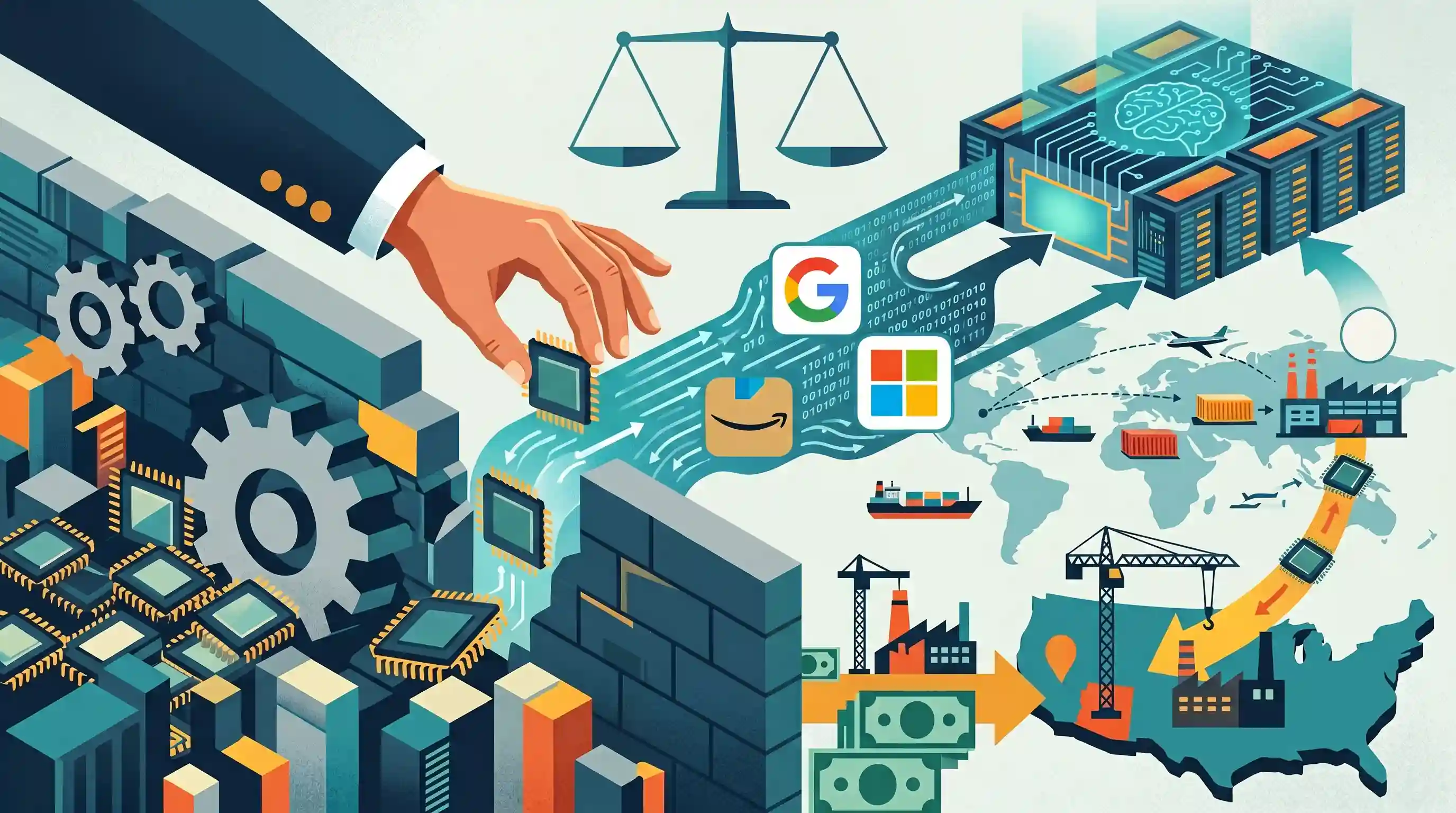
The incoming U.S. administration under Donald Trump is reportedly planning to provide "carve-outs" for major tech firms like Amazon, Google, and Microsoft from impending tariffs on semiconductor chips. These exemptions are designed to protect the development of massive Artificial Intelligence (AI) data centers, which heavily rely on imported chips. The policy is expected to be tied to investment commitments from the Taiwan Semiconductor Manufacturing Company (TSMC), which is already investing $165 billion in chip factories in Arizona. This reflects a strategic balancing act by the U.S. to enforce trade protectionism while safeguarding its leadership in critical emerging technologies.
Key Points
- The incoming U.S. administration plans to exempt major tech companies (Amazon, Google, Microsoft) from upcoming tariffs on semiconductor chips.
- The carve-out aims to ensure these companies can continue importing chips necessary for building massive Artificial Intelligence (AI) data centers.
- The exemption will be closely linked to a massive investment commitment by TSMC, which is putting $165 billion into semiconductor manufacturing facilities in Arizona.
- The policy move highlights the complex balance between trade protectionism (tariffs) and the strategic necessity of maintaining dominance in emerging technologies like AI.
Important Terms
TSMC (Taiwan Semiconductor Manufacturing Company)

The world's largest contract semiconductor manufacturer (foundry), based in Taiwan. It produces over 90% of the world's most advanced logic chips essential for AI and smartphones.
UPSC context
GS Paper 2 (International Relations) and GS Paper 3 (Economy/S&T); crucial for understanding global electronics supply chains and 'Silicon Diplomacy'.
Semiconductors
Materials with electrical conductivity between conductors and insulators. They serve as the 'brain' of modern electronics, including AI processors, telecommunications, and automotive systems.
UPSC context
GS Paper 3 (Science & Technology); central to India's Semiconductor Mission and technological self-reliance (Atmanirbhar Bharat).
Trade Protectionism
Economic policy of restraining trade between nations through methods such as tariffs on imported goods, restrictive quotas, and various other government regulations.
UPSC context
GS Paper 3 (Economy); relevant for discussing trade wars, WTO compliance, and impacts on globalized markets.
Hyperscalers
Large-scale cloud service providers (e.g., Amazon, Google, Microsoft) that operate massive data center networks. They are the primary drivers of demand for high-performance AI semiconductor chips.
UPSC context
GS Paper 3 (Economy/S&T); important for understanding the digital economy, cloud infrastructure, and the concentration of technological power.
U.S. Commerce Department
The U.S. executive department responsible for promoting economic growth. It oversees international trade, export controls, and the implementation of domestic industrial policies like the CHIPS Act.
UPSC context
GS Paper 2 (International Relations); vital for tracking U.S. trade policy shifts and their diplomatic ramifications for India.
Global Supply Chain Resilience
The ability of a global supply chain to withstand and recover from disruptions. Policies often involve 'friend-shoring' or 'de-risking' to reduce dependence on a single geographical source.
UPSC context
GS Paper 2 & 3; a major theme in post-pandemic geopolitics and India's role in the 'China Plus One' strategy.
Prelims Trap
New tech tariffs apply uniformly across all domestic importers to ensure level market competition.
Tariff regimes increasingly utilize targeted 'carve-outs' for specific end-users (like Big Tech) to balance broad protectionism with the need to sustain critical domestic infrastructure.
Static Concepts Connected
What are the exceptions to the WTO's Most-Favored-Nation (MFN) principle?
- Security Exception: GATT Article XXI allows members to breach WTO obligations, like MFN, to protect essential national security interests (increasingly used for semiconductors and critical tech).
- Free Trade Agreements: Members can grant preferential, non-MFN tariff rates to specific countries within formal Free Trade Agreements (FTAs) or Customs Unions.
- GSP Concessions: The Generalized System of Preferences (GSP) permits developed countries to offer non-reciprocal lower tariffs to developing nations.
What makes materials like Silicon and Gallium Arsenide essential for microchips?
- Controllable Conductivity: Their electrical conductivity can be precisely altered by introducing specific impurities, a process known as doping.
- Specific Band Gap: They possess a moderate energy band gap, allowing electrons to jump to the conduction band only under specific heat or voltage conditions, enabling binary logic.
- High Electron Mobility: Compound materials like Gallium Arsenide offer faster electron movement than plain silicon, crucial for high-frequency data transmission in massive AI data centers.
Cross-Topic Patterns
AI Infrastructure + Trade Protectionism
AI supremacy requires hardware geopolitics. US tariff carve-outs show how industrial policy is uniquely tailored to protect critical tech sectors from supply chain shocks.
Market Access + Domestic Localisation
Linking tariff exemptions to TSMC's US investments mirrors India's Semiconductor PLI strategy: leveraging domestic market access to force localized manufacturing and reduce geopolitical chokepoints.

Techno-nationalism + WTO security exceptions (Article XXI) + Semiconductor supply chains are highly probable for a 2026 Mains GS-2/GS-3 Q.
Linked PYQs · 3
Linked PYQs · 3
- 2012MainsGS2
Discuss the likely negative impact of the protectionist measures proposed by the US on India's software industry.
- 2020PrelimsGS1
With the present state of development, Artificial Intelligence can effectively do which of the following? 1. Bring down electricity consumption in industrial units 2. Create meaningful short stories and songs 3. Disease diagnosis 4. Text-to-Speech Conversion 5. Wireless transmission of electrical energy Select the correct answer using the code given below:
- 2023MainsGS3
Introduce the concept of Artificial Intelligence (AI). How does Al help clinical diagnosis? Do you perceive any threat to privacy of the individual in the use of Al in healthcare?
