United States Financial Arrears and UN Funding Crisis
Source:The Hindu ↗
Why It Matters
The financial stability of the United Nations is crucial for global governance, peacekeeping, and humanitarian aid. The recurring funding crises and the shifting posture of the US away from multilateral institutions directly impact the efficacy of the UN Security Council and specialized agencies, forming a core part of the GS-2 syllabus on global institutions and their mandates.
Summary
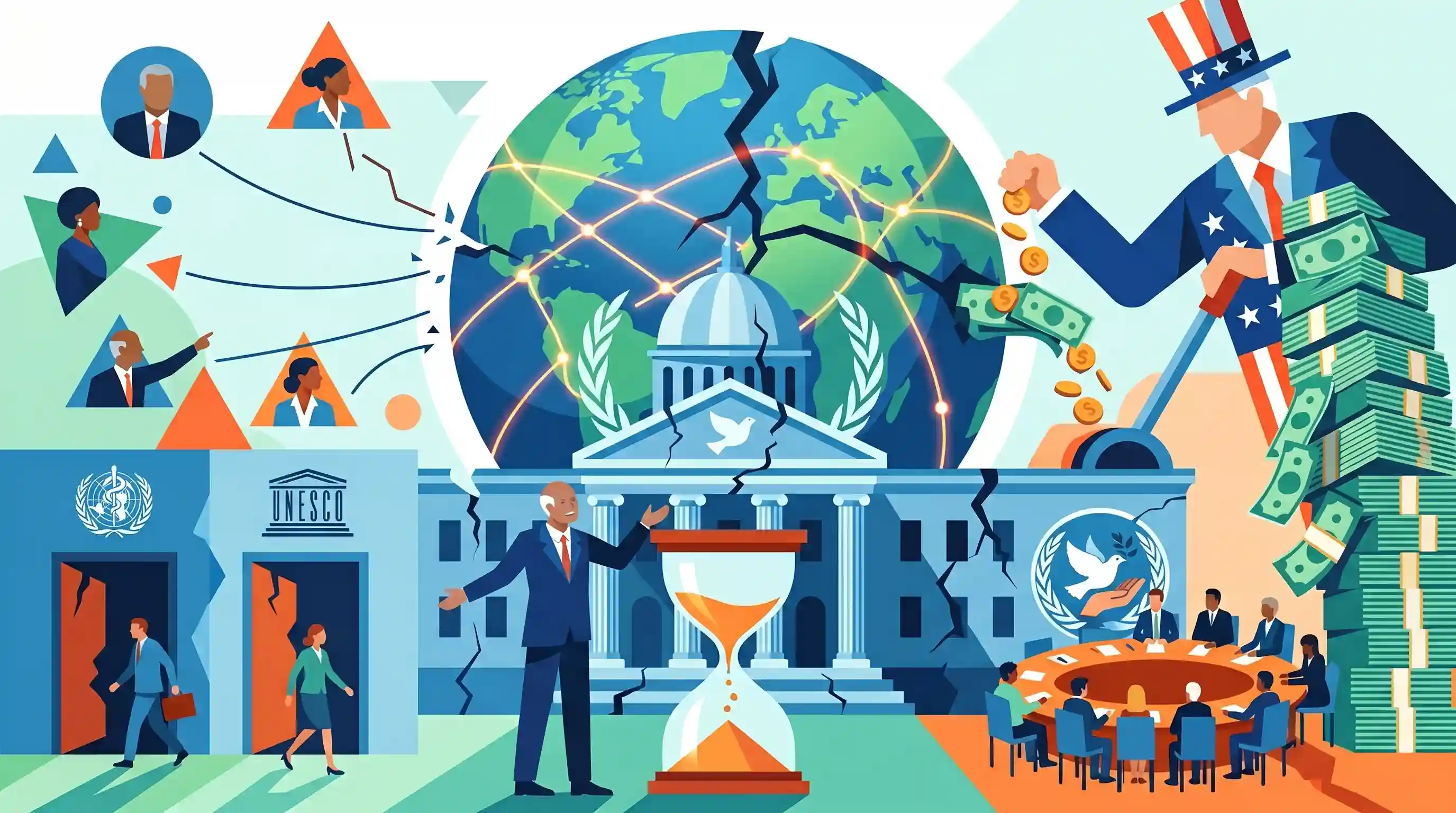
The United States has paid a fraction (about $160 million) of the nearly $4 billion it currently owes to the United Nations across its regular and peacekeeping budgets. This massive financial shortfall compounds the UN's risk of "imminent financial collapse," as warned by UN Secretary-General Antonio Guterres. Although the U.S. remains the largest overall contributor to the UN, it has frequently used its financial contributions as a geopolitical lever. Under the Trump administration, the US has withdrawn from critical UN agencies like the WHO and UNESCO, citing systemic inefficiencies and political bias. Furthermore, the administration’s new "Board of Peace"—originally intended to oversee a Gaza ceasefire—is viewed by critics as an attempt to undermine and rival the authority of the UN Security Council. This highlights a growing trend of US unilateralism and a strategic retreat from traditional multilateral institutional frameworks, which severely impacts global governance and international security operations.
Key Points
- The US has released $160 million out of an estimated $4 billion in arrears owed to the UN, covering both regular budget dues and peacekeeping operations.
- UN Secretary-General Antonio Guterres has warned of an imminent financial collapse for the organization due to major member states defaulting on assessed contributions.
- The US, historically the largest financial contributor to the UN, has shown a recent pattern of retreating from multilateral commitments under the Trump administration, including withdrawing from agencies like the WHO and UNESCO.
- The creation of the US-led "Board of Peace," initially focused on the Gaza crisis, is interpreted as a potential rival to the UN Security Council, signaling a strategic shift away from UN-centric global governance.
- The ongoing financial squeeze severely limits the UN's operational capacity, significantly affecting global peacekeeping missions and vital humanitarian initiatives.
Important Terms
Board of Peace

A Trump-administration initiative (est. 2026) initially for Gaza’s post-war governance, later expanded as a potential unilateral rival to the UN Security Council for global conflict mediation.
UPSC context
GS-II: International Relations. Represents a shift from multilateralism to unilateralism, impacting global governance and India's strategic autonomy.
Multilateralism
The practice of multiple countries working together on a given issue through international institutions to achieve common goals based on shared rules and norms.
UPSC context
GS-II: Fundamental concept in IR; tests understanding of global institutional frameworks vs. sovereign unilateralism.
UN Security Council (UNSC)
The primary UN organ responsible for maintaining international peace and security, consisting of 5 permanent (veto-wielding) and 10 non-permanent members.
UPSC context
GS-II: Important International institutions. Focus on reforms and the 'veto' power's impact on global stability.
UN Peacekeeping Operations
A unique UN instrument assisting conflict-torn countries. Funded by member assessments, these operations face a liquidity crisis due to major arrears from contributors like the U.S.
UPSC context
GS-II: International security. Relevant given India's role as one of the largest troop contributors.
UNESCO
A specialized UN agency promoting international cooperation through education, science, and culture. The U.S. has repeatedly withdrawn, citing political bias.
UPSC context
GS-II: International agencies. Tests understanding of cultural diplomacy and institutional politicization.
World Health Organization (WHO)
The specialized UN agency for international public health. U.S. withdrawal signals a shift toward nationalized health policy over global collaborative responses.
UPSC context
GS-II: Issues relating to Health. Critical for understanding global pandemic preparedness and healthcare governance.
Prelims Trap
A UN member state immediately loses its UNGA voting rights upon failing to pay its assessed dues.
Under Article 19, voting rights are only suspended if arrears equal or exceed contributions due for the preceding TWO full years, not immediately.
Static Concepts Connected
How are UN regular and peacekeeping budgets assessed?
- Regular Budget: Mandatory and calculated based on a nation's GNI and capacity to pay, with a ceiling of 22% (assigned to the US) and a floor of 0.001%.
- Peacekeeping Premium: Assessed separately. The P5 members pay a mandatory higher premium because of their exclusive Security Council veto power in authorizing peacekeeping missions.
- Voluntary Contributions: Agencies like UNICEF, WHO, and UNDP largely rely on voluntary funding, distinct from the mandatory assessed dues of the central UN budget.
What happens under Article 19 of the UN Charter?
- Loss of Vote: A member state loses its UNGA vote if financial arrears equal or exceed the total assessed contributions due for the preceding two full years.
- Waiver Provision: The General Assembly can grant a waiver and restore voting rights if it determines the default is due to conditions beyond the member's control.
Cross-Topic Patterns
Minilateralism bypassing Multilateralism
The proposed US-led 'Board of Peace' mirrors the broader shift toward issue-based minilaterals (Quad, AUKUS, I2U2) as major powers bypass veto-paralyzed UN structures.
Financial weaponization in IR
Withholding UN funding to force institutional change mirrors the weaponization of the SWIFT network and US dollar dominance—key themes in recent UPSC GS-2 and GS-3 papers.

A Prelims multi-statement question on Article 19 voting suspensions and the P5's peacekeeping funding premium is highly likely.
Linked PYQs · 2
Linked PYQs · 2
- 2019MainsGS2
‘Too little cash, too much politics, leaves UNESCO fighting for life.’ Discuss the statement in the light of US' withdrawal and its accusation of the cultural body as being 'anti-Israel bias'.
- 2025MainsGS2
"The reform process in the United Nations remains unresolved, because of the delicate imbalance of East and West and entanglement of the USA vs. Russo-Chinese alliance.” Examine and critically evaluate the East-West policy confrontations in this regard.
