Ukraine Peace Talks and US Security Guarantees Architecture
Source:The Hindu ↗
Why It Matters
The article outlines a potential breakthrough in the prolonged Russia-Ukraine conflict, introducing alternative security mechanisms outside formal NATO expansion. This is crucial for UPSC aspirants studying international relations, as it highlights shifting alliances, European security frameworks, and the geopolitical implications of a negotiated peace on global stability.
Summary
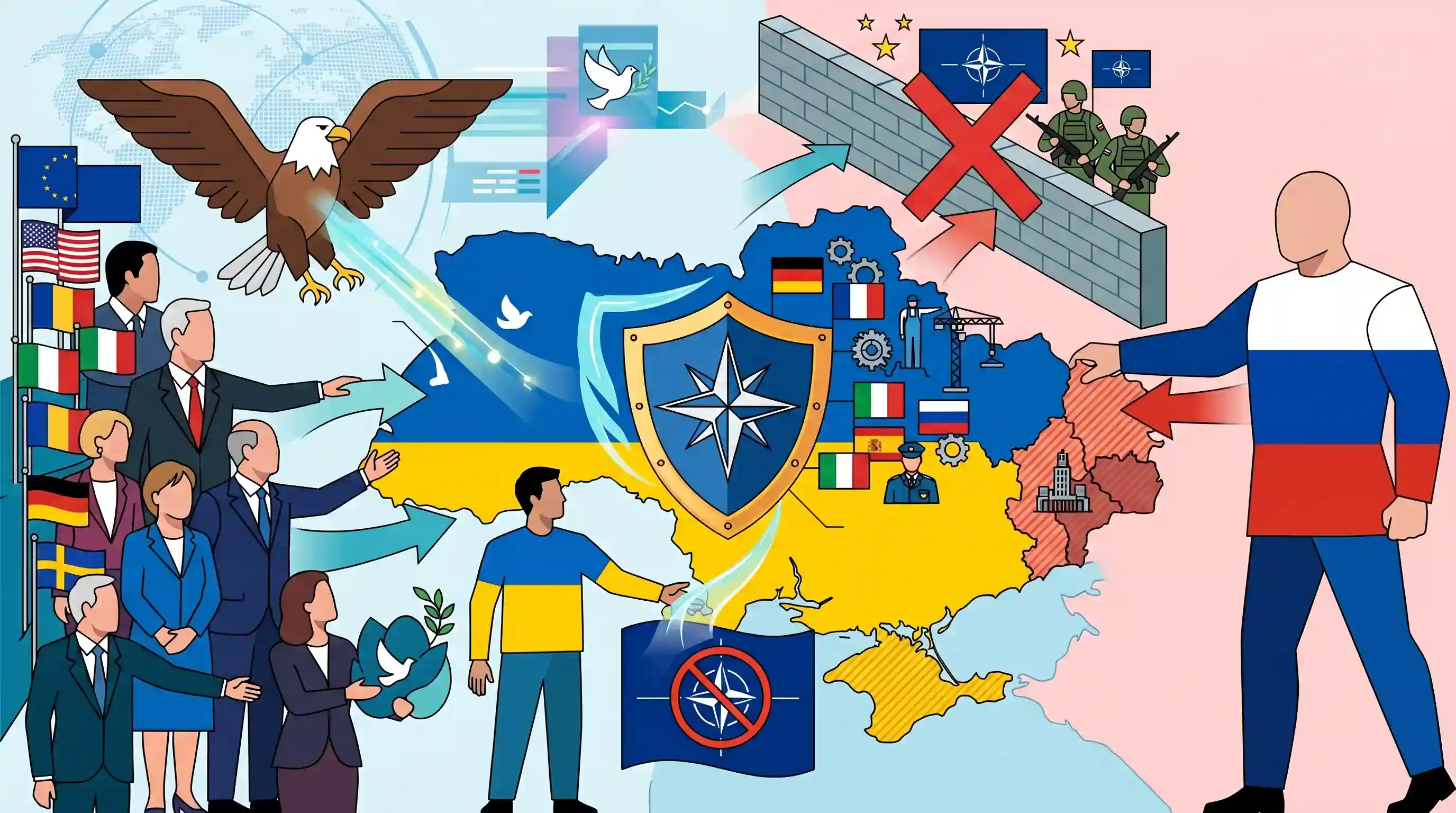
As peace negotiations aimed at ending the Russia-Ukraine war advance, US and European officials have agreed to offer Ukraine robust, "Article 5-like" security guarantees. A proposed framework includes establishing a European-led "multinational force Ukraine" to help secure the country and rebuild its military capabilities. In return for these assurances, Ukrainian President Volodymyr Zelenskyy has expressed readiness to abandon his country's pursuit of formal NATO membership. While consensus is building around a US-brokered peace plan, critical differences remain regarding Russia's territorial demands in the Donbas region—specifically Donetsk—and Moscow's firm stance against any NATO troop presence in Ukraine.
Key Points
- US and European leaders have agreed to provide Ukraine with robust, 'Article 5-like' security guarantees as part of an emerging peace settlement with Russia.
- The proposed security architecture involves a European-led 'multinational force Ukraine' (MFU) of up to 800,000 personnel to secure Ukrainian skies, seas, and rebuild its armed forces.
- Ukrainian President Zelenskyy indicated a willingness to drop Ukraine's bid for formal NATO membership if these stringent security guarantees are met.
- Ongoing negotiations are attempting to reconcile differences over Russia's demands for territorial concessions in the Donbas region (notably Donetsk) and its strict opposition to NATO troops on Ukrainian soil.
Important Terms
Article 5 (NATO)

The core collective defense clause of the North Atlantic Treaty, stating that an armed attack against one member is an attack against all, requiring mutual assistance.
UPSC context
GS II (International Relations); vital for analyzing global security architectures and the legal obligations of military alliances.
NATO
An intergovernmental military alliance of 32 countries formed in 1949 to provide collective security against external threats, particularly through political and military cooperation.
UPSC context
GS II (International Relations); central to studying post-Cold War geopolitics, regional conflicts, and India's strategic neutrality.
European Union (EU)
An economic and political union of 27 European member states that operates through a system of supranational independent institutions and intergovernmental-negotiated decisions.
UPSC context
GS II (International Relations); critical for understanding regional integration and India's evolving strategic and economic ties with Europe.
Multinational Force – Ukraine (MNF-U)
A proposed European-led coalition of willing nations designed to provide post-war security guarantees, rebuild military capabilities, and monitor ceasefires within Ukrainian territory.
UPSC context
GS II (International Relations); represents an innovative post-conflict stabilization model and a new layer of non-NATO security architecture.
Prelims Trap
The proposed Multinational Force Ukraine (MFU) is a UN-mandated peacekeeping operation.
The MFU is an extra-UN, European-led security framework proposed outside the UN system. It deliberately bypasses the UN Security Council to avoid Russia's veto power.
Static Concepts Connected
What distinguishes Collective Defense from Collective Security in international relations?
- Collective Defense: An alliance designed to counter external threats, like NATO's Article 5, where an armed attack on one member is treated as an attack on all.
- Collective Security: A universal, inward-looking system (like the UN Charter) where all members agree to collectively punish any state within the system that commits an act of aggression.
What are the geographical and economic features of the Donbas region?
- Location and Composition: Situated in eastern Ukraine bordering Russia, the region primarily encompasses the administrative oblasts (provinces) of Donetsk and Luhansk.
- Economic Significance: It is a heavily industrialized, densely populated region known for its massive coal reserves, metallurgy, and heavy manufacturing, making it a critical strategic asset.
Cross-Topic Patterns
European Strategic Autonomy
A European-led multinational force of up to 800,000 personnel signals a concrete move toward EU defense autonomy, reducing reliance on the US security umbrella amid shifting transatlantic dynamics.
The "Finlandization" Geopolitical Model
Ukraine's willingness to abandon NATO membership in exchange for security guarantees reflects "Finlandization"—a strategy of strict neutrality maintained by smaller states to prevent conflict with a neighboring superpower.

Map-based pairings of Donbas/Donetsk and conceptual statements on 'Finlandization' or non-UN alliances are highly probable in 2026.
Linked PYQs · 2
Linked PYQs · 2
- 2023MainsGS2
‘The expansion and strengthening of NATO and a stronger US-Europe strategic partnership works well for India.’ What is your opinion about this statement ? Give reasons and examples to support your answer.
- 2023PrelimsGS1
Consider the following pairs: Area of conflict mentioned in news Country where it is located 1. Donbas : Syria 2. Kachin : Ethiopia 3. Tigray : North Yemen How many of the above pairs are correctly matched?
