United States Nuclear Reactors Advance India Clean Energy Goals
Source:Indian Express ↗
Why It Matters
The article highlights the intersection of international diplomacy, domestic legislation (liability laws), and sustainable development. It is highly relevant for understanding India's strategic partnerships (GS2) and its pathways to achieving energy security and environmental sustainability (GS3).
Summary
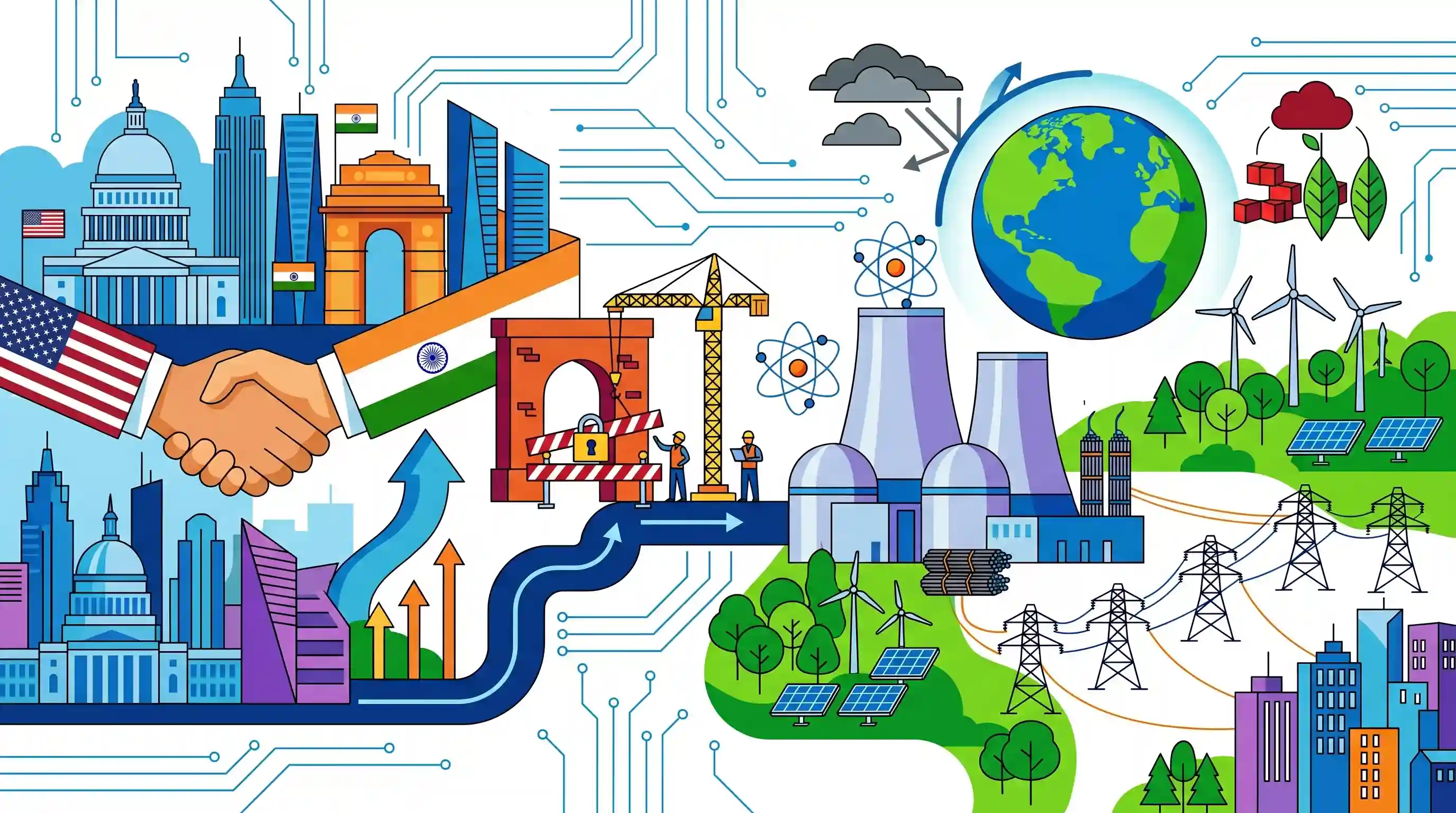
The editorial discusses the renewed momentum in India-US relations regarding the installation of US nuclear reactors in India. This step is pivotal for realizing the commercial potential of the historic 2008 civil nuclear deal, which had been stalled primarily due to concerns over India's strict Civil Liability for Nuclear Damage Act. Advancing this cooperation is viewed as crucial for India's energy security and its transition toward clean, low-carbon baseload energy to meet climate targets, while further solidifying the strategic partnership between the two democracies.
Key Points
- India and the US are making renewed efforts to facilitate the sale and construction of US-designed nuclear reactors in India, marking progress from the landmark 2008 civil nuclear deal.
- Nuclear energy plays a critical role in addressing India\'s dual goals of ensuring reliable energy security and achieving its climate commitments for clean base-load power generation.
- A major bottleneck for foreign suppliers has been India\'s Civil Liability for Nuclear Damage Act (2010), which places liability on suppliers in the event of a nuclear accident. Resolving or mitigating these liability risks is essential for commercializing the deal.
- Successful implementation of reactor sales will deepen the India-US strategic partnership, shifting ties from diplomatic milestones to tangible clean-tech cooperation.
Important Terms
Indo-US Civil Nuclear Agreement (123 Agreement)

A 2008 landmark framework allowing India to access civilian nuclear technology and fuel from the US despite not signing the NPT, effectively ending India's global nuclear isolation and legitimizing its nuclear status.
UPSC context
GS Paper II (International Relations). A watershed moment in India-US ties and global non-proliferation norms.
Civil Liability for Nuclear Damage Act (CLNDA), 2010
Indian legislation establishing a compensation mechanism for nuclear accidents. It is controversial for holding suppliers liable ("right of recourse"), which deviates from the international norm of exclusive operator liability.
UPSC context
GS Paper II (Polity) and Paper III (Energy). Key legal bottleneck in operationalizing international nuclear deals.
Small Modular Reactors (SMRs)
Advanced nuclear reactors with capacities up to 300 MW(e). They are factory-built, scalable, and safer, making them ideal for India’s clean energy transition and replacing retired coal plants.
UPSC context
GS Paper III (Energy/S&T). Focuses on decarbonization, private sector participation, and technological innovation.
Nuclear Suppliers Group (NSG)
A 48-nation export control regime regulating nuclear-related trade. India received a unique "clean waiver" in 2008 for nuclear commerce but seeks full membership for stable technology access.
UPSC context
GS Paper II (International Institutions). Tests knowledge of global export control regimes and India's diplomatic challenges.
International Atomic Energy Agency (IAEA)
The UN-affiliated watchdog promoting peaceful nuclear energy use while verifying, through "safeguards," that nuclear materials are not diverted for military use. India’s civilian reactors operate under its inspections.
UPSC context
GS Paper II (International Organizations). Essential for understanding global nuclear governance and safeguards.
Prelims Trap
"India is a signatory to the COP28 Declaration to Triple Nuclear Energy Capacity by 2050."
Despite its massive domestic nuclear expansion plans, India did not sign this declaration, maintaining its principled stance against sectoral alliances outside the formal UNFCCC process.
Static Concepts Connected
How does India's CLNDA 2010 differ from global nuclear liability norms?
- Global Norm: International conventions (like Paris and Vienna) channel liability exclusively to the operator of the nuclear installation, not the supplier.
- Supplier Liability: Section 17(b) of the Act grants the operator a 'right of recourse' to claim damages from suppliers if defective equipment causes an accident.
- Insurance Pool: The ₹1,500 crore Indian Nuclear Insurance Pool (INIP) was established in 2015 to cover these unique supplier liability risks and break the commercial deadlock.
What are the key advantages of Small Modular Reactors (SMRs)?
- Modularity: Components are factory-assembled and transported to the site, which drastically reduces upfront capital costs and typical nuclear construction delays.
- Passive Safety: SMRs rely on physical phenomena like natural circulation and gravity to shut down safely without human intervention or external power.
- Reduced Footprint: Generating up to 300 MW(e) per unit, their smaller footprint allows placement in locations unsuitable for larger traditional nuclear plants.
Cross-Topic Patterns
Clean baseload vs Intermittent renewables
While solar and wind are intermittent, nuclear provides the stable, low-carbon baseload power crucial for phasing out coal and meeting India's Panchamrit climate targets.
Strategic autonomy & NSG Waivers
The 2008 deal secured a unique Nuclear Suppliers Group waiver for India to trade civilian nuclear tech without signing the NPT, demonstrating major diplomatic leverage.

Expect a Prelims question mixing CLNDA's 'right of recourse' clause with India's strategic refusal to sign the COP28 nuclear pledge.
Linked PYQs · 3
Linked PYQs · 3
- 2018PrelimsGS1
In the Indian context, what is the implication of ratifying the 'Additional Protocol' with the 'International Atomic Energy Agency (IAEA)'?
- 2019PrelimsGS1
Recently, India signed a deal known as 'Action Plan for Prioritization and Implementation of Cooperation Areas in the Nuclear Field' with which of the following countries?
- 2025MainsGS2
"Energy security constitutes the dominant kingpin of India's foreign policy, and is linked with India's overarching influence in Middle Eastern countries.” How would you integrate energy security with India's foreign policy trajectories in the coming years?
