US Nuclear Firms Evaluate Investment Potential Under Shanti Act
Source:Indian Express ↗
Why It Matters
The SHANTI Act, 2025 marks a paradigm shift in India's energy policy, fundamentally altering the legal and economic framework of the nuclear sector to allow private and foreign participation, which is critical for meeting India's future clean baseload energy demands.
Summary
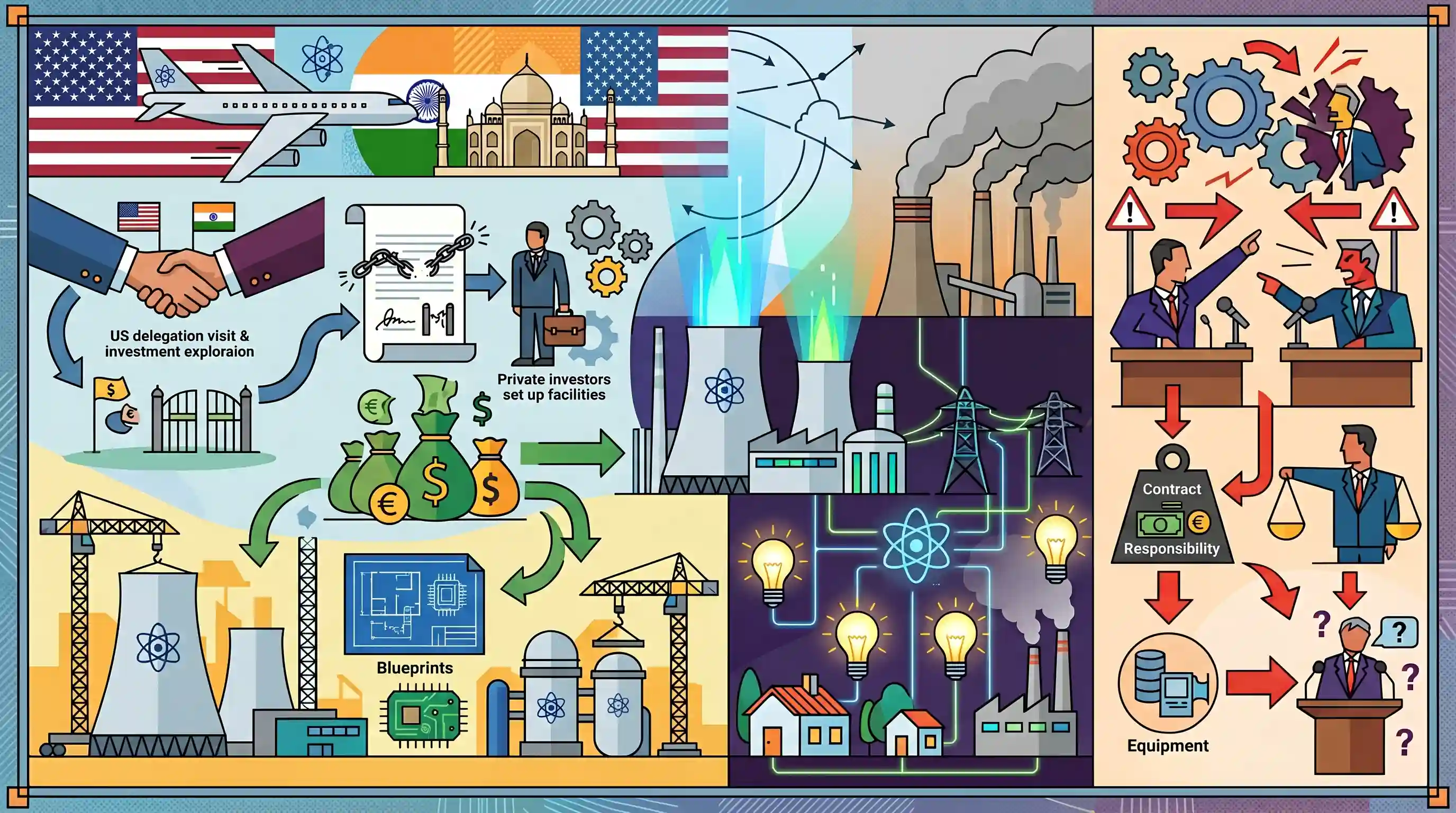
A US delegation led by Energy Secretary Jennifer Granholm is visiting India to explore investment opportunities in the nuclear sector, triggered by the recent passage of the SHANTI Act, 2025. This landmark legislation dismantles the state monopoly on nuclear power, enabling private sector entry, foreign investment, and the adoption of imported Light Water Reactors (LWRs) and Small Modular Reactors (SMRs). With specific authorisations granted to US firms for technology transfer, India seeks to deploy nuclear power as a clean, reliable base load alternative to coal. However, the new law has sparked political debate over the restructuring of the civil liability regime, particularly concerning equipment supplier accountability.
Key Points
- A US delegation led by Energy Secretary Jennifer Granholm is evaluating investment potential in India's nuclear sector following the passage of the SHANTI Act, 2025.
- The SHANTI Act, 2025 opens the Indian nuclear energy sector to private participation, foreign funding, and imported Light Water Reactor (LWR) technology, replacing older restrictive laws.
- Several US nuclear firms have obtained authorisations under US regulation 10CFR810 to transfer technology to Indian entities, facilitating collaborations.
- India aims to utilise nuclear energy as a sustainable base load alternative to coal, transitioning from indigenous Pressurised Heavy Water Reactors (PHWRs) to modern LWRs and Small Modular Reactors (SMRs).
- Opposition parties have voiced concerns regarding the SHANTI Act, specifically over the perceived dilution of civil liability for nuclear equipment suppliers compared to the previous 2010 Act.
Important Terms
SHANTI Act, 2025

A landmark legislation replacing the Atomic Energy Act, 1962, and CLND Act, 2010, ending India's state monopoly on nuclear power and enabling private and foreign investment (up to 49%).
UPSC context
GS Paper III: Energy/Security; significant for understanding the transition to a liberalized nuclear energy market and foreign policy alignment.
Atomic Energy Act, 1962
The predecessor law that restricted nuclear power generation and fuel management exclusively to government-owned entities like NPCIL; its repeal by the SHANTI Act allows private sector entry.
UPSC context
GS Paper III: Infrastructure/Energy; tests knowledge of the historical state-led model versus the current privatized shift in critical sectors.
Civil Liability for Nuclear Damage Act, 2010
Repealed by the SHANTI Act, this 2010 law was criticized for 'Section 17(b),' which exposed equipment suppliers to potentially unlimited liability, deterring foreign reactor vendors for over a decade.
UPSC context
GS Paper II: International Relations (India-US); GS III: Energy. Tests understanding of legal barriers to technology transfer and international conventions.
Nuclear Energy Mission
A government initiative aimed at scaling India's nuclear capacity to 100 GW by 2047, emphasizing Small Modular Reactors (SMRs) and private-public partnerships for energy transition.
UPSC context
GS Paper III: Energy/Climate Change. Crucial for questions on India's 'Net Zero' targets (2070) and energy security.
Small Modular Reactors (SMRs)
Advanced nuclear reactors with a capacity typically up to 300 MW, characterized by modular construction, lower capital costs, and suitability for industrial captive power or replacing coal plants.
UPSC context
GS Paper III: Science & Technology. A high-priority topic for emerging technology and decentralized energy solutions in the civil nuclear sector.
U.S.-India TRUST Initiative
A bilateral technology framework launched by PM Modi and President Trump in February 2025, replacing iCET to deepen cooperation in nuclear energy, AI, and critical minerals.
UPSC context
GS Paper II: International Relations. Represents the current evolution of strategic technology partnerships between India and the United States.
Adani Atomic Energy Limited
A wholly owned subsidiary of Adani Power, established in early 2026, marking the first major private sector move into nuclear generation following the enactment of the SHANTI Act.
UPSC context
GS Paper III: Economy/Infrastructure. Illustrates the practical implementation of policy changes and the entry of private conglomerates into strategic sectors.
Prelims Trap
Foreign nuclear equipment suppliers bear the primary, absolute liability in case of a nuclear accident in India.
Primary absolute liability falls on the operator (historically NPCIL). The controversy is about the operator's "right of recourse" to sue the supplier under Section 17 of the CLNDA 2010.
Static Concepts Connected
How do Pressurised Heavy Water Reactors differ from Light Water Reactors?
- Fuel Requirements: PHWRs use unenriched natural uranium as fuel, whereas Light Water Reactors (LWRs) require low-enriched uranium to sustain the nuclear chain reaction.
- Moderator and Coolant: PHWRs use heavy water (Deuterium Oxide, D2O) as both a coolant and a neutron moderator. LWRs use ordinary (light) water.
What is the India-specific IAEA safeguards agreement?
- Separation Plan: Under the 2008 Indo-US deal, India agreed to formally separate its civilian nuclear facilities from its strategic (military) programs.
- Permanent Safeguards: All designated civilian reactors and imported foreign nuclear technologies are placed under permanent IAEA safeguards to ensure non-diversion of nuclear material for weapons.
Cross-Topic Patterns
SMRs + Renewable Grid Stability
Small Modular Reactors (SMRs) provide dispatchable base-load power. As India rapidly scales intermittent renewables like solar and wind, SMRs are critical for maintaining grid stability without relying on coal.
FDI in Strategic Sectors
Dismantling the state monopoly in atomic energy mirrors recent phased openings in the space sector (IN-SPACe) and defense manufacturing, highlighting a broader governance shift toward private capital in strategic tech.

Expect a 2026 prelims multi-statement question contrasting SMRs vs traditional reactors alongside India's nuclear civil liability rules.
Linked PYQs · 2
Linked PYQs · 2
- 2011MainsGS2
Subsequent to the Nuclear Suppliers' Group (NSG) waiver in 2008, what are the agreements on nuclear energy that India has signed with different countries?
- 2020PrelimsGS1
In India, why are some nuclear reactors kept under "IAEA Safeguards" while others are not?
