US directive to restart nuclear weapons testing and global security
Source:Indian Express ↗
Why It Matters
The resumption of nuclear weapons testing, even 'non-critical' ones, by a major superpower challenges the established norms of the Comprehensive Nuclear-Test-Ban Treaty (CTBT) and the broader non-proliferation regime. This development is critical for understanding shifting global security dynamics, arms races, and the deterrence postures of major powers like the US, Russia, and China.
Summary
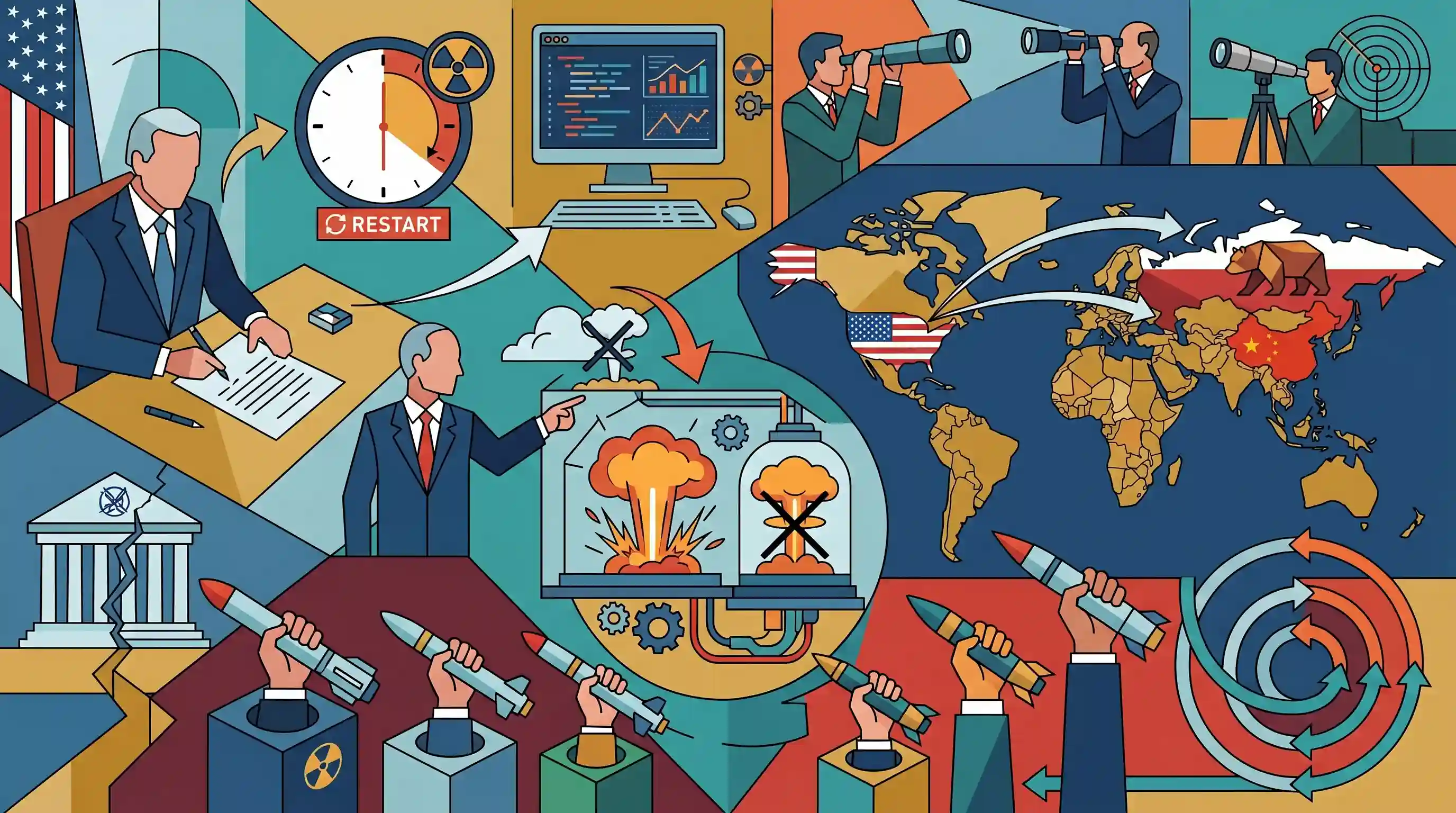
US President Donald Trump has issued a directive to restart nuclear weapons testing after a 33-year hiatus. However, US Energy Secretary Chris Wright clarified that the planned activities will involve 'non-critical explosions' or 'system tests' rather than full-scale nuclear detonations with a yield. The primary goal is to ensure the reliability of modernized weapons that are replacing older components of the US nuclear stockpile. While the US has previously relied on advanced computer simulations to maintain its arsenal, this shift toward physical testing is perceived as a strategic message to global rivals such as Russia and China. This development raises concerns regarding the global non-proliferation regime and the potential for a renewed arms race.
Key Points
- US President Donald Trump has directed the military to restart nuclear weapons testing, ending a 33-year pause.
- US Energy Secretary Chris Wright clarified that the planned tests are 'system tests' or 'non-critical explosions' that will not produce a nuclear yield.
- The tests aim to ensure the reliability and functionality of newly modernized nuclear weapons replacing aging stockpiles.
- Previously, the US relied on advanced physics and computational simulations to verify the safety and efficacy of its nuclear arsenal without physical testing.
- The move is widely viewed as a geopolitical signal to US rivals, notably Russia and China, potentially sparking concerns about a renewed global arms race.
Important Terms
Comprehensive Nuclear-Test-Ban Treaty (CTBT)

A multilateral treaty banning all nuclear explosions for civilian and military purposes. Adopted in 1996, it has not entered into force as key 'Annex 2' states (e.g., US, China) haven't ratified it.
UPSC context
GS Paper II (IR) and GS III (Security). Tests understanding of global arms control architecture and India's 'non-signatory' status.
Treaty on the Non-Proliferation of Nuclear Weapons (NPT)
A landmark 1968 treaty aimed at preventing the spread of nuclear weapons. It rests on three pillars: non-proliferation, disarmament, and the peaceful use of nuclear energy.
UPSC context
GS Paper II. Focuses on the 'grand bargain' between nuclear and non-nuclear states and India’s concerns regarding its discriminatory nature.
Nuclear Testing Moratorium
A voluntary suspension of nuclear explosive testing. The US has maintained such a moratorium since 1992, relying instead on computer simulations and subcritical experiments to ensure arsenal reliability.
UPSC context
GS Paper III (Security). Evaluates knowledge of historical shifts in nuclear policy and the impact on global deterrence.
Subcritical Testing
Tests involving fissile material that do not reach a 'critical mass' and thus do not produce a nuclear explosion or yield. They are used to verify the safety and performance of warheads.
UPSC context
GS Paper III (Science & Tech). Distinguishes between explosive testing and scientific maintenance of a nuclear stockpile.
National Nuclear Security Administration (NNSA)
A semi-autonomous agency within the US Department of Energy responsible for enhancing national security through the military application of nuclear science and maintaining the US nuclear stockpile.
UPSC context
GS Paper II (IR). Relevant for understanding the institutional framework of major powers’ nuclear governance.
Stockpile Stewardship Program
A 1990s-era program to maintain nuclear weapons without explosive testing, using sophisticated simulations and high-tech experiments to ensure warheads remain functional as they age.
UPSC context
GS Paper III (Security). Relates to the technical challenges of nuclear disarmament and arsenal modernization.
Prelims Trap
"Sub-critical nuclear explosive tests are strictly prohibited under the Comprehensive Nuclear-Test-Ban Treaty (CTBT)."
The CTBT only bans super-critical tests (yield-producing chain reactions). Sub-critical tests produce zero nuclear yield and are not banned. This loophole is exactly why India refused to sign the treaty.
Static Concepts Connected
What is the difference between sub-critical and super-critical nuclear testing?
- Sub-critical tests: Involves chemical explosives and fissile material but deliberately prevents a self-sustaining chain reaction, resulting in a zero-yield explosion.
- Super-critical tests: Triggers a self-sustaining nuclear chain reaction, resulting in a full-scale nuclear detonation and measurable explosive yield.
- CTBT loophole: The treaty does not explicitly ban sub-critical tests, allowing advanced nuclear states to physically test weapon components without violating international law.
What were India’s primary objections to signing the CTBT?
- Discriminatory nature: It allowed P-5 nations to refine arsenals via sub-critical tests and supercomputers, while permanently stunting non-nuclear weapon states from developing basic deterrents.
- No disarmament timeline: The treaty lacked a binding, time-bound commitment from recognized nuclear-weapon states for universal, comprehensive nuclear disarmament.
- Sovereignty violation: Article XIV made the treaty's entry-into-force contingent on 44 specific nations (including India) signing it, disregarding India's sovereign choice.
Cross-Topic Patterns
Sub-critical testing & India's Doctrine
As P-5 nations resume physical sub-critical testing, India’s reliance on 1998 Pokhran-II data and its voluntary moratorium may face domestic debate regarding the modernization of its own nuclear deterrent.
Supercomputing vs Physical Deterrence
The US shift from supercomputing (Stockpile Stewardship Program) back to physical system tests highlights a geopolitical trust deficit where digital modeling is no longer considered sufficient for deterrence signaling.

Expect a multi-statement Prelims question on CTBT loopholes (sub-critical tests) paired with India's 1998 voluntary testing moratorium.
Linked PYQs · 3
Linked PYQs · 3
- 2018MainsGS2
In what ways would the ongoing US-Iran Nuclear Pact Controversy affect the national interest of India? How should India respond to this situation?
- 2018PrelimsGS1
What is/are the consequence/consequences of a country becoming the member of the 'Nuclear Suppliers Group'? 1. It will have access to the latest and most efficient nuclear technologies. 2. It automatically becomes a member of "The Treaty on the Non-Proliferation of Nuclear Weapons (NPT)". Which of the statements given above is/are correct?
- 2020PrelimsGS1
In India, why are some nuclear reactors kept under "IAEA Safeguards" while others are not?
