Iran Rejects Western Hegemony Amid West Asian Geopolitical Shifts
Source:The Hindu ↗
Why It Matters
The blockade of the Strait of Hormuz directly threatens global energy supply chains, significantly impacting India's energy security and inflation. Furthermore, Iran's pivot towards the SCO and its confrontation with the U.S. and Israel forces India to delicately balance its strategic partnerships in West Asia with its ties to the West.
Summary
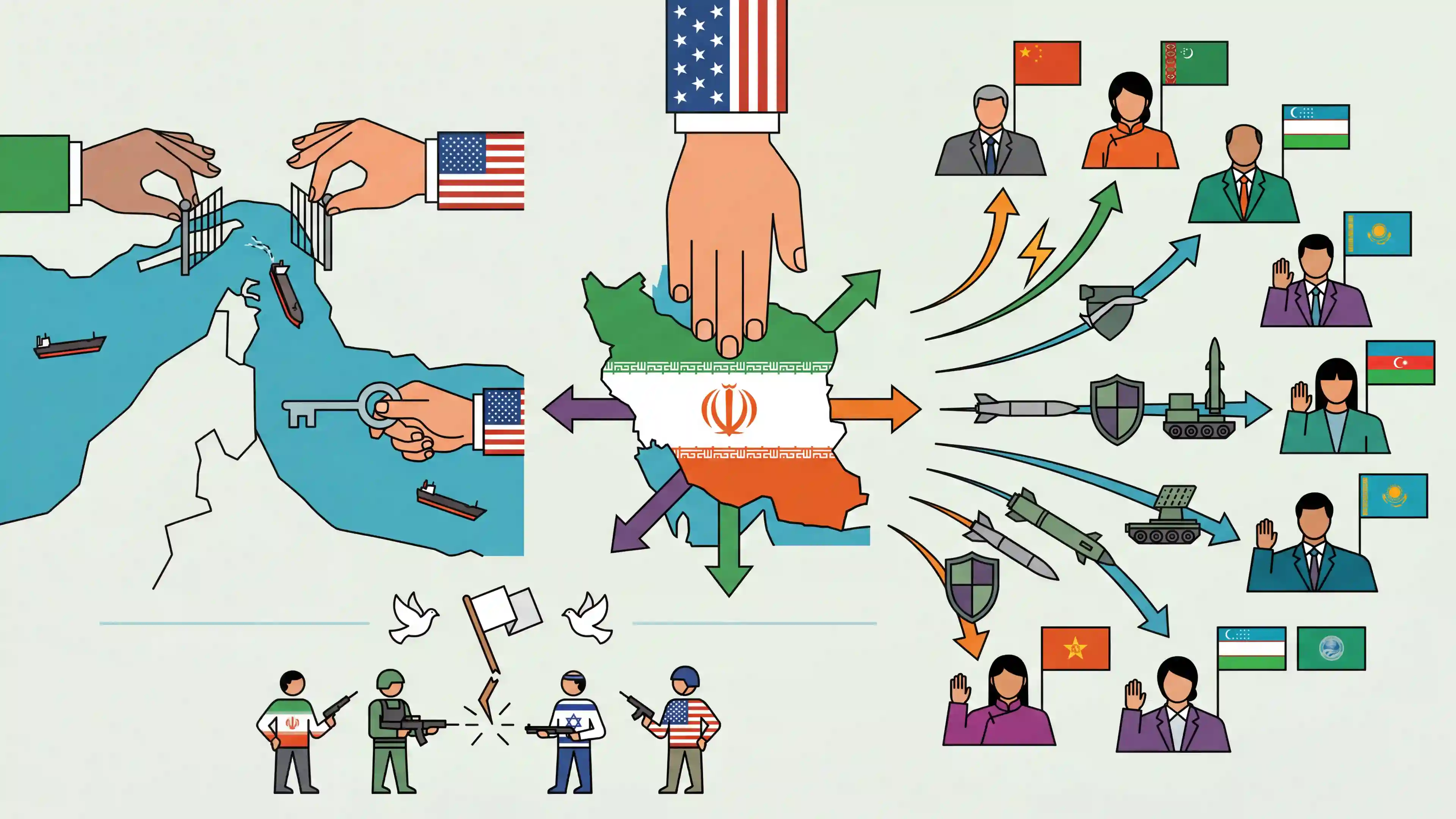
Iran has asserted that the United States is no longer in a position to "dictate" policies to independent nations, signaling a pushback against Western influence in the Middle East. The statement comes as Tehran evaluates a U.S. proposal to unblock the Strait of Hormuz, a critical maritime chokepoint for global energy markets that Iran has effectively restricted amid ongoing regional conflict. While a fragile ceasefire has halted direct hostilities between Iran, Israel, and the U.S., a permanent resolution remains elusive. Furthermore, Iran emphasized its commitment to strengthening strategic ties by offering to share its defensive military capabilities with member states of the Shanghai Cooperation Organisation (SCO).
Key Points
- Iran asserted that the U.S. can no longer dictate policies to independent nations, reflecting changing geopolitical dynamics in the Middle East.
- Tehran is weighing a U.S. proposal concerning the unblocking of the Strait of Hormuz, a critical chokepoint for global energy markets that Iran has effectively sealed off.
- A fragile ceasefire has temporarily paused direct confrontations involving Iran, Israel, and the U.S., though talks for a permanent resolution remain inconclusive.
- Ahead of a Shanghai Cooperation Organisation (SCO) defense ministers' meeting, Iran expressed readiness to share its defensive military capabilities with SCO member states and other independent nations.
Important Terms
Shanghai Cooperation Organisation (SCO)

A permanent Eurasian intergovernmental organization founded in 2001, focusing on security, political, and economic cooperation among its 10 members, including India, China, and Russia.
UPSC context
GS Paper 2: International Relations; crucial for India’s regional connectivity, counter-terrorism (RATS), and energy diplomacy in Eurasia.
Strait of Hormuz
A narrow, strategically vital waterway linking the Persian Gulf to the Gulf of Oman; it is the world’s most important energy chokepoint.
UPSC context
GS Paper 1 (Geography) and Paper 3 (Energy Security); tests mapping skills and understanding of global oil supply vulnerabilities.
Maritime Chokepoint
A narrow sea route through which large volumes of global trade must pass, making it susceptible to blockades or maritime disruptions.
UPSC context
GS Paper 3: Security and Infrastructure; relevant for maritime security, international trade law (UNCLOS), and naval strategy.
West Asia Geopolitics
The complex interaction of power, influence, and conflict in the Middle East, primarily involving the rivalry between Iran, Saudi Arabia, Israel, and external powers like the U.S.
UPSC context
GS Paper 2: International Relations; focuses on India’s 'Look West' policy, energy security, and the safety of the Indian diaspora.
Iran
A West Asian nation and SCO member (since 2023) that holds a strategic position along the Strait of Hormuz and maintains a contentious relationship with Western powers.
UPSC context
GS Paper 2: Bilateral relations; significant for India’s Chabahar Port project and International North-South Transport Corridor (INSTC).
Prelims Trap
"The Strait of Hormuz connects the Persian Gulf directly to the Red Sea."
The Strait of Hormuz connects the Persian Gulf to the Gulf of Oman. It is the Bab-el-Mandeb strait that connects the Red Sea to the Gulf of Aden.
Static Concepts Connected
What are the key maritime chokepoints in West Asia?
- Strait of Hormuz: Connects the Persian Gulf to the Gulf of Oman. Bordered by Iran, Oman, and the UAE. Crucial for 20% of global oil trade.
- Bab el-Mandeb: Connects the Red Sea to the Gulf of Aden. Bordered by Yemen on the Arabian Peninsula, and Djibouti and Eritrea in the Horn of Africa.
- Suez Canal: Artificial sea-level waterway in Egypt connecting the Mediterranean Sea to the Red Sea, separating the African continent from Asia.
What is the current composition and security focus of the SCO?
- Membership expansion: India and Pakistan joined in 2017. Iran became the 9th full member in 2023, followed by Belarus as the 10th in 2024.
- RATS mechanism: The Regional Anti-Terrorist Structure (RATS), headquartered in Tashkent, coordinates security, intelligence sharing, and counter-terrorism military exercises among member states.
Cross-Topic Patterns
Hormuz closures & India's Energy Security
Blockades in the Strait of Hormuz directly threaten India's crude imports, amplifying the Mains relevance of India's Strategic Petroleum Reserves (SPRs) and alternative transit corridors like INSTC.
Middle East Multipolarity via SCO/BRICS
Iran leveraging SCO defense ties highlights the transition from US hegemony to a multipolar Middle East that relies on Eurasian platforms (SCO, BRICS) for diplomatic cover and security.

A 2026 Prelims question will likely mix SCO recent expansions with map locations of West Asian chokepoints (Hormuz, Bab-el-Mandeb, etc).
Linked PYQs · 4
Linked PYQs · 4
- 2025MainsGS2
"Energy security constitutes the dominant kingpin of India's foreign policy, and is linked with India's overarching influence in Middle Eastern countries.” How would you integrate energy security with India's foreign policy trajectories in the coming years?
- 2021MainsGS2
Critically examine the aims and objectives of SCO. What importance does it hold for India?
- 2023MainsGS2
‘Virus of Conflict is affecting the functioning of the SCO’ In the light of the above statement point out the role of India in mitigating the problems.
- 2018MainsGS2
“India’s relations with Israel have, of late, acquired a depth and diversity, which cannot be rolled back.” Discuss.
