Civil Society Protests and Executive Power Checks in US Politics
Source:The Hindu ↗
Why It Matters
The article highlights the crucial role of civil society and mass protests in democracies as a check on executive power. The U.S.-Iran conflict and sweeping domestic policy shifts in the U.S. have far-reaching global and geopolitical ramifications, which are central to GS2 topics covering international affairs and comparative political dynamics.
Summary
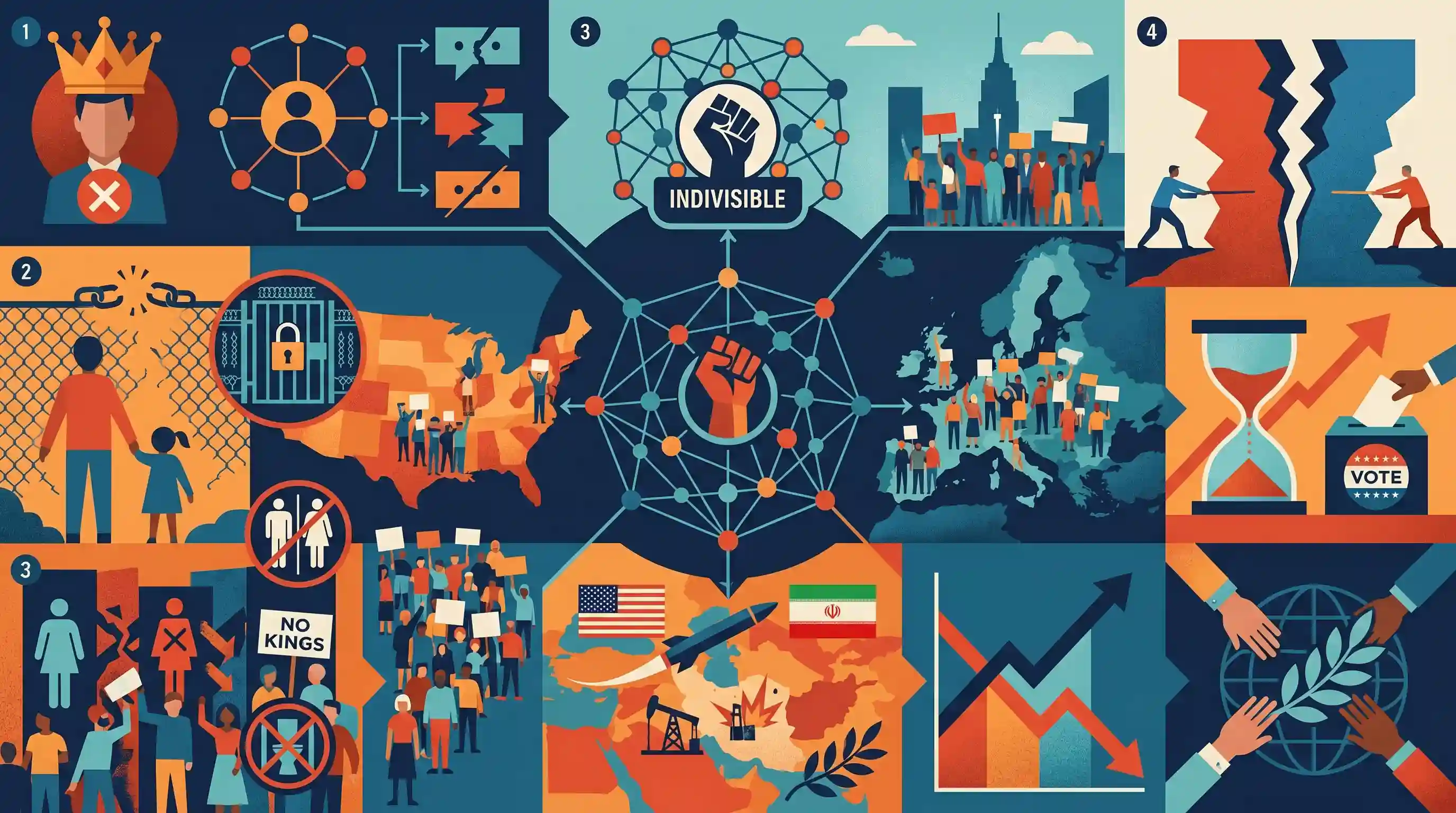
Millions of people across the United States and Europe joined the "No Kings" rallies to protest against U.S. President Donald Trump's administration. The demonstrations focused on grievances regarding hardline immigration policies, the rollback of transgender rights, the U.S. war with Iran, and perceived authoritarian governance. Spearheaded by civil society groups like Indivisible, the global movement underscored growing public pushback against aggressive executive actions and international conflicts, while also highlighting the deep political polarization shaping U.S. politics ahead of midterm elections.
Key Points
- Millions of demonstrators participated in "No Kings" rallies across the U.S. and Europe, protesting against U.S. President Donald Trump's policies and perceived authoritarianism.
- Key grievances included hardline immigration enforcement by ICE, the rollback of transgender rights, and the U.S. war with Iran.
- Civil society organizations such as Indivisible and the New York Civil Liberties Union spearheaded the movement, highlighting the importance of the right to dissent.
- Global solidarity protests occurred in European cities like Rome, Paris, and London, linking U.S. issues with local concerns such as anti-war sentiments and opposition to far-right governance.
- The widespread protests and pushback from conservative quarters illustrate the deep political polarization in the U.S. ahead of midterm elections.
Important Terms
Indivisible

A U.S. progressive grassroots movement that organizes local advocacy and constituent pressure to influence legislative outcomes and resist perceived authoritarianism or regressive policies.
UPSC context
GS II: Governance/Polity. Tests understanding of pressure groups and their role in a functioning democracy.
U.S. Customs and Immigration Enforcement (ICE)
A federal law enforcement agency under the U.S. Department of Homeland Security responsible for enforcing immigration laws and conducting investigations into transnational criminal activity.
UPSC context
GS II: International Relations/Governance. Relevant for discussions on migration policy, human rights, and bilateral relations.
New York Civil Liberties Union (NYCLU)
The New York affiliate of the American Civil Liberties Union (ACLU), which uses litigation and advocacy to protect constitutional rights and civil liberties.
UPSC context
GS II: Social Justice/Polity. Pertains to the role of NGOs and protection of fundamental rights.
Civil Society
The collective sphere of voluntary organizations, associations, and social movements that operate outside the state and market to promote public interests.
UPSC context
GS II: Governance. Essential for questions on democratic accountability and citizen-led development.
Rule of Law
The political principle that all people and institutions, including government leaders, are subject to and accountable to law that is fairly applied.
UPSC context
GS II: Polity. A fundamental doctrine tested in topics related to constitutionalism and democratic governance.
Executive Overreach
Situations where the executive branch of government exceeds its constitutional or legal authority, often bypassing legislative or judicial checks.
UPSC context
GS II: Separation of Powers. Critical for analyzing the balance of power in comparative constitutions.
Prelims Trap
Like the US Constitution, the Indian Constitution guarantees absolute freedom of speech and peaceful assembly to its citizens.
Unlike the US First Amendment, India's Article 19 rights are not absolute and are subject to reasonable restrictions under Article 19(2) and (3).
Static Concepts Connected
How does the Right to Freedom of Assembly operate under the Indian Constitution?
- Article 19(1)(b): Guarantees all citizens the fundamental right to assemble peaceably and without arms.
- Reasonable Restrictions: The State can impose restrictions in the interest of India's sovereignty, integrity, or public order.
- Section 144 / BNS equivalency: Executive magistrates can prohibit assemblies of five or more people to prevent danger to human life, health, or public tranquility.
What are the primary democratic functions of Civil Society Organizations (CSOs)?
- Watchdog Role: Monitoring state actions, ensuring accountability, and preventing executive overreach or authoritarian tendencies.
- Policy Advocacy: Representing marginalized or vulnerable communities (e.g., minorities, immigrants) in the policy-making and judicial processes.
- Democratic Mobilization: Organizing peaceful protests and channeling public dissent into constructive democratic engagement.
Cross-Topic Patterns
US-Iran War + India's Energy Security
A US-Iran conflict disrupts Middle East stability, directly impacting global oil prices, India's import bill, and strategic connectivity projects like the Chabahar Port.
Transnational Advocacy + Civil Society
Domestic grievances like immigration and minority rights are triggering transnational solidarity movements, highlighting how local civil society networks now influence international diplomatic narratives.

The strategic fallout of the US-Iran conflict on India's Chabahar port and energy security is a prime GS-2 Mains target for 2026.
Linked PYQs · 2
Linked PYQs · 2
- 2018MainsGS2
In what ways would the ongoing US-Iran Nuclear Pact Controversy affect the national interest of India? How should India respond to this situation?
- 2025MainsGS2
Civil Society Organizations are often perceived as being anti-State actors than non-State actors. Do you agree? Justify.
