US Supreme Court Ruling on Presidential Tariffs
Source:Indian Express ↗
Why It Matters
The event serves as an excellent case study on the limits of executive power and the role of the judiciary (Comparative Constitution - GS2), while also shedding light on the mechanics of trade wars and the shift away from multilateralism towards protectionism (Economy - GS3).
Summary
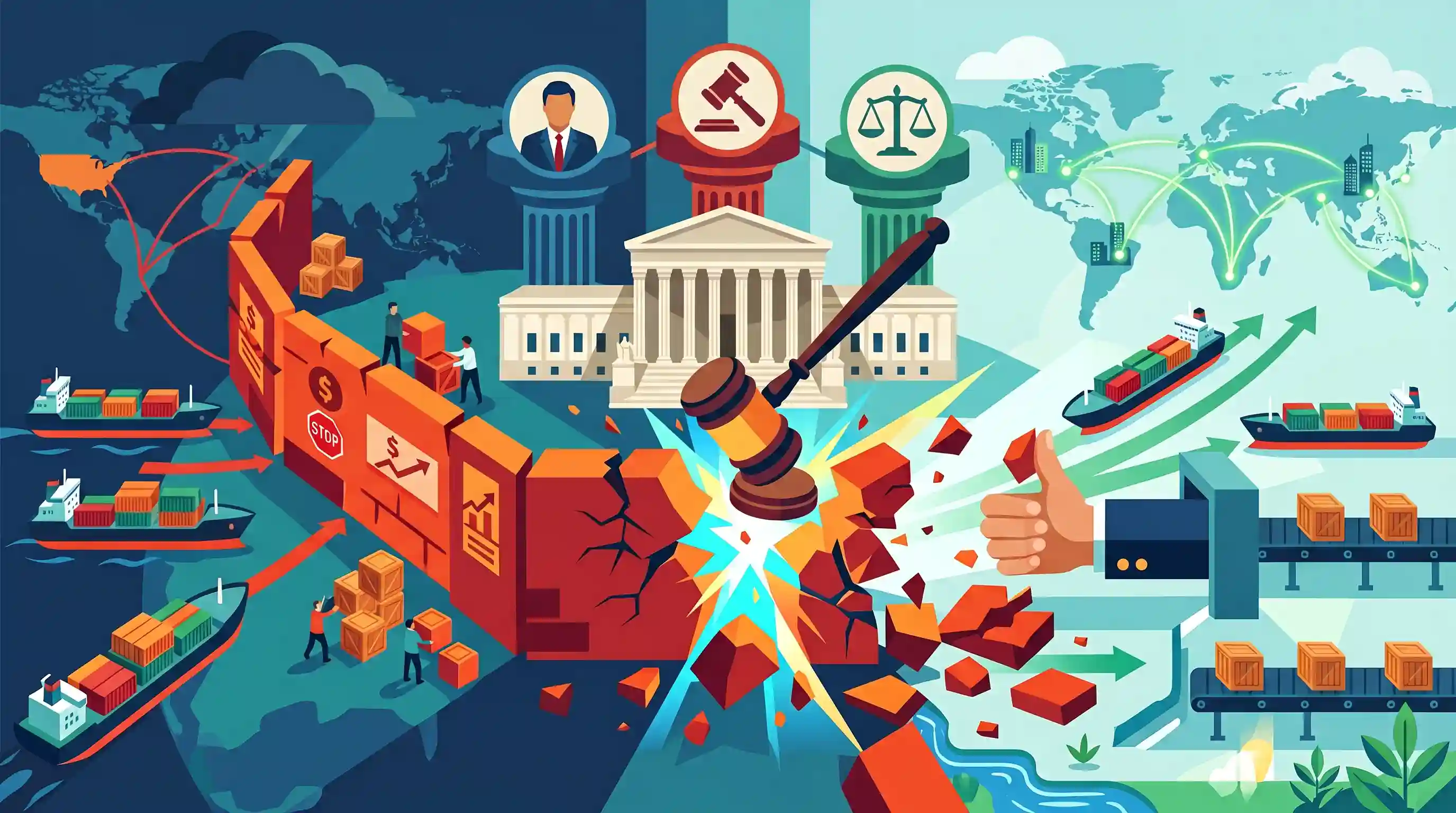
The US Customs and Border Protection (CBP) has halted the collection of specific tariffs introduced by former US President Donald Trump after the US Supreme Court struck them down as illegal. The ruling represents a significant check on unilateral executive action in trade policy through judicial review. It also carries broader implications for international trade by rolling back some protectionist measures that had escalated global trade tensions.
Key Points
- The US Supreme Court ruled that certain tariffs imposed during Donald Trump's presidency were illegal.
- Following the ruling, the US Customs and Border Protection (CBP) stopped the collection of these contested tariffs.
- The decision limits executive overreach regarding protectionist trade measures and affirms the power of judicial review over trade policies in the US.
- This development could potentially ease trade barriers and influence ongoing debates surrounding global protectionism versus free trade.
Important Terms
International Emergency Economic Powers Act (IEEPA)

A 1977 law allowing US Presidents to regulate economic transactions during national emergencies. Recently, the US Supreme Court ruled it cannot be used unilaterally to impose broad import tariffs.
UPSC context
GS Paper-II (International Relations); tests understanding of legal frameworks governing global trade and executive vs. legislative powers in the US.
US Customs and Border Protection (CBP)
The federal law enforcement agency responsible for managing US borders, including the collection of customs duties and enforcement of trade regulations and tariffs.
UPSC context
GS Paper-III (Economy); relevant for understanding administrative mechanisms in international trade and customs enforcement.
Separation of Powers
A constitutional doctrine dividing government responsibilities into distinct branches to prevent any one branch from exercising the core functions of another.
UPSC context
GS Paper-II (Polity/Comparative Constitution); tests the ability to compare the limits of executive authority in different democratic systems (India vs. US).
Protectionism
An economic policy of restricting imports from other countries through methods such as tariffs on imported goods, import quotas, and a variety of other government regulations.
UPSC context
GS Paper-III (Economy); core concept for questions on global trade wars, WTO challenges, and impact on Indian exports.
Judicial Review
The power of courts to decide on the constitutionality of legislative enactments and executive actions, acting as a check on the other branches.
UPSC context
GS Paper-II (Polity); fundamental concept in Indian and US constitutional law; tests understanding of the judiciary's role as a guardian of the constitution.
Section 122 (Trade Act of 1974)
A provision of the Trade Act of 1974 allowing the US President to impose temporary import surcharges (up to 15%) for 150 days to address balance-of-payment deficits.
UPSC context
GS Paper-II (IR); specific legal tool used in trade negotiations; relevant for India-US bilateral trade friction.
Prelims Trap
The WTO dispute settlement body struck down the US tariffs imposed by Donald Trump as illegal.
The tariffs were struck down by the US Supreme Court under domestic constitutional law, not by the WTO. The US executive frequently bypassed WTO dispute mechanisms.
Static Concepts Connected
How does the Indian Constitution restrict the executive's power to levy tariffs?
- Article 265: Mandates that "no tax shall be levied or collected except by authority of law," ensuring only the legislature (Parliament) can impose taxes.
- Customs Act 1962: Parliament delegates limited power to the executive to adjust tariff rates within prescribed legislative bounds, preventing sweeping, unilateral executive taxation.
What is the WTO's structural stance on unilateral retaliatory tariffs?
- Violates MFN Principle: Unilateral tariffs applied to specific countries violate the Most-Favored-Nation rule, which requires equal tariff treatment of all WTO members.
- Bypasses Dispute Settlement: The WTO mandates members to use its Dispute Settlement Understanding (DSU) rather than taking unilateral retaliatory measures under domestic laws.
Cross-Topic Patterns
Comparative Constitution: Article 265
The US ruling provides a perfect comparative constitution case study for Mains GS2, contrasting US executive trade powers with India's strict legislative control over taxation under Article 265.
WTO Crisis & Unilateralism
As domestic courts rather than the paralyzed WTO Appellate Body resolve major tariff disputes, global trade regulation increasingly fragments into unilateralism and domestic legal battles.

Expect a GS2 Mains question comparing the separation of powers regarding taxation and trade policy between the US and Indian Constitutions.
Linked PYQs · 4
Linked PYQs · 4
- 2025MainsGS3
What are the challenges before the Indian economy when the world is moving away from free trade and multilateralism to protectionism and bilateralism? How can these challenges be met?
- 2023MainsGS3
What are the direct and indirect subsidies provided to farm sector in India? Discuss the issues raised by the World Trade Organization (WTO) in relation to agricultural subsidies.
- 2020MainsGS2
Judicial Legislation is antithetical to the doctrine of separation of powers as envisaged in the Indian Constitution. In this context justify the filing of large number of public interest petitions praying for issuing guidelines to executive authorities.
- 2025MainsGS2
Compare and contrast the President's power to pardon in India and in the USA. Are there any limits to it in both the countries? What are 'preemptive pardons'?
