Energy Infrastructure Demands of Artificial Intelligence
Source:The Hindu ↗
Why It Matters
The article highlights the hidden environmental and infrastructural costs of the digital revolution. As India pursues ambitious digitalization and the IndiaAI mission, it will inevitably face similar surges in energy demand from data centers. Balancing this exponential energy requirement with sustainable, clean energy generation—while avoiding grid collapse—will be crucial. It also signals a shifting global perspective on nuclear energy, viewing it as a necessary, reliable baseload alternative to intermittent renewables for powering continuous, high-intensity digital infrastructure.
Summary
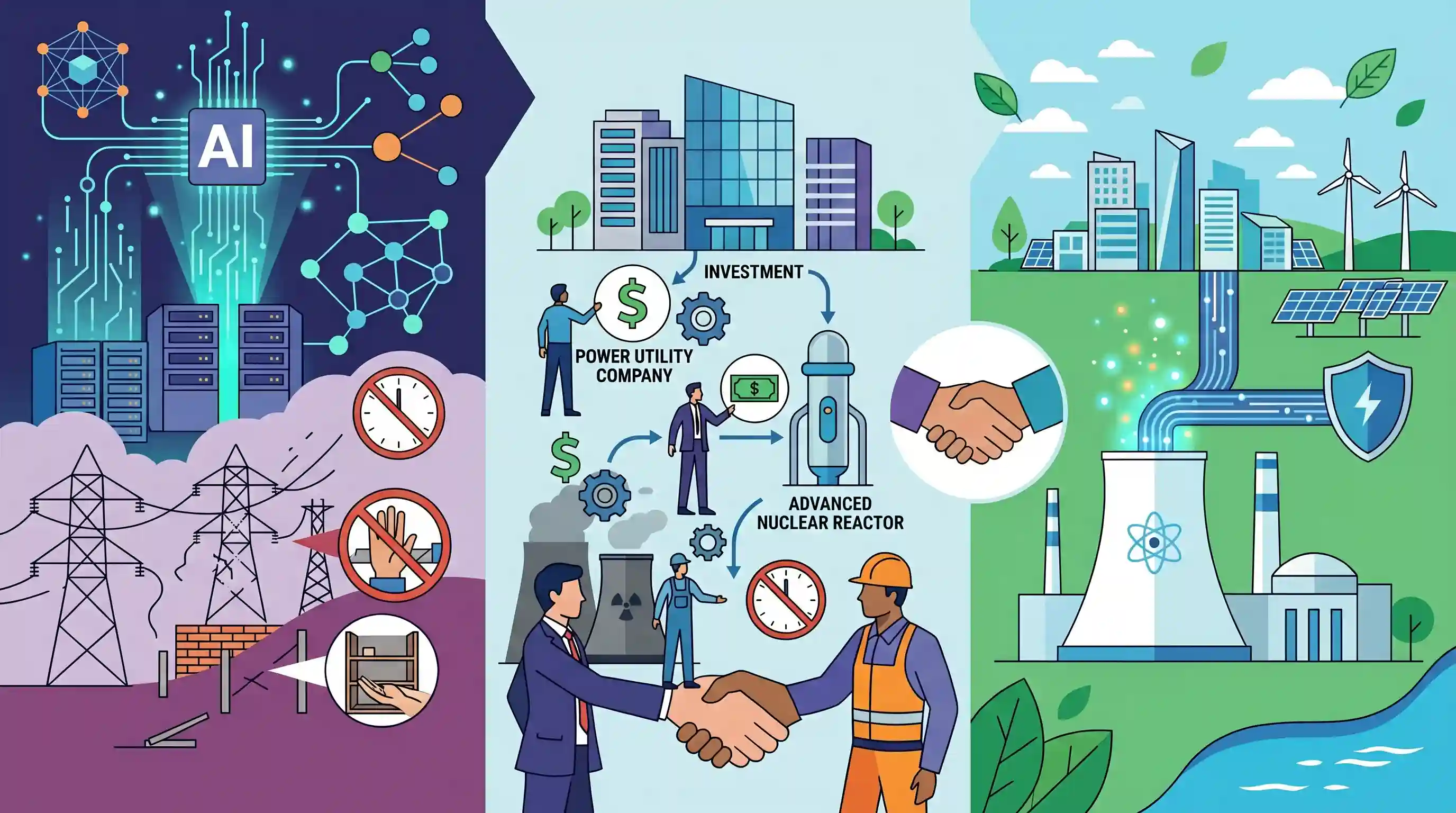
Alphabet’s President and Chief Investment Officer, Ruth Porat, has warned that the United States is failing to scale its energy infrastructure fast enough to meet the massive electricity demands of expanding artificial intelligence (AI) networks. As power grids struggle with long connection wait times and supply chain shortages, major tech companies are taking unprecedented steps to secure their own energy sources. This includes purchasing power companies, directly investing in advanced nuclear reactors, and partnering with utilities like NextEra Energy to restart decommissioned nuclear power plants. The trend highlights the immense resource footprint of AI and data centers, driving a renewed interest in nuclear power as a critical source of reliable, clean baseload energy for the digital economy.
Key Points
- Artificial intelligence expansion is triggering an unprecedented surge in electricity demand due to the energy-intensive nature of massive data centers.
- U.S. power grids are struggling to keep pace with this demand, facing bottlenecks such as long grid connection wait times and shortages of key equipment like gas turbines.
- To bypass grid constraints, Big Tech companies are heavily investing in proprietary energy infrastructure, securing their own power supplies and even acquiring energy firms.
- The demand for continuous, clean baseload power is driving a revival in nuclear energy, with tech firms investing in advanced nuclear reactors and contracting utilities to restart decommissioned nuclear plants.
Important Terms
Baseload Energy

The minimum amount of electric power a utility must provide to meet the continuous demand of its customers. It is 'always-on' power, unlike intermittent sources like solar or wind.
UPSC context
GS Paper 3: Energy. Crucial for understanding why AI data centers require nuclear or thermal power over intermittent renewables.
Small Modular Reactors (SMRs)
Advanced nuclear reactors with a capacity of up to 300 MW, designed to be factory-assembled and transported to sites. They offer enhanced safety and lower capital costs than traditional plants.
UPSC context
GS Paper 3: Science & Technology. A priority for India’s clean energy transition and meeting high-density power needs for digital infrastructure.
Data Centers
Centralized physical facilities housing servers and networking hardware to store, process, and distribute data. AI data centers are significantly more energy-intensive than traditional ones due to GPU cooling needs.
UPSC context
GS Paper 3: Infrastructure. Focuses on the environmental footprint of the digital economy and India’s 'Data Center Policy' for self-reliance.
Energy Security
The uninterrupted availability of energy sources at an affordable price, encompassing long-term investments in supply and the ability of systems to react to sudden changes in demand.
UPSC context
GS Paper 3: Economy/Security. Tests the balance between technological growth (AI) and the resilience of national power grids.
Nuclear Energy
A low-carbon energy source that uses controlled fission reactions to generate heat. It provides steady power, making it a critical 'clean' alternative for energy-intensive sectors like AI.
UPSC context
GS Paper 3: Science & Technology. Relates to India’s Three-Stage Nuclear Power Programme and the push for carbon neutrality by 2070.
AI Infrastructure
The foundational physical and technical resources—including high-performance computing (GPUs), data storage, and high-speed networking—required to train and deploy artificial intelligence models.
UPSC context
GS Paper 3: S&T. Central to the IndiaAI Mission and the debate over the resource-intensive nature of emerging technologies.
Prelims Trap
Small Modular Reactors (SMRs) are advanced nuclear fusion reactors preferred by tech companies for clean energy.
SMRs are advanced nuclear *fission* reactors, not fusion. While they are smaller and modular, they still use traditional fission processes.
Static Concepts Connected
What is the difference between Baseload Power and Peaking Power?
- Baseload power: The minimum, continuous level of electricity demand over 24 hours. Sources like nuclear, coal, and hydro provide this steady supply.
- Peaking power: Additional power generated to meet variable peak demand. Sources include gas turbines, pumped storage hydro, and battery systems that can spin up quickly.
- Intermittent renewables: Solar and wind are variable and cannot independently serve as baseload power for 24/7 AI data centers without massive grid-scale storage.
What are the key features of Small Modular Reactors (SMRs)?
- Size & Capacity: They are advanced nuclear fission reactors with a power capacity of up to 300 MW(e) per module, roughly one-third of traditional reactors.
- Modularity: They can be factory-assembled and transported as a unit to the installation site, drastically reducing construction time and capital costs.
- Passive safety: They rely on passive systems like natural circulation, convection, and gravity to shut down safely without human intervention during emergencies.
Cross-Topic Patterns
Tech Net-Zero vs. GenAI Energy Demand
Big Tech's "Net Zero by 2030" targets are clashing with the massive energy footprint of GenAI, forcing a strategic pivot from purely intermittent renewables to nuclear investments to maintain 24/7 operations.
Rise of Captive Power in Big Tech
Big tech directly acquiring energy infrastructure mirrors the concept of "captive power plants" under India's Electricity Act, aiming to bypass state grid transmission bottlenecks, AT&C losses, and interconnection delays.

A 2026 prelims question will likely merge Generative AI's massive baseload power requirements with Small Modular Reactor (SMR) features.
Linked PYQs · 4
Linked PYQs · 4
- 2023MainsGS3
Introduce the concept of Artificial Intelligence (AI). How does Al help clinical diagnosis? Do you perceive any threat to privacy of the individual in the use of Al in healthcare?
- 2017MainsGS3
Give an account of the growth and development of nuclear science and technology in India. What is the advantage of fast breeder reactor programme in India?
- 2018MainsGS3
“Access to affordable, reliable, sustainable and modern energy is the sine qua non to achieve Sustainable Development Goals (SDGs).” Comment on the progress made in India in this regard.
- 2025MainsGS3
The fusion energy programme in India has steadily evolved over the past few decades. Mention India's contributions to the international fusion energy project International Thermonuclear Experimental Reactor (ITER). What will be the implications of the success of this project for the future of global energy?
