India Protests US Navy Strikes on Merchant Ships Protecting Seafarers
Source:The Hindu ↗
Why It Matters
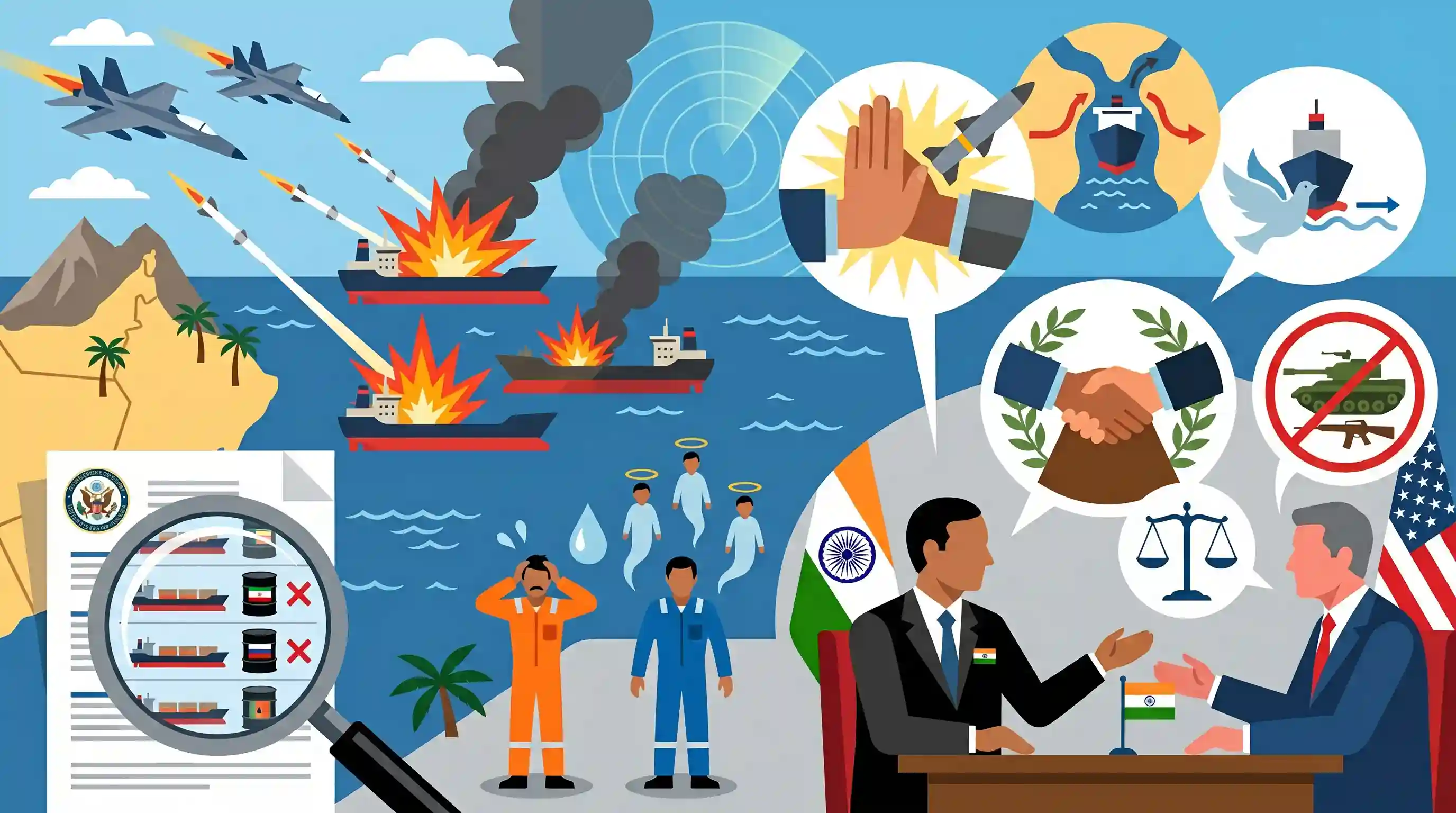
The incident highlights the vulnerability of Indian seafarers to collateral damage in global geopolitical conflicts. It also tests the India-US strategic partnership, bringing to the fore their differing approaches toward secondary sanctions enforcement, particularly concerning Iran and Russia, and the fundamental right to freedom of navigation.
Summary
India strongly protested against the US Navy's airstrikes on three merchant vessels off the coast of Oman, which resulted in the deaths of three Indian seafarers. The US justified the military action by stating the foreign-flagged vessels were sanctioned by the US Treasury's OFAC for illicitly transporting Iranian and Russian oil. In response, India summoned a senior US diplomat, emphasizing that such strikes must stop and that the unimpeded right to navigation through the strategically vital Strait of Hormuz must be maintained. India also reiterated its principled stance that complex geopolitical issues should be resolved through dialogue and diplomacy rather than military force.
Key Points
- India lodged a strong diplomatic protest with the US, summoning its Charge d'Affaires over US Navy strikes on three merchant vessels off the Oman coast that killed three Indian seafarers.
- The targeted ships (Marivex, Settebello, and Jalveer) were foreign-flagged but carried Indian crew; the US targeted them for violating OFAC sanctions by allegedly transporting Iranian and Russian oil.
- India firmly stated that military strikes on merchant shipping are unacceptable and emphasized that international disputes should be resolved through dialogue and diplomacy.
- The MEA reiterated the strategic importance of unimpeded right to navigation and uninterrupted maritime access through the Strait of Hormuz.
Important Terms
United Nations Convention on the Law of the Sea (UNCLOS)

A 1982 international treaty establishing a legal framework for all marine activities, defining maritime zones such as Territorial Seas and Exclusive Economic Zones (EEZ).
UPSC context
GS Paper 2 (IR) and GS Paper 3 (Maritime Security); tests understanding of global commons and maritime boundary disputes.
Strait of Hormuz
A strategic maritime chokepoint between Iran and Oman connecting the Persian Gulf to the Arabian Sea, facilitating nearly 20% of global petroleum liquid transit.
UPSC context
GS Paper 1 (Geography) and GS Paper 2 (IR); vital for India's energy security and West Asian geopolitics.
Freedom of Navigation
A principle of international law, codified in UNCLOS Article 87, ensuring that ships from any state can traverse the high seas without interference from others.
UPSC context
GS Paper 2 (IR); central to debates on maritime order, South China Sea, and global trade security.
Office of Foreign Assets Control (OFAC)
An agency of the US Treasury Department that administers and enforces economic and trade sanctions based on US foreign policy and national security objectives.
UPSC context
GS Paper 2 (IR) and GS Paper 3 (Security); relevant for studying secondary sanctions and impact on Indian shipping.
Ministry of External Affairs (MEA)
The Indian government ministry responsible for managing foreign relations, protecting national interests, and ensuring the welfare of the Indian diaspora and seafarers abroad.
UPSC context
GS Paper 2 (Governance/IR); key actor in India's diplomatic response to international crises and citizen protection.
Demarche
A formal diplomatic representation or protest made by one government to another, often expressing concern or demanding action regarding a specific incident.
UPSC context
GS Paper 2 (IR); tests knowledge of diplomatic instruments and standard procedures in bilateral crisis management.
Prelims Trap
Merchant vessels passing through the Strait of Hormuz exercise the 'Right of Innocent Passage'.
Straits used for international navigation fall under 'Transit Passage', which cannot be suspended. 'Innocent Passage' applies to territorial waters.
Static Concepts Connected
What are the geographical features and significance of the Strait of Hormuz?
- Water bodies: It serves as the sole sea passage linking the Persian Gulf to the Gulf of Oman and the wider Arabian Sea.
- Bordering nations: It is bordered by Iran to the north and by Oman and the United Arab Emirates to the south.
- Strategic value: It is a critical global maritime chokepoint, handling nearly 20% of global petroleum consumption and vital to India's energy security.
How do UN multilateral sanctions differ from US OFAC secondary sanctions?
- UN Sanctions: Mandated by the UN Security Council under Chapter VII of the UN Charter; they are legally binding on all UN member states.
- Unilateral Sanctions: Imposed by individual nations. India maintains a principled stance against extraterritorial domestic laws and only recognizes UN-mandated multilateral sanctions.
- Secondary Sanctions: Measures like OFAC penalize third-party foreign entities for trading with sanctioned countries, weaponizing access to the US financial system to enforce compliance.
Cross-Topic Patterns
Seafarer diaspora & energy security
India's massive maritime workforce (10% globally) often intersects with energy diplomacy, making consular protection in global chokepoints a core element of India's energy supply chain security.
OFAC, CAATSA, and Strategic Autonomy
The US targeting Indian-crewed ships via OFAC parallels past friction over CAATSA (S-400), showcasing India's consistent rejection of secondary sanctions to maintain strategic autonomy.

Map locations of West Asian straits paired with UNCLOS passage rights (transit vs innocent) are highly likely in Prelims 2026.
Linked PYQs · 4
Linked PYQs · 4
- 2012MainsGS2
How have the US sanctions against Iran affected India's bilateral relations with Iran?
- 2014MainsGS2
With respect to the South China sea, maritime territorial disputes and rising tension affirm the need for safeguarding maritime security to ensure freedom of navigation and over flight throughout the region. In this context, discuss the bilateral issues between India and China.
- 2022PrelimsGS1
With reference to the United Nations Convention on the Law of Sea, consider the following statements : 1. A coastal state has the right to establish the breadth of its territorial sea up to a limit not exceeding 12 nautical miles, measured from baseline determined in accordance with the convention. 2. Ships of all states, whether coastal or land-locked, enjoy the right of innocent passage through the territorial sea. 3. The Exclusive Economic Zone shall not extend beyond 200 nautical miles from the baseline from which the breadth of the territorial sea is measured. Which of the statements given above are correct?
- 2017MainsGS2
Indian diaspora has an important role to play in South-East Asian countries' economy and society. Appraise the role of Indian diaspora in South-East Asia in this context.
