US Allegations on Tariff Evasion and Transshipment Hubs
Source:The Hindu ↗
हे का महत्त्वाचे आहे
It underscores the vulnerability of India's manufacturing and export sectors to US protectionist policies and trade wars, highlighting how geopolitical rivalries (US-China) and secondary sanctions (Russian oil) complicate India's bilateral relations and economic diplomacy.
सारांश
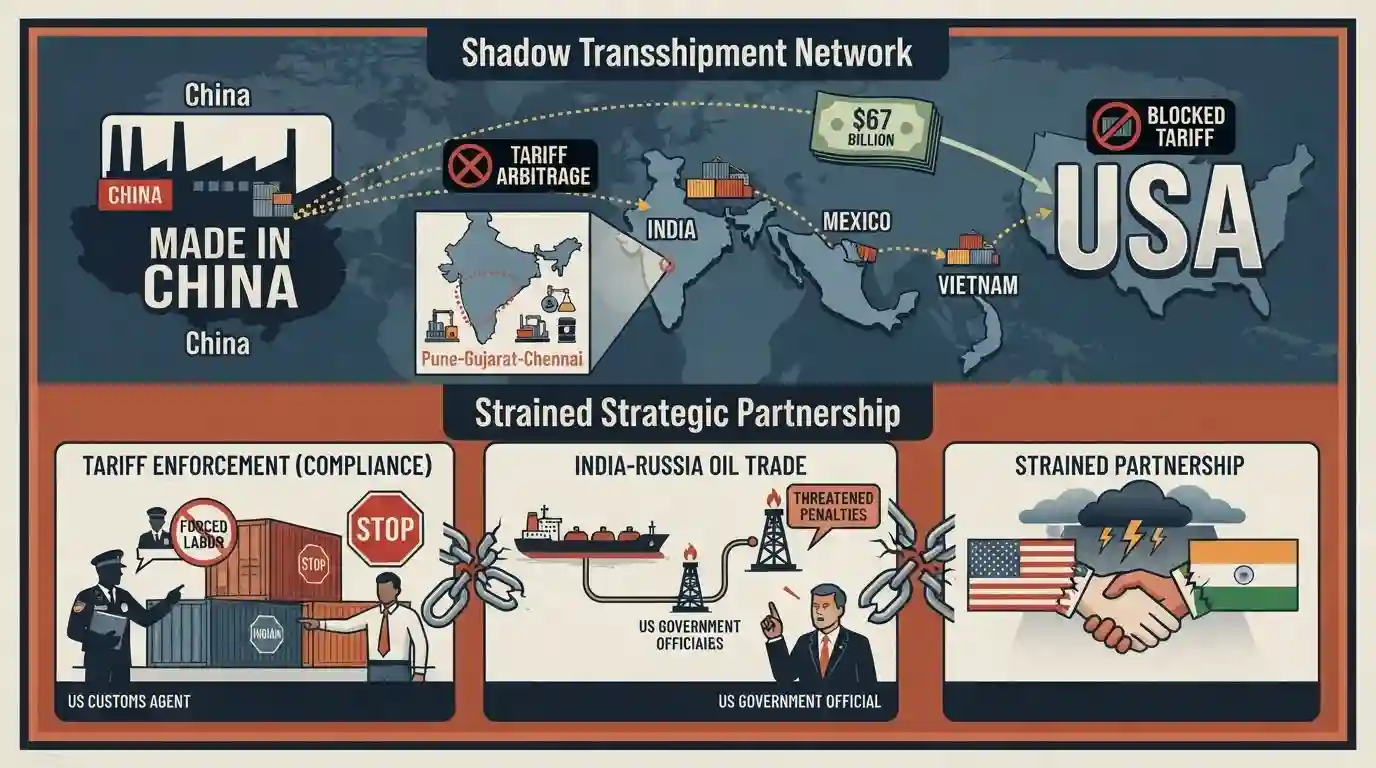
The United States has identified India as one of over 40 countries facilitating China's evasion of US tariffs through a "shadow transshipment network." A report by the Coalition for a Prosperous America (CPA) alleges that over $67 billion in Chinese goods reach the US via hubs like India, Mexico, and Vietnam. The Pune-Gujarat-Chennai belt was singled out for routing machinery and chemicals to exploit tariff arbitrage. These accusations add significant strain to the India-US strategic partnership, compounding existing trade frictions such as recent tariffs related to forced labor compliance and threatened penalties over India's continued imports of Russian oil.
मुख्य मुद्दे
- A US-based group linked to the White House has accused India and over 40 other nations of acting as transit hubs in a shadow network that helps China evade US tariffs.
- The report, titled 'The Great Transhipment Scam,' estimates that over $67 billion in US-bound goods are transshipped from China via major hubs like Mexico, India, and Vietnam.
- India's Pune-Gujarat-Chennai industrial belt was specifically flagged for transshipping Chinese machinery and chemicals to exploit 'tariff arbitrage.'
- These allegations exacerbate existing Indo-US trade frictions, as India already faces 10% US tariffs over forced labor gaps and the threat of 100% tariffs for importing Russian oil.
- The development highlights escalating US protectionism under the Section 301 Trade Act and the complex challenges of managing global supply chains amidst the US-China trade war.
महत्त्वाच्या संज्ञा
Section 301 Trade Act

A provision of the US Trade Act of 1974 empowering the USTR to investigate and unilaterally impose punitive tariffs or trade sanctions on nations whose policies unfairly burden or discriminate against US commerce.
UPSC context
GS Paper II/III: Bilateral trade, international relations, trade disputes, and global trade barriers affecting Indian exports.
Shadow Transshipment Network
A global routing network where exporters redirect goods through third-party countries—using minor assembly or repackaging—to mask the true country of origin and evade targeted import tariffs.
UPSC context
GS Paper III: International trade, global supply chains, trade evasion tactics, and their impact on India’s bilateral relations.
Coalition for a Prosperous America (CPA)
A bipartisan US advocacy coalition of agriculture, manufacturing, and labor representatives that champions protectionist trade policies, reshoring, and the domestic enforcement of tariffs.
UPSC context
GS Paper II/III: US pressure groups, trade lobbying, protectionist trade policies, and implications for India-US commerce.
Tariff Arbitrage
The economic practice of exploiting differences in customs duties or trade regulations across different jurisdictions to reduce the overall landed cost of imported goods.
UPSC context
GS Paper III: Economic definitions, global supply chain optimization, international trade, and commercial compliance strategies.
पूर्वपरीक्षा सापळा
Section 301 trade penalties are authorized and implemented under the World Trade Organization (WTO) dispute settlement framework.
Section 301 of the Trade Act of 1974 is a unilateral US domestic law. It allows the US to penalize trade partners directly, explicitly bypassing the WTO's dispute settlement mechanisms.
संबंधित स्थिर संकल्पना
How are Rules of Origin (RoO) related to transshipment and tariff evasion?
- Transshipment: Routing goods through a third country to avoid tariffs or sanctions imposed on the actual country of origin.
- Rules of Origin (RoO): Criteria used to determine the national source of a product, essential for preventing trade deflection in FTAs and enforcing tariffs.
- Substantial Transformation: Under WTO/customs rules, a product must undergo "substantial transformation" in the transit country to legally claim it as its new origin.
What is Section 301 of the US Trade Act?
- Unilateral Tool: A domestic US law allowing the US Trade Representative (USTR) to investigate and penalize foreign trade practices deemed unreasonable.
- WTO Incompatibility: Because it bypasses the WTO's Dispute Settlement Body (DSB) to enforce unilateral tariffs, it is frequently criticized for violating WTO multilateral rules.
- Impact on India: Historically used against India for intellectual property issues (Special 301), its scope now heavily targets broad supply chain and tariff evasion practices.
आंतर-विषय नमुने
China Plus One vs. Trade Deflection
Western "China Plus One" diversification often inadvertently creates "China-linked" transshipment hubs (like Vietnam and India). This draws US protectionist backlash, complicating the intended strategic supply-chain partnerships.
Strategic Autonomy vs. Trade Weaponization
US threats of 100% tariffs over India's Russian oil imports expose the recurring friction between India's independent energy security strategy and the aggressive weaponization of US domestic trade laws.

Expect a multi-statement question combining WTO Rules of Origin, US Section 301 unilateralism, and 'China Plus One' transshipment routes.
संबंधित PYQ · 3
संबंधित PYQ · 3
- 2025MainsGS3
What are the challenges before the Indian economy when the world is moving away from free trade and multilateralism to protectionism and bilateralism? How can these challenges be met?
- 2019MainsGS2
‘What introduces friction into the ties between India and the United States is that Washington is still unable to find for India a position in its global strategy, which would satisfy India's national self-esteem and ambitions.’ Explain with suitable examples.
- 2020PrelimsGS1
With reference to Trade-Related Investment Measures (TRIMS), which of the following statements is/are correct? 1. Quantitative restrictions on imports by foreign investors are prohibited. 2. They apply to investment measures related to trade in both goods and services. 3. They are not concerned with the regulation of foreign investment. Select the correct answer using the code given below:
