US military establishes strategic war stockpile in Australia
Source:The Hindu ↗
Why It Matters
The establishment of US military stockpiles in Australia and the Philippines directly reflects the shifting strategic balance in the Indo-Pacific. For UPSC aspirants, this highlights the operationalization of US alliances (like AUKUS) aimed at countering China's assertiveness, which in turn impacts India's own geopolitical calculations within frameworks like the Quad and its vision for a free and open Indo-Pacific.
Summary
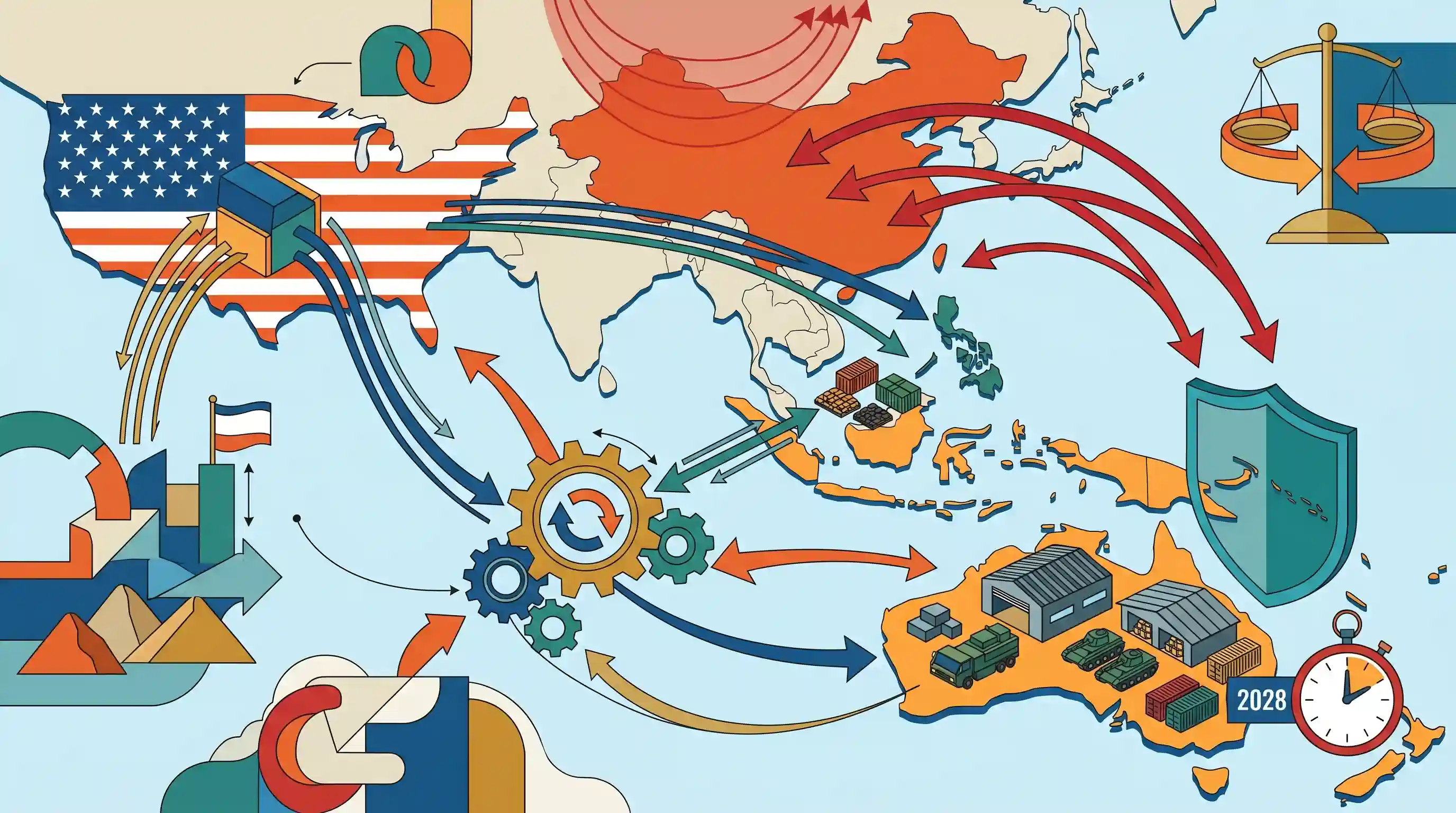
The United States military, specifically the US Marine Corps, is moving to build a permanent, 'war-ready' weapons and equipment stockpile in southeastern Australia. Located in Bandiana, Victoria, the site offers a strategic advantage by being largely out of range of China's primary missile capabilities. Slated to reach full capacity by 2028, this facility will complement another new stockpile opening in the Philippines, which is situated much closer to the South China Sea. The initiative underscores the intensifying geopolitical rivalry between the US and China, reflecting Washington's commitment to reinforcing logistical resilience and bolstering military preparedness alongside its allies in the Indo-Pacific.
Key Points
- The US Marine Corps plans to establish a permanent, 'war-ready weapons stockpile' in Bandiana, Victoria (Australia) by 2028.
- The location was chosen strategically as it remains out of range of most Chinese missile systems, providing a secure rear base for logistics.
- A complementary stockpile is opening this year in the Philippines, which is geographically closer to potential flashpoints in the contested South China Sea.
- The stockpiles aim to provide resilient global sustainment, equipment maintenance, and supply-chain security for US and allied forces across the Indo-Pacific.
- This development represents a significant step in the ongoing US-China strategic rivalry and the increasing militarisation of the broader Indo-Pacific region.
Important Terms
Indo-Pacific

A geopolitical region spanning the Indian and Pacific Oceans, viewed as a single strategic system. It is the primary theater for US-China rivalry and India's "Act East" policy.
UPSC context
GS II: IR; tests maritime security, India's role as a regional leader, and "Free and Open Indo-Pacific" initiatives.
AUKUS
A trilateral security partnership between Australia, the UK, and the US focused on the Indo-Pacific, involving the sharing of advanced defense technologies like nuclear-powered submarines.
UPSC context
GS II: Global Groupings; tests understanding of new security architectures and their impact on India’s strategic autonomy.
Logistical Resilience
The ability of military supply chains to absorb shocks, adapt to disruptions, and maintain sustained support for forces in contested or hostile environments.
UPSC context
GS III: Security; relevant for modern warfare sustainment and the shift toward integrated theatre commands.
South China Sea
A maritime region in the Western Pacific characterized by major territorial disputes and vital global trade routes, serving as a focal point of regional tension.
UPSC context
GS II: IR; tests knowledge of UNCLOS, freedom of navigation, and maritime disputes affecting India's energy interests.
Pre-positioning (Military)
The strategic storage of military equipment, vehicles, and supplies near potential conflict zones to enable rapid deployment and reduce response times during crises.
UPSC context
GS II: IR; tests understanding of deterrence strategies and bilateral defense logistics agreements like India's LEMOA.
US Marine Corps
A branch of the US Armed Forces specializing in amphibious warfare and rapid expeditionary deployment, central to US force posture in the Indo-Pacific.
UPSC context
GS II: IR; tests awareness of foreign military roles in regional security and US-China strategic competition.
Prelims Trap
The Bandiana military stockpile is a joint initiative being developed under the AUKUS security partnership.
Aspirants often conflate all recent US-Australia military moves with AUKUS or the Quad. This is a bilateral US Marine Corps logistics initiative, distinct from the AUKUS nuclear submarine pact.
Static Concepts Connected
What are the First and Second Island Chains in Indo-Pacific geopolitics?
- First Island Chain: Runs from the Kuril Islands through Japan, Taiwan, to the Philippines. It forms a primary maritime defense line for the US and its allies.
- Second Island Chain: Extends from Japan through Guam to Eastern Indonesia, acting as a strategic rear echelon for US forces.
- A2/AD Strategy: China's "Anti-Access/Area Denial" strategy utilizes advanced missile systems to deny adversaries freedom of movement within these specific geographic chains.
How do US logistics agreements with treaty allies compare to its pact with India?
- LEMOA: India and the US signed the Logistics Exchange Memorandum of Agreement (LEMOA) in 2016 for reciprocal logistics support, refueling, and berthing.
- No Permanent Bases: Unlike permanent US stockpiles in Australia or the Philippines (EDCA), LEMOA does not allow the US to establish permanent military bases or war-ready depots on Indian soil.
Cross-Topic Patterns
China's A2/AD vs. India's SAGAR
As the US disperses assets to counter China's A2/AD, India must balance its "SAGAR" vision with the increasing militarisation of the Indo-Pacific and its own Andaman and Nicobar Islands strategic buildup.
Places in News: Victoria vs. Darwin
UPSC frequently tests geographic awareness. While Darwin (North Australia) hosts rotational US Marines, Bandiana (Victoria, South) provides out-of-missile-range strategic depth, highlighting a two-tiered geographic logistics strategy.

Expect a Prelims question mapping Indo-Pacific military hubs (Bandiana, Darwin, Guam) against China's First and Second Island chains.
Linked PYQs · 4
Linked PYQs · 4
- 2021MainsGS2
The newly tri-nation partnership AUKUS is aimed at countering China's ambitions in the Indo-Pacific region. Is it going to supersede the existing partnerships in the region? Discuss the strength and impact of AUKUS in the present scenario.
- 2021MainsGS2
“The USA is facing an existential threat in the form of a China, that is much more challenging than the erstwhile Soviet Union.” Explain.
- 2020MainsGS2
What is the significance of Indo-US defence deals over Indo-Russian defence deals? Discuss with reference to stability in the Indo-Pacific region.
- 2014MainsGS2
With respect to the South China sea, maritime territorial disputes and rising tension affirm the need for safeguarding maritime security to ensure freedom of navigation and over flight throughout the region. In this context, discuss the bilateral issues between India and China.
