US military conducts airstrikes on missile sites in Iran
Source:The Hindu ↗
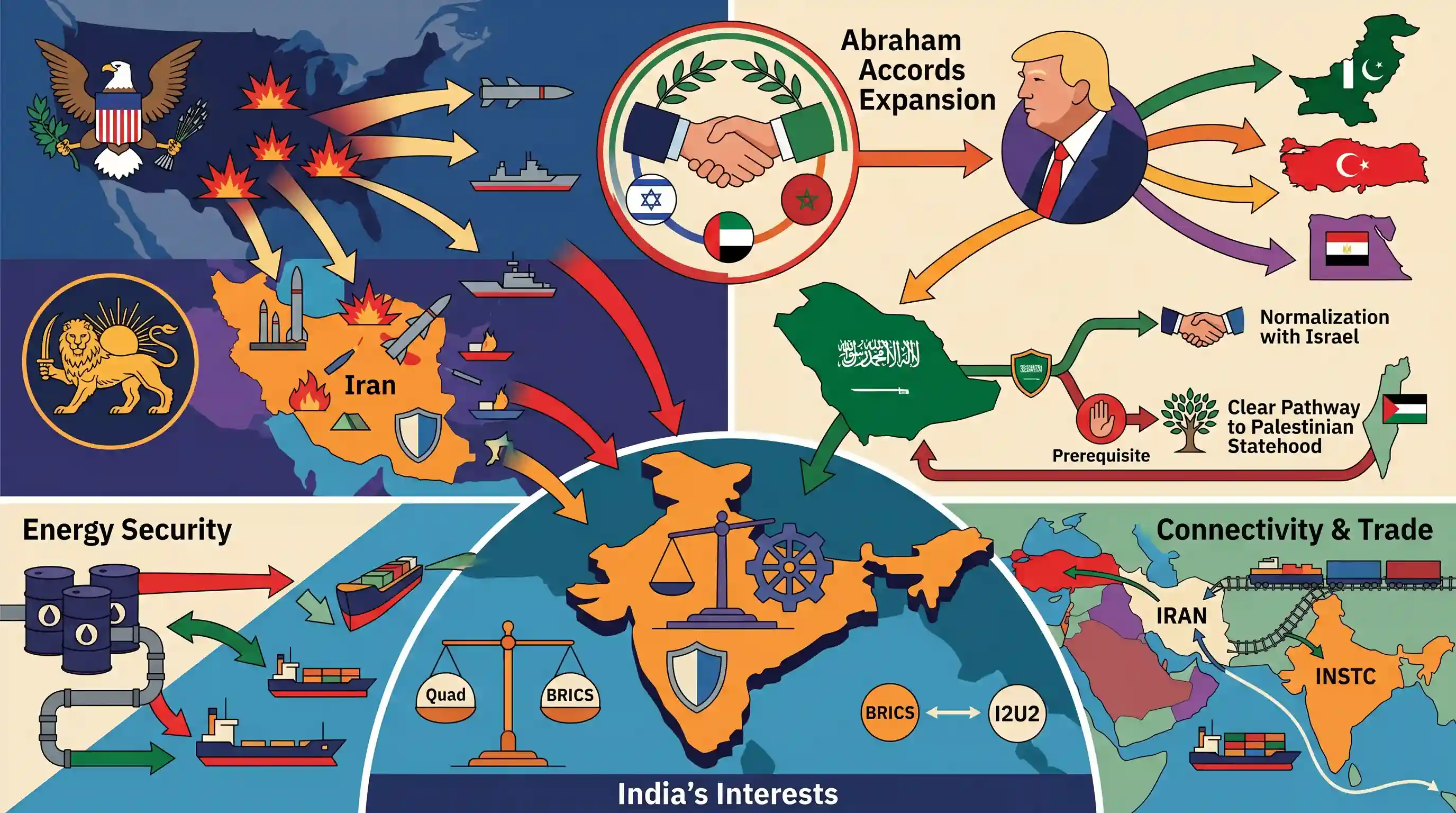
Why It Matters
The geopolitics of West Asia directly impact India's energy security, diaspora, and strategic investments (like the Chabahar port). The Abraham Accords signify a major realignment in the Middle East, and linking them to US-Iran relations presents new challenges and opportunities for regional stability.
Summary
The US military executed self-defence strikes on Iranian missile launch sites and boats in southern Iran. Concurrently, Donald Trump proposed that any agreement to resolve the Iran conflict should necessitate the expansion of the Abraham Accords. He suggested that countries including Saudi Arabia, Pakistan, Turkey, and Egypt should join the accords to normalize relations with Israel. While the accords previously facilitated normalization between Israel and nations like the UAE and Morocco, Saudi Arabia continues to insist on a clear pathway to Palestinian statehood before establishing diplomatic ties with Israel.
Key Points
- The US military conducted strikes on missile launch sites and minelaying boats in southern Iran, citing self-defence.
- Donald Trump proposed that a condition for ending the conflict with Iran should involve expanding the Abraham Accords.
- He suggested that countries like Saudi Arabia, Pakistan, Turkey, Egypt, Jordan, and Qatar should normalize relations with Israel as part of this expansion.
- The Abraham Accords, brokered during Trump's first term, previously normalized Israel's ties with the UAE, Bahrain, Sudan, Morocco, and Kazakhstan.
- Saudi Arabia maintains its stance that recognizing Israel is contingent upon a clear pathway to Palestinian statehood.
Important Terms
Abraham Accords

A series of 2020 agreements brokered by the US to normalize diplomatic, economic, and cultural relations between Israel and several Arab nations, including the UAE, Bahrain, and Morocco.
UPSC context
GS Paper II (International Relations); critical for shifting West Asian alliances and India's 'Link West' policy.
Two-State Solution
The primary framework for resolving the Israeli-Palestinian conflict by establishing an independent State of Palestine alongside Israel, based on pre-1967 borders with East Jerusalem as its capital.
UPSC context
GS Paper II (Bilateral & Global Groupings); central to India's long-standing diplomatic position on Middle East peace.
Normalization
The process of establishing formal diplomatic relations—including exchanging ambassadors and opening embassies—between countries that previously lacked official ties or were in a state of conflict.
UPSC context
GS Paper II (International Relations); tests understanding of diplomatic breakthroughs and regional security architecture.
West Asia
A strategically vital region for India's foreign policy, serving as its 'extended neighborhood' and a primary source for energy security, trade, and diaspora remittances.
UPSC context
GS Paper II (Regional Groupings affecting India); critical for energy security and maritime stability in the IOR.
Self-Defence (International Law)
An inherent right under Article 51 of the UN Charter permitting states to use force in response to an armed attack to protect their sovereignty and territorial integrity.
UPSC context
GS Paper II (International Institutions/Law); relevant for assessing the legality of military interventions and global security norms.
Prelims Trap
"Egypt, Jordan, and Saudi Arabia are signatories to the Abraham Accords."
Egypt (1979) and Jordan (1994) normalized ties with Israel via distinct peace treaties decades ago. Saudi Arabia has currently refused to sign the Accords.
Static Concepts Connected
What is India's 'De-hyphenation' policy in West Asia?
- Meaning: Treating relations with Israel and Palestine (or Arab states) as independent, rather than viewing them through a mutually exclusive, zero-sum lens.
- Strategic utility: Allowed India to pursue distinct strategic depths—defence/tech with Israel and energy/diaspora with Gulf states—without ideological constraints.
How does the Arab Peace Initiative contrast with the Abraham Accords?
- Arab Peace Initiative (2002): Proposed by Saudi Arabia, it strictly conditioned the Arab world's recognition of Israel on the establishment of an independent Palestinian state.
- Abraham Accords (2020): Decoupled diplomatic and economic normalization from the Palestinian issue, allowing states like UAE and Bahrain to formalize ties immediately.
Cross-Topic Patterns
Accords birthing the West Asian Quad
The UAE-Israel normalization under the Accords directly enabled the creation of the I2U2 grouping, marking India's strategic shift toward minilateralism in West Asia.
IMEC viability and Saudi-Israel ties
The ambitious India-Middle East-Europe Economic Corridor (IMEC) fundamentally relies on geopolitical stability and the eventual diplomatic normalization between Saudi Arabia and Israel.

West Asia questions in 2026 will likely fuse Abraham Accord signatories with broader regional groupings like I2U2 and IMEC transit routes.
Linked PYQs · 2
Linked PYQs · 2
- 2023PrelimsGS1
Consider the following statements: Statement-I: Israel has established diplomatic relations with some Arab States. Statement-II: The 'Arab Peace Initiative' mediated by Saudi Arabia was signed by Israel and Arab League. Which one of the following is correct in respect of the above statements?
- 2022MainsGS2
How will I2U2 (India, Israel, UAE and USA) grouping transform India's position in global politics?
