US military prepares contingency plans for prolonged Iran campaign
Source:The Hindu ↗
Why It Matters
Any escalation in US-Iran tensions directly impacts global crude oil prices, threatening India's energy security and economic stability. It also poses significant risks to the large Indian diaspora in the Middle East, making this a critical area of study for GS-II (International Relations) and GS-III (Economy).
Summary
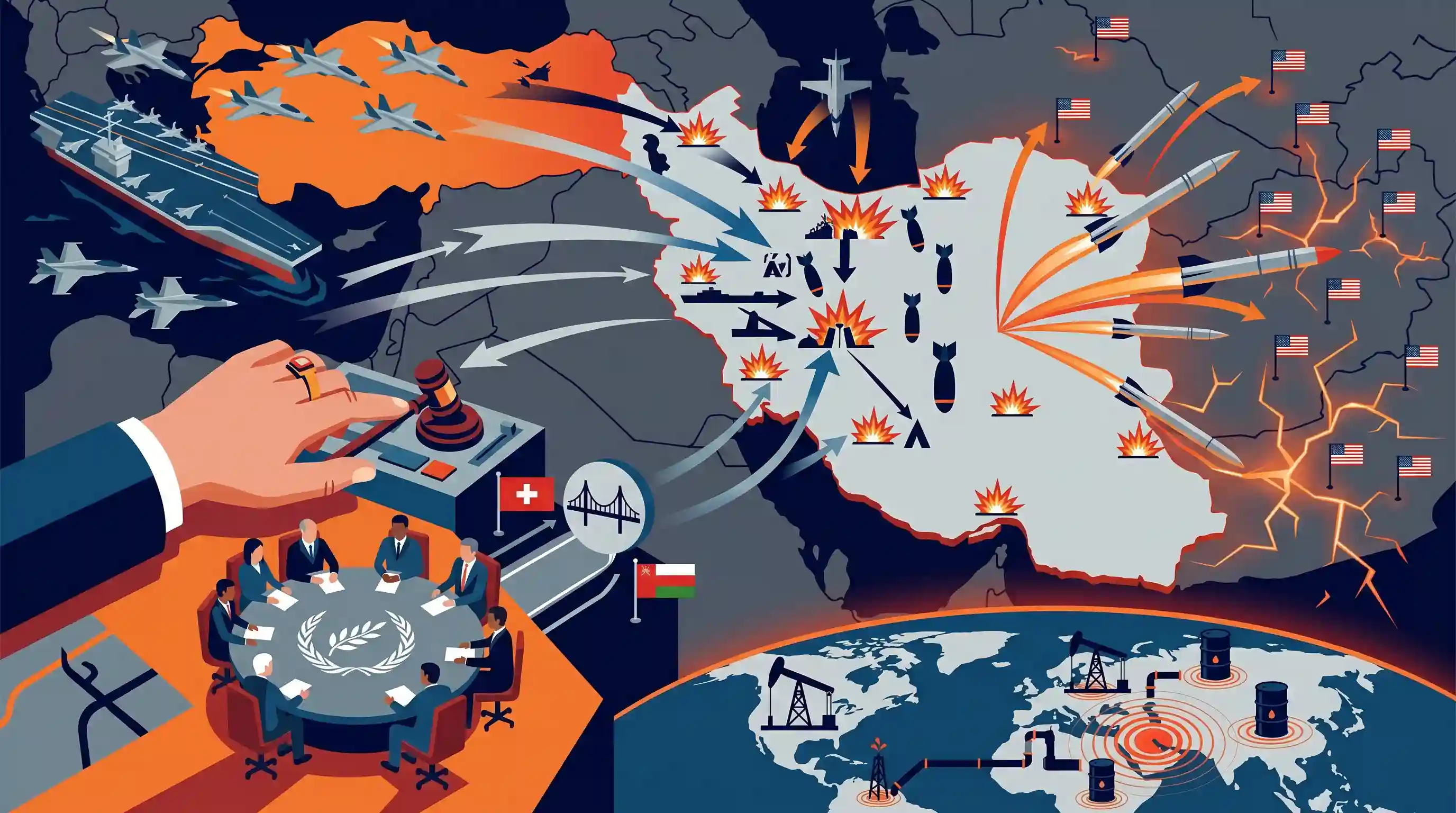
The US military is reportedly preparing contingency plans for a sustained, potentially weeks-long campaign against Iran if directed by President Donald Trump. While the US administration is simultaneously engaging in diplomatic backchannels in Geneva mediated by Oman, it has significantly amassed naval and air assets in the Middle East. The proposed military options would involve extended air and naval strikes targeting Iran's broader security infrastructure, moving beyond isolated attacks on nuclear sites. In response, Iran has warned of severe retaliation against US bases across the region. The escalating geopolitical tensions heighten the risk of a widespread regional conflict, which could have profound implications for global stability and energy markets.
Key Points
- The US military is drawing up plans for a potentially weeks-long, sustained air and naval campaign against Iran in case President Donald Trump orders an attack.
- Despite military preparations, backchannel diplomatic negotiations mediated by Oman are taking place in Geneva, as the US administration reportedly prefers to strike a deal.
- A sustained US military campaign could target Iran's broader state and security apparatus, rather than being limited to single-strike operations on nuclear facilities.
- Iran's Islamic Revolutionary Guard Corps has warned of retaliation against any of the numerous US military bases scattered across allied Middle Eastern nations.
- The potential for a US-Iran military conflict carries a high risk of expanding into a wider regional war, impacting global geopolitics and energy security.
Important Terms
Islamic Revolutionary Guard Corps (IRGC)

Elite branch of Iran’s Armed Forces established in 1979. It protects the clerical regime, controls major economic sectors, and manages regional proxy networks like Hezbollah and Hamas.
UPSC context
GS II: International Relations & Security; tests understanding of regional power structures and asymmetric warfare in West Asia.
Strait of Hormuz
A narrow waterway between Iran and Oman connecting the Persian Gulf to the Arabian Sea. It is the world’s most vital oil chokepoint, handling ~20% of global consumption.
UPSC context
GS I: Geography & GS II: Energy Security; critical for India’s crude oil imports and maritime trade stability.
Joint Comprehensive Plan of Action (JCPOA)
The 2015 agreement between Iran and P5+1 powers (US, UK, France, Russia, China, Germany) to curb Iran’s nuclear program in exchange for economic sanctions relief.
UPSC context
GS II: International Relations; important for questions on nuclear non-proliferation and global diplomatic architecture.
Global Energy Security
The reliable, uninterrupted availability of energy sources at an affordable price. For India, it involves balancing high import dependency with strategic petroleum reserves and renewable transitions.
UPSC context
GS III: Economic Development & Infrastructure; tests India’s vulnerability to global supply shocks and geopolitical volatility.
West Asia
The UPSC-preferred term for the Middle East, encompassing the Arabian Peninsula and Iran. It is a core pillar of India’s "Link West" foreign policy.
UPSC context
GS II: International Relations; crucial for understanding India’s diaspora welfare, energy interests, and strategic balancing.
Prelims Trap
Chabahar port is situated inside the Persian Gulf, making it highly vulnerable to the closure of the Strait of Hormuz.
Chabahar is located on the Makran coast (Gulf of Oman), deliberately outside the Strait of Hormuz. This gives it strategic immunity from Gulf closures.
Static Concepts Connected
What are the key maritime chokepoints in the Middle East?
- Strait of Hormuz: Connects the Persian Gulf to the Gulf of Oman and Arabian Sea. Critical for ~20% of global oil transit; bordered by Iran, Oman, and UAE.
- Bab el-Mandeb: Connects the Red Sea to the Gulf of Aden and Arabian Sea. Vital for Suez Canal maritime traffic; bordered by Yemen, Djibouti, and Eritrea.
- Suez Canal: Artificial waterway in Egypt connecting the Mediterranean Sea to the Red Sea, dividing Africa and Asia.
How do global crude oil price shocks macroeconomically impact India?
- Current Account Deficit: India imports ~85% of its crude requirements; higher oil prices inflate the import bill, structurally widening the Current Account Deficit (CAD).
- Imported Inflation: Higher fuel prices increase transportation and logistics costs across the economy, leading to persistent cost-push inflation.
- Currency Depreciation: Increased dollar demand to pay for expensive oil imports puts downward pressure on the Indian Rupee, causing depreciation.
- Fiscal Deficit: If the government absorbs the price shock via fuel subsidies or excise duty cuts, it widens the fiscal deficit.
Cross-Topic Patterns
Chabahar + INSTC + Sanctions Waivers
Escalation against Iran threatens India's US sanctions-waiver for Chabahar Port, directly jeopardizing the INSTC and India's sole strategic gateway to Central Asia that bypasses Pakistan.
Asymmetric Warfare + Non-State Proxies
Iran's 'Mosaic Defense' connects state strategy with non-state proxies (Houthis, Hezbollah). UPSC is increasingly testing the exact geographic locations and ideological affiliations of these regional proxy groups.

Expect a 2026 Prelims combo question mapping Middle East chokepoints/ports alongside statements on CAD and imported cost-push inflation.
Linked PYQs · 5
Linked PYQs · 5
- 2025MainsGS2
"Energy security constitutes the dominant kingpin of India's foreign policy, and is linked with India's overarching influence in Middle Eastern countries.” How would you integrate energy security with India's foreign policy trajectories in the coming years?
- 2018MainsGS2
In what ways would the ongoing US-Iran Nuclear Pact Controversy affect the national interest of India? How should India respond to this situation?
- 2012MainsGS2
How have the US sanctions against Iran affected India's bilateral relations with Iran?
- 2022PrelimsGS1
The term "Levant" often heard in the news roughly corresponds to which of the following regions?
- 2015PrelimsGS1
The area known as 'Golan Heights' sometimes appears in the news in the context of the events related to
