US Military Operations Planning Amid Regional Escalation
Source:The Hindu ↗
Why It Matters
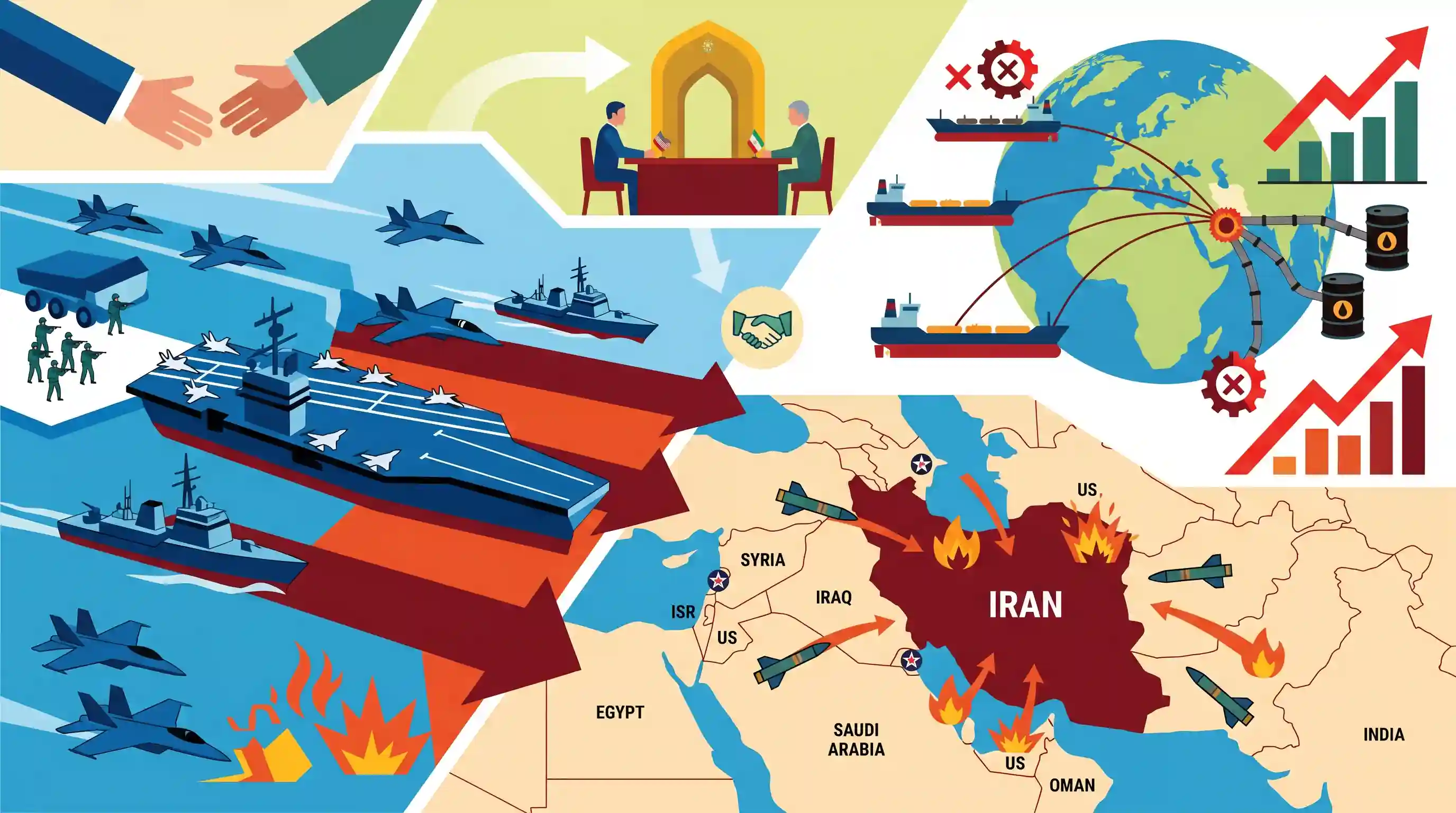
The Middle East is crucial to global energy security and hosts a large Indian diaspora. A prolonged US-Iran conflict would drastically disrupt global supply chains, spike oil prices, and force India into a delicate diplomatic balancing act given its strategic ties with both the US and Iran (e.g., Chabahar Port, INSTC).
Summary
The United States military is actively preparing for potential weeks-long sustained operations against Iran as regional tensions escalate. Alongside diplomatic efforts involving US envoys and Oman-mediated negotiations in Geneva, the US is reinforcing its Middle Eastern military footprint with an additional aircraft carrier, thousands of troops, fighter aircraft, and guided-missile destroyers. An American offensive, which President Trump has hinted could aim at "regime change," would likely trigger significant Iranian retaliation against US bases spread across several Middle Eastern nations. This volatile standoff has deep implications for global energy security and broader geopolitical stability in the region.
Key Points
- The US military is preparing for potential weeks-long, sustained operations against Iran if ordered by President Trump.
- To bolster its regional presence, the US is dispatching an additional aircraft carrier, fighter jets, guided-missile destroyers, and thousands of troops to the Middle East.
- Negotiations between US Envoys (Steve Witkoff, Jared Kushner) and Iran are slated to take place in Geneva, facilitated by Oman, potentially to de-escalate tensions.
- US operations, if executed, would expand significantly beyond the June "Midnight Hammer" strikes, potentially aiming at "regime change" as floated by Trump.
- An American offensive is expected to provoke massive retaliatory strikes from Iran against US bases across the Middle East, threatening regional stability.
Important Terms
Operation Midnight Hammer

A 2025-2026 US military operation involving high-precision airstrikes against Iranian nuclear facilities at Fordow, Natanz, and Isfahan, utilizing B-2 stealth bombers and bunker-buster munitions.
UPSC context
GS Paper 2 (IR); tests knowledge of US-Iran conflict escalations, nuclear proliferation, and military interventions in West Asia.
GBU-57 Massive Ordnance Penetrator (MOP)
A 30,000-pound US precision-guided "bunker-buster" bomb designed to penetrate hardened underground targets; it saw its first operational combat use during the strikes on Iran.
UPSC context
GS Paper 3 (Security/S&T); relevant for understanding modern warfare technology and strategic deterrence against fortified nuclear infrastructure.
Strait of Hormuz
A vital maritime chokepoint between the Persian Gulf and Gulf of Oman, through which approximately 20-30% of global oil transit passes.
UPSC context
GS Paper 1 (Geography) & 2 (IR); critical for assessing India’s energy security and vulnerability to regional maritime blockades.
Oman-Mediated Diplomacy
The strategic neutral role of the Sultanate of Oman in facilitating indirect back-channel negotiations and frameworks for de-escalation between the United States and Iran.
UPSC context
GS Paper 2 (IR); illustrates the importance of regional mediators in navigating complex West Asian power dynamics.
Energy Security
The availability of energy sources at an affordable price; for India, this involves managing import dependency and maintaining Strategic Petroleum Reserves during regional conflicts.
UPSC context
GS Paper 3 (Economy/Infrastructure); focuses on India's resilience against global oil price shocks and supply chain disruptions.
US Central Command (CENTCOM)
The US unified combatant command responsible for military operations and security interests across the Middle East, Central Asia, and parts of North Africa.
UPSC context
GS Paper 2 (International Relations); key for analyzing US power projection and security architecture in India's extended neighborhood.
Prelims Trap
"Chabahar port is situated within the Persian Gulf, making it vulnerable to blockades at the Strait of Hormuz."
Chabahar is located on the Gulf of Oman, outside the Strait of Hormuz. This location is strategically vital precisely because it bypasses the highly vulnerable Persian Gulf choke point.
Static Concepts Connected
What are the key maritime choke points in the Middle East relevant to energy security?
- Strait of Hormuz: Connects the Persian Gulf to the Gulf of Oman, separating Iran and Oman. It carries nearly 20% of global oil trade.
- Bab el-Mandeb: Connects the Red Sea to the Gulf of Aden, bordered by Yemen on the Arabian Peninsula, and Djibouti and Eritrea in the Horn of Africa.
- Suez Canal: An artificial sea-level waterway in Egypt connecting the Mediterranean Sea to the Red Sea, separating the African continent from Asia.
How does Chabahar Port integrate into India's strategic transit frameworks?
- Afghanistan Access: Provides India with direct trade access to Afghanistan and Central Asia, completely bypassing Pakistani territory.
- INSTC Linkage: Acts as a critical maritime gateway for the International North-South Transport Corridor, connecting India to Russia and European markets.
- Sanctions Exemption: Historically received narrow US sanction waivers due to its specific role in the economic development and reconstruction of Afghanistan.
Cross-Topic Patterns
Gulf Conflict & Imported Inflation
Supply shocks in the Strait of Hormuz directly spike India's crude import bill, aggravating twin deficit challenges (CAD and Fiscal Deficit) and causing imported inflation.
Oman as the "Switzerland of West Asia"
Oman's Ibadi Islamic tradition and strict non-interventionist stance allow it to host backchannel US-Iran talks, contrasting with the active proxy involvements of other regional powers.

Expect a match-the-pair map question linking key Middle Eastern military bases (Al Udeid, Fifth Fleet) or choke points to host nations.
Linked PYQs · 3
Linked PYQs · 3
- 2025MainsGS2
"Energy security constitutes the dominant kingpin of India's foreign policy, and is linked with India's overarching influence in Middle Eastern countries.” How would you integrate energy security with India's foreign policy trajectories in the coming years?
- 2025PrelimsGS1
India is one of the founding members of the International North-South Transport Corridor (INSTC), a multimodal transportation corridor, which will connect
- 2017PrelimsGS1
Mediterranean Sea is a border of which of the following countries? 1. Jordan 2. Iraq 3. Lebanon 4. Syria Select the correct answer using the code given below:
