US Manufacturing Slowdown and Inflation Expectations
Source:The Hindu ↗
Why It Matters
Understanding U.S. macroeconomic indicators (like PMI and inflation) and Federal Reserve policies is crucial for UPSC aspirants, as these global economic shifts directly impact India's monetary policy, exchange rates, capital flows, and trade dynamics.
Summary
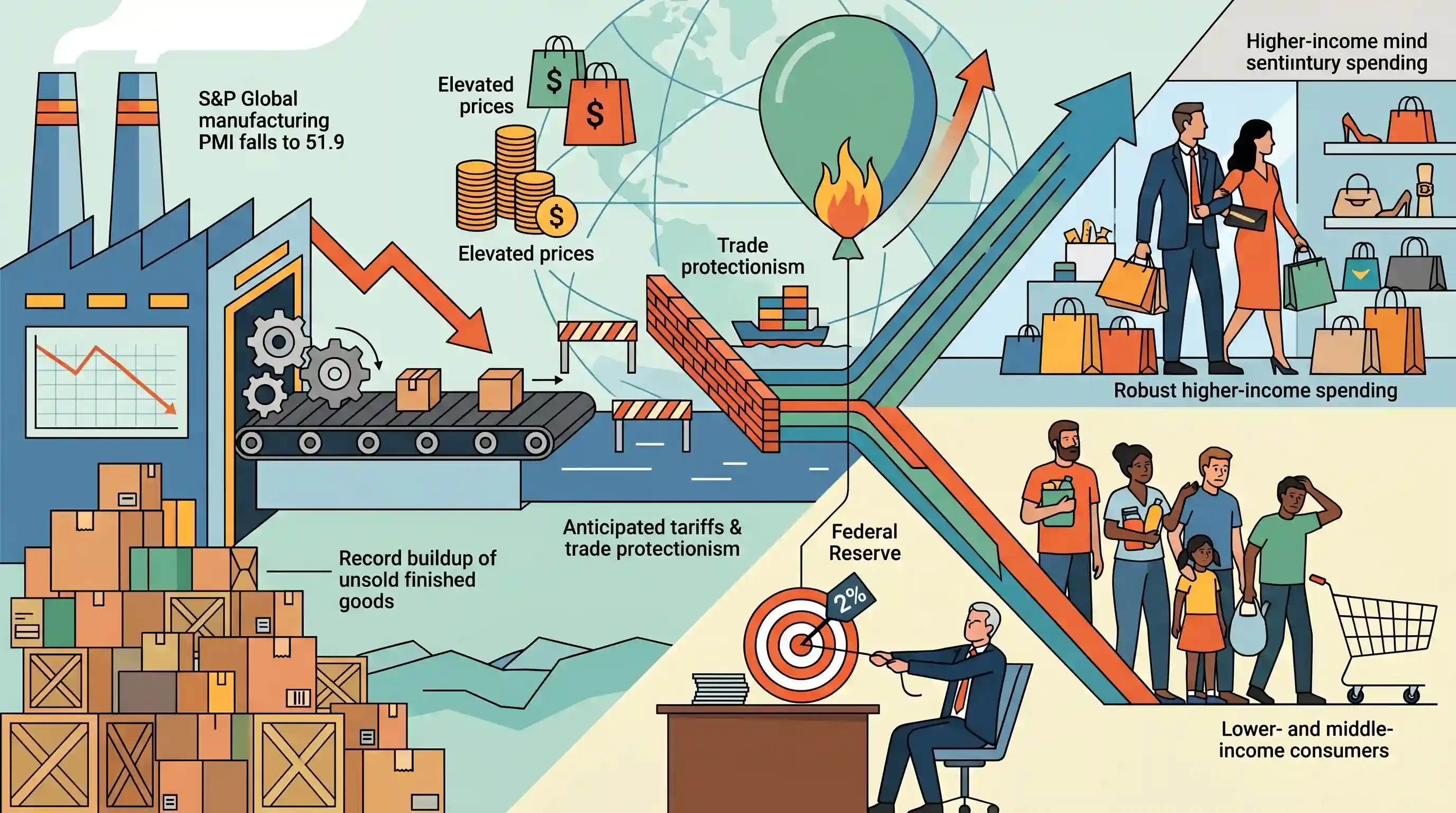
U.S. manufacturing activity slowed in November 2024, driven by elevated prices and anticipated tariffs that dampened consumer demand. The S&P Global manufacturing Purchasing Managers' Index (PMI) fell to 51.9, leading to a record buildup of unsold finished goods. The economic environment reflects a 'K-shaped' trajectory, disproportionately impacting lower- and middle-income consumers while higher-income spending remains robust. Persistently high five-year inflation expectations of 3.4% pose challenges for the Federal Reserve's monetary policy and its 2% target, highlighting risks to broader macroeconomic stability.
Key Points
- U.S. manufacturing experienced a slowdown in November, with the S&P Global PMI slipping to 51.9 due to high prices curbing demand.
- A record accumulation of unsold finished goods was reported, indicating manufacturers produced more than they could sell amidst slowing new orders.
- The economic strain is unevenly distributed, exhibiting a 'K-shaped' dynamic where lower and middle-income consumers struggle while higher-income households continue to spend.
- Inflation expectations remain elevated at 3.4% over the next five years, complicating the Federal Reserve's path to its 2% inflation target.
- Anticipated protectionist trade policies and tariffs under the incoming administration are contributing to economic uncertainty and price pressures.
Important Terms
Federal Reserve (The Fed)

The central bank of the United States responsible for conducting monetary policy, regulating banks, and maintaining financial stability through interest rate adjustments.
UPSC context
GS Paper 3 (Economy); tests impact of global monetary policy on Indian forex reserves, capital outflows, and rupee valuation.
Purchasing Managers' Index (PMI)
A survey-based economic indicator that tracks monthly changes in the manufacturing and services sectors; a reading above 50 signifies expansion, while below 50 indicates contraction.
UPSC context
GS Paper 3 (Industrial Growth); crucial leading indicator used to forecast GDP trends and compare with official IIP data.
K-shaped Recovery
A post-recession scenario where different sectors or income groups recover at divergent rates, leading to increased inequality as some thrive while others continue to struggle.
UPSC context
GS Paper 3 (Inclusive Growth); vital for discussing post-pandemic inequality and the structural limitations of aggregate GDP growth.
Inflation Expectations
The rate at which consumers and businesses expect prices to rise in the future, which can influence current spending, wage negotiations, and price-setting.
UPSC context
GS Paper 3 (Monetary Policy); tests understanding of the wage-price spiral and the central bank's role in anchoring economic sentiment.
S&P Global
A prominent global financial information and analytics corporation that provides essential market data, including the Purchasing Managers' Index (PMI) for many nations.
UPSC context
GS Paper 3 (Economy); identifies a major source of private high-frequency data used for global and domestic economic monitoring.
University of Michigan (Consumer Sentiment Index)
A major academic institution known for its Consumer Sentiment Index, a high-frequency indicator of US consumer confidence and long-term inflation expectations.
UPSC context
GS Paper 3 (External Sector); relevant for tracking global demand drivers and their indirect impact on Indian exports and trade.
Prelims Trap
A falling PMI (e.g., from 53 to 51.9) indicates that the manufacturing sector is contracting and experiencing negative growth.
A PMI above 50 always signifies expansion compared to the previous month. A drop from 53 to 51.9 merely shows expansion is happening at a slower pace, not an outright contraction.
Static Concepts Connected
What is a K-shaped economic trajectory?
- Divergent paths: Different sectors, industries, or income groups recover or grow at varying rates, often moving in completely opposite directions.
- Wealth inequality: Asset owners and higher-income households see wealth gains, while lower-income wage earners face job losses, high inflation, and stagnation.
- Policy challenge: It complicates broad macroeconomic tools (like interest rates), which struggle to address structural inequalities without triggering broader inflation or recession.
How does prolonged US monetary tightening impact the Indian economy?
- Capital flight: Higher interest yields in the US pull Foreign Portfolio Investment (FPI) away from emerging markets like India.
- Imported inflation: Capital outflows depreciate the Rupee against the Dollar, making inelastic imports like crude oil more expensive and fueling domestic inflation.
- Corporate debt burden: Indian corporates holding unhedged, dollar-denominated External Commercial Borrowings (ECBs) face significantly higher debt-servicing costs in Rupee terms.
Cross-Topic Patterns
US Protectionism + Indian Exports
Anticipated US tariffs compound domestic manufacturing slowdowns. This links directly to India's challenge in boosting merchandise exports amidst rising global trade barriers and fragmented global supply chains.
Imported Inflation + RBI Stance
Sticky US inflation means prolonged high US rates. This forces the RBI to delay domestic rate cuts to prevent capital flight, linking US domestic spending to Indian growth cycles.

A 2026 Prelims question will likely blend PMI interpretation with the effects of US protectionism and monetary tightening on emerging markets.
Linked PYQs · 4
Linked PYQs · 4
- 2022PrelimsGS1
Consider the following statements: 1. Tight monetary policy of US Federal Reserve could lead to capital flight. 2. Capital flight may increase the interest cost of firms with existing External Commercial Borrowings (ECBs). 3. Devaluation of domestic currency decreases the currency risk associated with ECBs. Which of the statements given above are correct?
- 2023PrelimsGS1
Consider the following statements: Statement-I: In the post-pandemic recent past, many Central Banks worldwide had carried out interest rate hikes. Statement-II: Central Banks generally assume that they have the ability to counteract the rising consumer prices via monetary policy means. Which one of the following is correct in respect of the above statements?
- 2022PrelimsGS1
With reference to the Indian economy, consider the following statements: 1. If the inflation is too high, Reserve Bank of India (RBI) is likely to buy government securities. 2. If the rupee is rapidly depreciating, RBI is likely to sell dollars in the market. 3. If interest rates in the USA or European Union were to fall, that is likely to induce RBI to buy dollars. Which of the statements given above are correct?
- 2021MainsGS3
Do you agree that the Indian economy has recently experienced V-shaped recovery? Give reasons in support of your answer.
