US Temporary Waiver on Iranian Oil Sanctions
Source:Indian Express ↗
Why It Matters
The article highlights a critical shift in global energy geopolitics. For UPSC aspirants, understanding US-Iran relations is vital for analyzing India's energy security imperatives, supply chain diversification, and the geopolitical significance of the Strait of Hormuz in international trade.
Summary
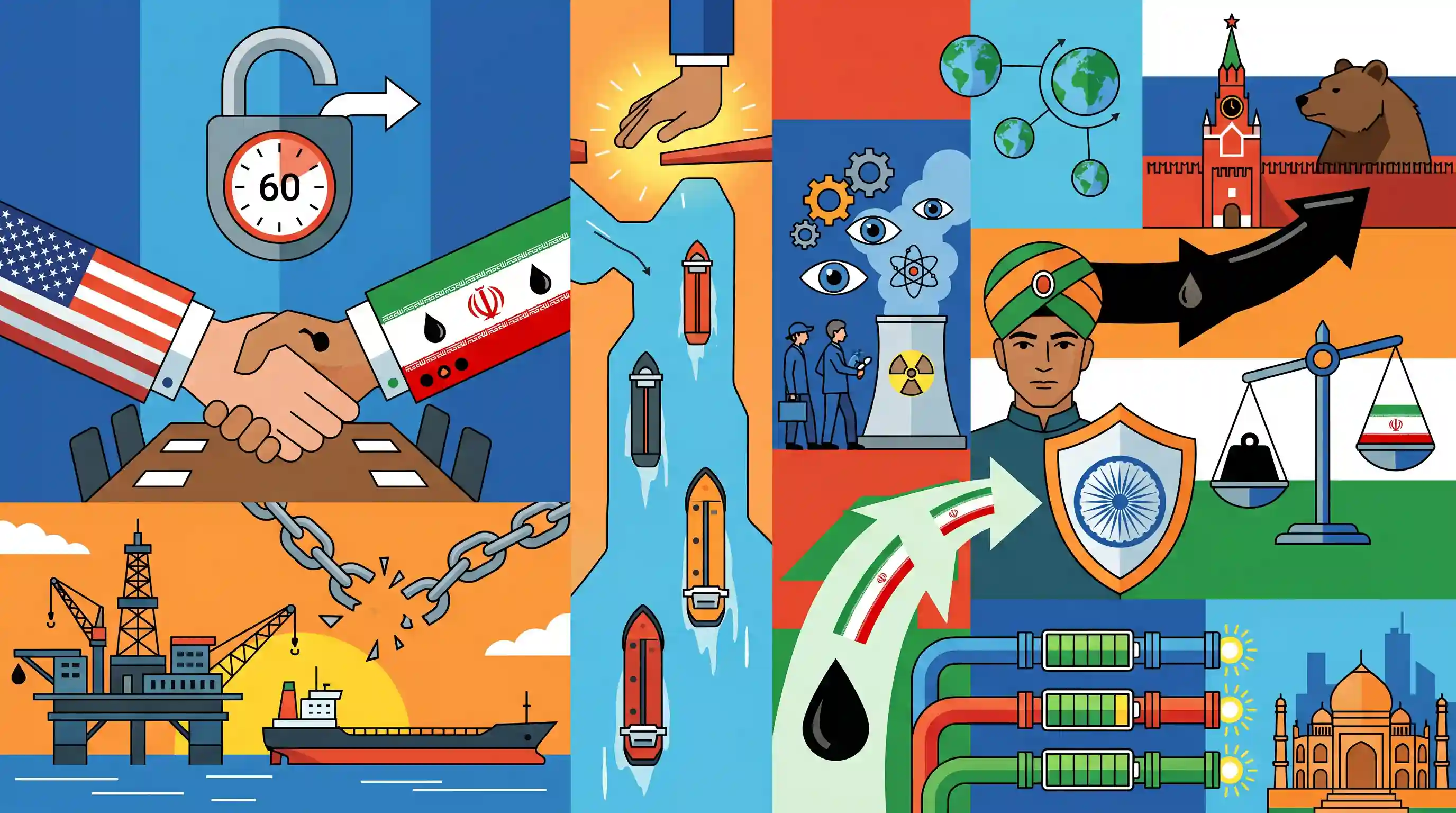
The United States has announced a temporary 60-day waiver on sanctions targeting Iranian oil exports after diplomatic talks in Switzerland. In return, Iran committed to ensuring unhindered transit through the strategically vital Strait of Hormuz and allowing IAEA inspectors back into the country. This temporary easing of sanctions presents a crucial window for India, once a major buyer of Iranian oil before the 2019 sanctions, to diversify its crude sourcing away from its current heavy reliance on Russian imports and bolster its energy security amidst global supply constraints.
Key Points
- The United States has granted a 60-day temporary waiver on Iranian oil sanctions following diplomatic negotiations in Switzerland.
- In exchange for the waiver, Iran has agreed to guarantee free maritime transit through the Strait of Hormuz and permit IAEA inspectors to resume their work.
- This development offers India an opportunity to diversify its crude oil imports and alleviate domestic energy supply pressures.
- India historically relied on Iranian oil before US sanctions were tightened in 2019, but has recently pivoted to importing record volumes of Russian crude.
Important Terms
IAEA (International Atomic Energy Agency)

Autonomous 1957 intergovernmental organization promoting peaceful nuclear technology and verifying non-diversion to weapons through safeguards. Headquartered in Vienna; India is a founding member.
UPSC context
GS Paper 2 (International Relations); tests knowledge of global watchdogs and India's role in nuclear non-proliferation regimes.
Strait of Hormuz
Strategically vital maritime chokepoint connecting the Persian Gulf to the Gulf of Oman. Approximately 20-25% of global oil and one-third of LNG transit this narrow passage.
UPSC context
GS Paper 1 (Geography) and GS Paper 3 (Energy Security); critical for mapping and maritime security questions.
Energy Security
A nation's ability to ensure the uninterrupted availability of energy sources at an affordable price, balancing import dependence with domestic production and diversification.
UPSC context
GS Paper 3 (Indian Economy/Infrastructure); essential for discussing oil import dependency and economic resilience.
JCPOA (Joint Comprehensive Plan of Action)
A 2015 agreement between Iran and P5+1 nations to limit Iran's nuclear program in exchange for sanctions relief. US withdrawal in 2018 triggered current oil sanctions.
UPSC context
GS Paper 2 (International Relations); tests understanding of West Asian geopolitics and multi-lateral diplomacy.
Secondary Sanctions
Economic penalties imposed by one country (e.g., US) on third-party nations (e.g., India) for conducting business with a sanctioned entity (e.g., Iran).
UPSC context
GS Paper 2 (Effect of policies of developed countries); tests knowledge of diplomatic pressure and strategic autonomy.
Strategic Petroleum Reserves (SPR)
Government-controlled underground storage facilities for crude oil designed to cushion against global supply shocks and price volatility during geopolitical crises.
UPSC context
GS Paper 3 (Energy Security); relevant for questions on India's emergency preparedness and energy infrastructure.
Prelims Trap
US sanctions on Iranian oil are backed by a UN Security Council resolution, making compliance mandatory for India.
These are unilateral US secondary sanctions, not UN mandates. India halted imports in 2019 to maintain access to the US financial system, not due to international law.
Static Concepts Connected
Which water bodies and countries border the Strait of Hormuz?
- Water bodies: Connects the Persian Gulf in the west to the Gulf of Oman and the Arabian Sea in the southeast.
- Bordering nations: Bordered by Iran to the north, and Oman (Musandam peninsula) and the United Arab Emirates to the south.
- Strategic role: It is a critical chokepoint through which approximately 20% of the world's global oil consumption passes.
What are IAEA Safeguards under the Non-Proliferation Treaty (NPT)?
- Verification mandate: Technical measures and inspections to verify that a state's civilian nuclear materials are not diverted for military weapons programs.
- NPT requirement: Non-nuclear-weapon states party to the NPT must conclude comprehensive safeguard agreements with the IAEA to access civilian nuclear tech.
- Additional Protocol: A voluntary agreement that grants the IAEA expanded rights to inspect undeclared nuclear facilities and demand short-notice access.
Cross-Topic Patterns
De-dollarization and Vostro Accounts
The Rupee-Rial barter mechanism historically used for Iranian oil directly parallels India's recent Special Rupee Vostro Account (SRVA) push to bypass SWIFT and de-dollarize trade with sanctioned Russia.
Refinery Complexity and Strategic Autonomy
Indian refineries' high Nelson Complexity Index enables them to process heavy, sour crudes from both Iran and Russia, allowing India to pivot geopolitically based on discount availability and freight costs.

Expect a 2026 map question linking Middle Eastern chokepoints (Hormuz, Bab el-Mandeb) to bordering countries and global energy supply.
Linked PYQs · 3
Linked PYQs · 3
- 2025MainsGS2
"Energy security constitutes the dominant kingpin of India's foreign policy, and is linked with India's overarching influence in Middle Eastern countries.” How would you integrate energy security with India's foreign policy trajectories in the coming years?
- 2017MainsGS2
The question of India's Energy Security constitutes the most important part of India's economic progress. Analyze India's energy policy cooperation with West Asian countries.
- 2012MainsGS2
How have the US sanctions against Iran affected India's bilateral relations with Iran?
