West Asia Military Escalation and Regional Energy Security
Source:The Hindu ↗
Why It Matters
This development highlights the extreme volatility of West Asian geopolitics, directly threatening global energy security, the safety of maritime shipping lanes (Strait of Hormuz), and India's critical strategic investments (specifically Chabahar Port and the INSTC corridor). It underscores how localized conflicts can escalate and disrupt regional trade and diplomatic balances.
Summary
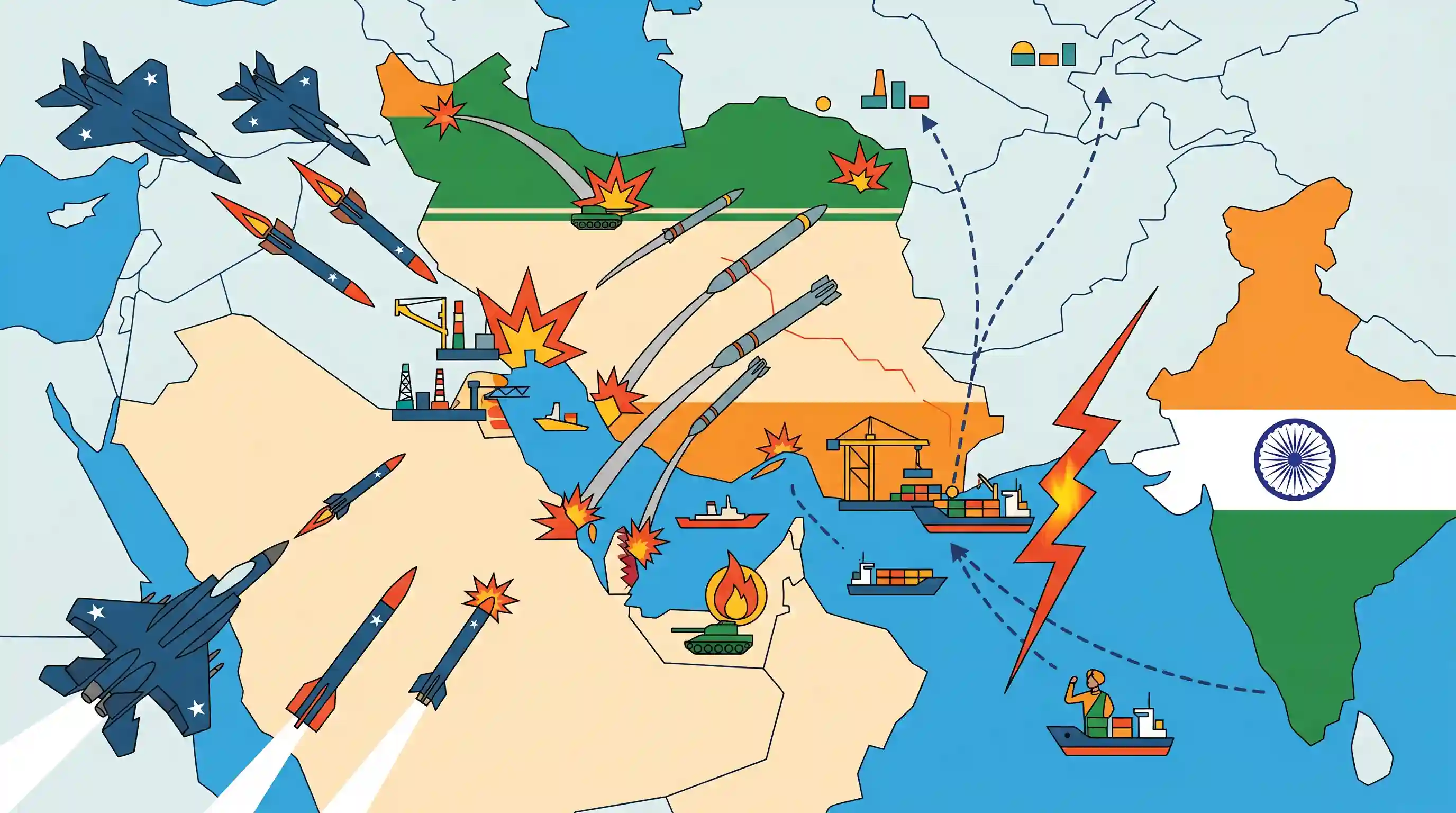
The United States launched fresh airstrikes across Iran targeting key military installations, coastal ports, and infrastructure networks following President Donald Trump’s warnings over attacks in the Strait of Hormuz. Iran retaliated by striking Bahrain, Kuwait, and Qatar, bringing the region closer to a full-scale Persian Gulf war. The strikes have major geopolitical and economic repercussions, notably impacting the port city of Chabahar—a critical strategic and maritime hub for India's connectivity projects in West and Central Asia.
Key Points
- The United States launched a series of fresh airstrikes targeting military sites, port facilities, airport runways, and missile launchers across Iran, following warnings from US President Donald Trump.
- The strikes struck key coastal and regional areas, including the vicinity of the Bushehr nuclear complex, Bandar Abbas, Konarak, Sirik, and the strategic port city of Chabahar. Infrastructure targets like a railway bridge in Golestan province and roads towards Mashhad were also hit.
- In retaliation, Iran targeted Bahrain, Kuwait, and Qatar, dragging neighboring Gulf Arab countries into the crossfire and threatening to collapse a fragile interim peace agreement in the Persian Gulf.
- The escalation began after Trump declared that Iranian-backed attacks on commercial vessels in the Strait of Hormuz had shattered a short-lived ceasefire, stressing the threat to global maritime security and freedom of navigation.
- The direct targeting of Chabahar is highly critical for India, as Chabahar Port serves as India’s gateway to Afghanistan and Central Asia, bypassing Pakistan, and is a vital node of the International North-South Transport Corridor (INSTC).
Important Terms
India-Iran Chabahar Port Agreement

A 10-year bilateral contract signed in May 2024 granting India operational and development rights over the Shahid Beheshti terminal at Iran's Chabahar Port, boosting connectivity to Central Asia.
UPSC context
GS Paper II (International Relations) and GS Paper III (Infrastructure); tests understanding of strategic trade corridors and regional diplomacy.
International North-South Transport Corridor (INSTC)
A 7,200-km multimodal transit network linking India, Iran, Central Asia, and Russia via ship, rail, and road, providing a faster, cheaper alternative to the traditional Suez Canal route.
UPSC context
GS Paper II (Bilateral & Regional Groupings); tests knowledge of regional connectivity, Eurasian trade dynamics, and strategic transport networks.
Strait of Hormuz
A critical global maritime chokepoint connecting the Persian Gulf and the Gulf of Oman, handling approximately 20% of the world's petroleum liquids and acting as a geopolitical flashpoint.
UPSC context
GS Paper I (World Geography) and GS Paper II (Global Security); tests knowledge of vital energy trade routes and maritime security.
Chabahar Port
A strategic deep-sea port in southeastern Iran on the Gulf of Oman, developed with Indian assistance to bypass Pakistan for trade access to landlocked Afghanistan and Central Asia.
UPSC context
GS Paper II (Bilateral Relations, Geopolitics); tests understanding of maritime connectivity, regional balancing, and neighborhood policy.
Prelims Trap
The Strait of Hormuz is bordered on its south by Saudi Arabia and directly connects the Persian Gulf to the Red Sea.
The Strait connects the Persian Gulf to the Gulf of Oman/Arabian Sea. Its southern coast is bordered by Oman (Musandam exclave) and UAE, not Saudi Arabia.
Static Concepts Connected
What is the structural division of Chabahar Port and India's operational mandate?
- Dual Terminals: Chabahar consists of two separate ports: Shahid Beheshti and Shahid Kalantari.
- India's Mandate: India's bilateral agreement only covers developing and operating the Shahid Beheshti terminal.
- Geographic Bypass: The port bypasses Pakistan to provide landlocked Central Asian nations direct maritime access.
What are the structural features of the INSTC and Ashgabat Agreement?
- INSTC Foundation: A 7,200 km multimodal corridor established by India, Iran, and Russia linking Mumbai to Moscow.
- Ashgabat Agreement: An international transit corridor connecting Central Asia to Persian Gulf ports; India joined in 2018.
Cross-Topic Patterns
Maritime security and energy inflation
Hormuz disruptions escalate global crude prices, directly expanding India's current account deficit and challenging domestic fiscal management.
Geopolitics vs infrastructure investments
US-Iran military conflicts test India's strategic autonomy, complicating bilateral agreements like Chabahar and multilateral corridors like the INSTC.

West Asian conflict will likely trigger 2026 prelims questions mapping Persian Gulf chokepoints alongside India's Chabahar/INSTC nodes.
Linked PYQs · 3
Linked PYQs · 3
- 2026PrelimsGS1
Ships from which of the following countries have to cross the Strait of Hormuz to reach out to the Indian Ocean ? 1. Bahrain 2. Syria 3. Qatar 4. Egypt Select the answer using the code given below :
- 2025MainsGS2
"Energy security constitutes the dominant kingpin of India's foreign policy, and is linked with India's overarching influence in Middle Eastern countries.” How would you integrate energy security with India's foreign policy trajectories in the coming years?
- 2017PrelimsGS1
What is the importance of developing Chabahar Port by India?
